Pairs with the Profit-Engine Map — a ready-to-use strategy tool. Included in the The Money Machine Casebook →
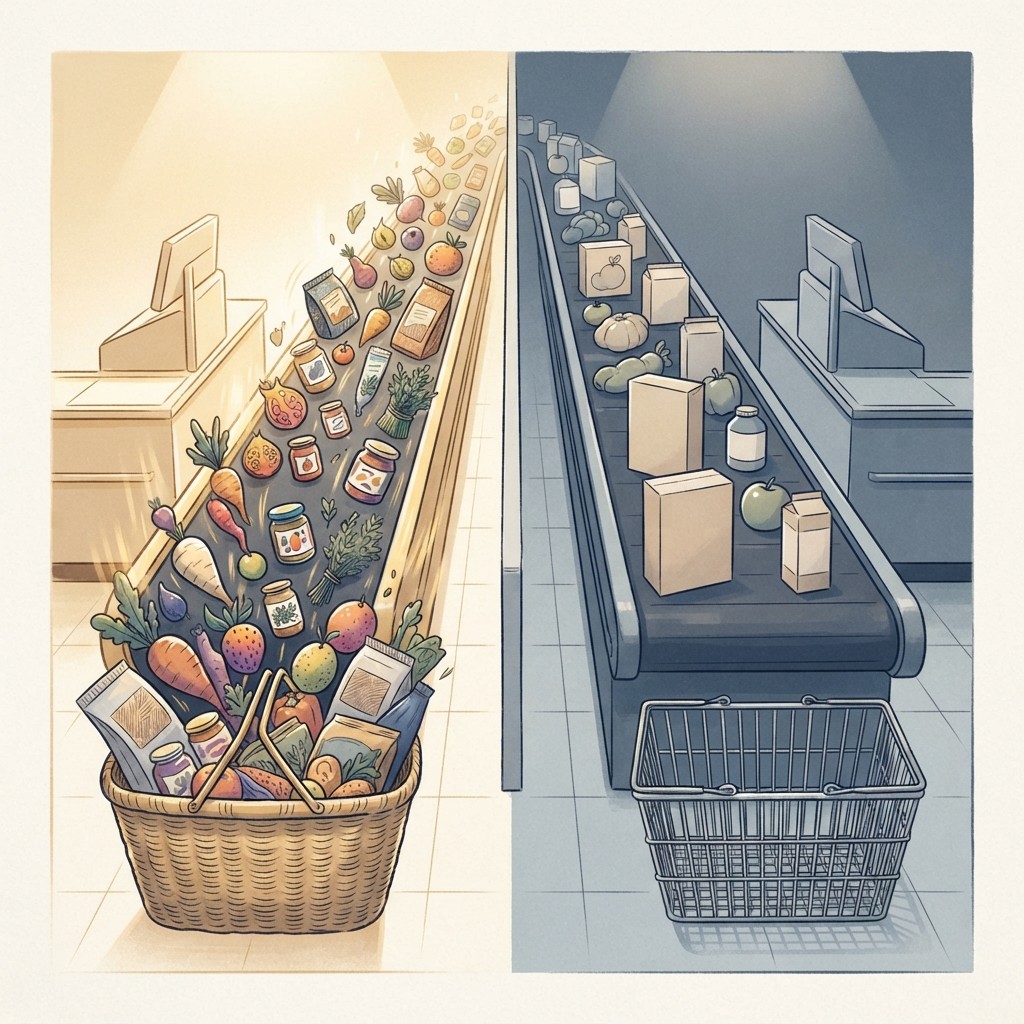
Walk into a Trader Joe's and try to find a name you'd recognize. No Frito-Lay endcap, no Coca-Cola cooler, no Tide pyramid by the door. Instead: Trader Joe's cookie butter, Trader Joe's frozen mandarin chicken, Trader Joe's everything-but-the-bagel seasoning. More than four out of five things on the shelf wear the same label as the store itself.1 It looks like a quirky stylistic choice. It is, in fact, the entire economic engine - and it runs in exactly the opposite direction from what most people assume.
The official story is that private label is a margin grab: house brands cost less to source, so the retailer pockets the difference. By that logic Trader Joe's should be one of the fattest-margin grocers in America. It isn't. Its blended gross margins are estimated in the low-to-mid 20% range - below the 27-30% a conventional supermarket earns.8 The savings are real. Trader Joe's just refuses to keep them.
Where the cost actually disappears
Start with what a national brand really costs a grocer. A box of brand-name cereal carries two surcharges before it ever sells. The first is the brand markup itself - the cost of the manufacturer's advertising, packaging, and sales force, baked into the wholesale price. The second is the slotting fee: the payment brands make to buy shelf space, which the grocer counts as income but which inflates the whole system. Trader Joe's collects no slotting fees at all.1 By putting its own label on the box, it strips out both layers at once. The product gets cheaper to put on the shelf, and the price tag can come down without the margin caving in.
Then comes the part rivals can't replicate by simply adding more store brands. A typical supermarket stocks tens of thousands of items; Trader Joe's runs a deliberately narrow assortment. Fewer products means more volume concentrated behind each one, which means more leverage with the supplier who makes it. The store isn't choosing between twelve peanut butters and skimming a little off each - it's buying one peanut butter in enormous quantity and dictating terms. Narrow shelves are the source of the purchasing power, not a consequence of it.
| Conventional grocer (national brand) | Trader Joe's (private label) | |
|---|---|---|
| Brand markup in wholesale price | Yes | Stripped out |
| Slotting fee charged to brand | Collected | None |
| SKUs competing for the shelf | Many | Often one |
| Purchasing leverage per item | Split across brands | Concentrated |
| Where the saving goes | Kept as margin | Mostly to the shelf price |
“Keeping things under the Trader Joe's label helps keep costs low - and we don't charge our suppliers slotting fees.”1
Cheaper shelves become busier shelves become cheaper shelves
Here is where it stops being a cost trick and becomes a flywheel. Lower prices and products you can't buy anywhere else pull customers in and keep them coming. That traffic does something to the one number that defines grocery economics: sales per square foot. Trader Joe's has long led U.S. grocers on this measure - Fortune pegged it around $1,750 per square foot in 2016, more than double Whole Foods.4 High productivity per square foot lets a thinly margined store still throw off serious cash, which funds the buying scale that lowers costs further, which lowers prices again. The flywheel runs on its own thinness.
The exclusivity closes the loop. Because the products carry the store's own name, the store becomes the brand. You can't comparison-shop Trader Joe's cookie butter on price, because nobody else sells it. There's no equivalent jar two aisles over at Kroger. That's why the same item that would be a generic 'store brand' anywhere else becomes a reason to drive past three other grocers - and why a former national-brand supplier can vanish from the shelves overnight. When Trader Joe's decided to stop selling branded goods, the vegan-food maker Tofutti reported losing nearly $2 million a year - the sales of what had been its largest customer - simply gone.23 The label was non-negotiable.
Why can't Kroger just do this?
The fair objection: every big grocer already has private label - Kroger, Costco, even Walmart push house brands hard. So why is Trader Joe's position structurally different rather than just further along the same road? Because the conventional grocer runs private label as a hedge inside a brand-led store. It still needs the national brands on the shelf, because shoppers expect them, which means it still collects slotting fees, still carries the wide assortment, and still splits its volume across competing labels. Bolting on more store brands can't deliver Trader Joe's economics, because the savings come from what it removes - the brands, the fees, the SKU sprawl - not from what it adds. You can't get to over 80% private label by adding house brands. You get there by being willing to throw the famous names out, and almost no grocer at scale is.
The honest counter is that Trader Joe's is private and never publishes its books. The margin and productivity figures are estimates - revenue itself is third-party guesswork, somewhere north of $20 billion in recent years by outside reckoning.7 Treat the exact numbers as directional, not gospel. But the mechanism doesn't depend on a precise figure. Whatever the true margin, the observable behavior - over 80% private label, no slotting fees, narrow shelves, prices low enough to draw crowds - all points the same way: a store engineered to make less per item and more per square foot.
The instinct with a cost advantage is to bank it as margin. The more powerful move, when your advantage is structural, is to spend it on price and let volume compound. Trader Joe's takes a thinner margin per item on purpose, because cheaper shelves pull traffic, traffic lifts sales per square foot, and high productivity funds the buying scale that lowers cost again. The catch: this only works if the advantage is built into how you operate - removing brands, fees, and SKU sprawl - not bolted on. A rival who keeps the national brands and just adds store labels gets the cost cut without the flywheel, and the flywheel was the whole point.
Trader Joe's looks like the friendliest store in America and runs like the most disciplined. It strips out the brands, the fees, and the choices, takes a smaller cut of every sale than its competitors, and somehow ends up the most productive grocer on the block. The label on the box was never decoration. It was the decision to stop selling other people's products - and to discover that owning the shelf, not the margin, is what compounds.
Stores that profit where you'd never look
Profit-Engine Map
A one-page map that pulls a business apart into the hook that gets the customer in the door and the engine that quietly earns the margin. Use it to see where the real profit lives, how the two halves are wired together, and what breaks if the link is cut. Blank to dissect your own P&L; filled as the worked example of a business whose advertised product is not where it makes its money.
Included, filled and blank, in the The Money Machine Casebook. See the set → · Preview the blank →
Sources
Where this comes from — the filings, records, and reporting behind it.
- 1More than 80% of Trader Joe's products are private label; keeping things under the Trader Joe's label helps keep costs low, and the company collects no slotting fees from suppliers.
- 2In fiscal 2011, Tofutti Brands lost nearly $2M in Trader Joe's sales after Trader Joe's 'decided to cease selling branded goods,' confirming the private-label transition in action as observable in SEC filings.
- 3Tofutti Brands confirmed in its FY2012 annual results that Trader Joe's, 'formerly the Company's largest customer,' ceased selling branded goods, causing a ~$2M annual revenue decline.
- 4Trader Joe's had the highest sales per square foot of any U.S. grocer as of February 2008 (BusinessWeek); Fortune estimated $1,750 per square foot in 2016, more than double Whole Foods.
- 5Trader Joe's first store opened in 1967 in Pasadena; the company began in 1958 as Pronto Markets under Rexall Drug; Coulombe bought the chain from Rexall and converted it to Trader Joe's. Coulombe served as founder/CEO until 1988.
- 6In 1979, Aldi Nord under Theo Albrecht bought Trader Joe's. Aldi Nord and the U.S. Aldi stores (Aldi Süd) are legally and financially separate companies. Trader Joe's is owned by Aldi Nord foundations, not by Aldi Süd.
- 7Trader Joe's estimated 2023 revenue exceeded $20 billion (attributed to CEO Dan Bane on a podcast); estimated $24–25 billion for 2024–2025 based on ~11% annual growth. As a private company these figures could not be independently verified. Earlier independent estimates: ~$13.3B (FY2022), ~$16.5B (2022 niche-grocer comp analysis).
- 8Trader Joe's gross margins are estimated in the low-to-mid 20% range, below the conventional supermarket average of 27–30%; private-label margins at TJ's are estimated at 25–30% vs. low-to-mid 20s for national brands stocked there.
More like this — beyond Trader Joe's
New Strategically analyses as they publish: the defining moves in business, checked against the record. No noise, and one click to leave.