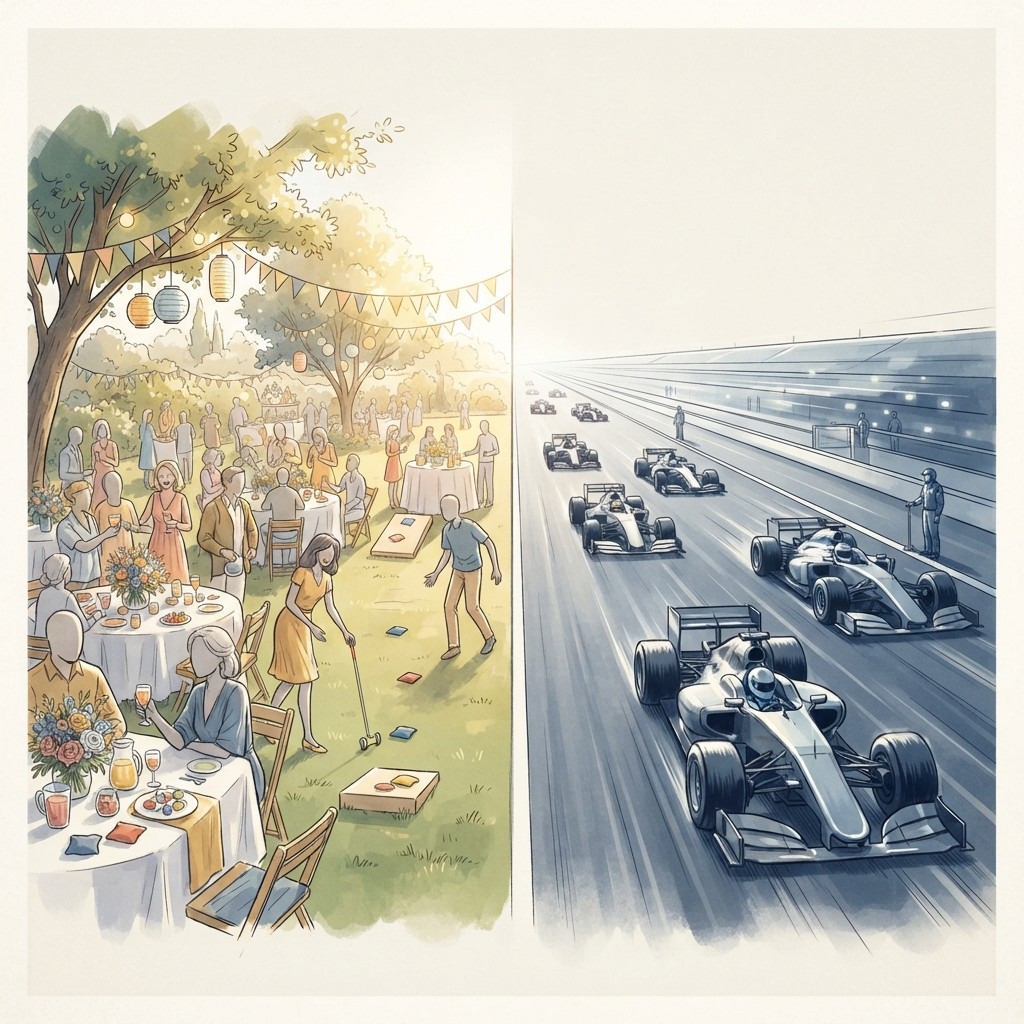
Every console generation, critics call the Nintendo box underpowered. Every generation, it turns out power was never what people were buying — and the scoreboard everyone's watching is the wrong one.
Pairs with the Profit-Engine Map — a ready-to-use strategy tool, filled for Nintendo. Included in the The Money Machine Casebook →
Start with the price of a go-kart game. In June 2025, Nintendo launched Mario Kart World at $79.99 — snapping the $60-then-$70 ceiling the entire industry had treated as a law of physics.2 The gaming press was appalled. Players grumbled. Then they bought it: roughly 14.7 million copies by early 2026, making it the best-selling launch title in the company's history.1 A company does not raise the price of admission by a third and grow its audience unless it is selling something no one else can sell.
That is the entire tell, and it points at a business most people misread. The console industry looks like one contest — build the most powerful box, win the generation — with three players and Nintendo perpetually in third on the spec sheet. But Nintendo isn't losing that contest. It declined to enter it, and built a different machine to make money.
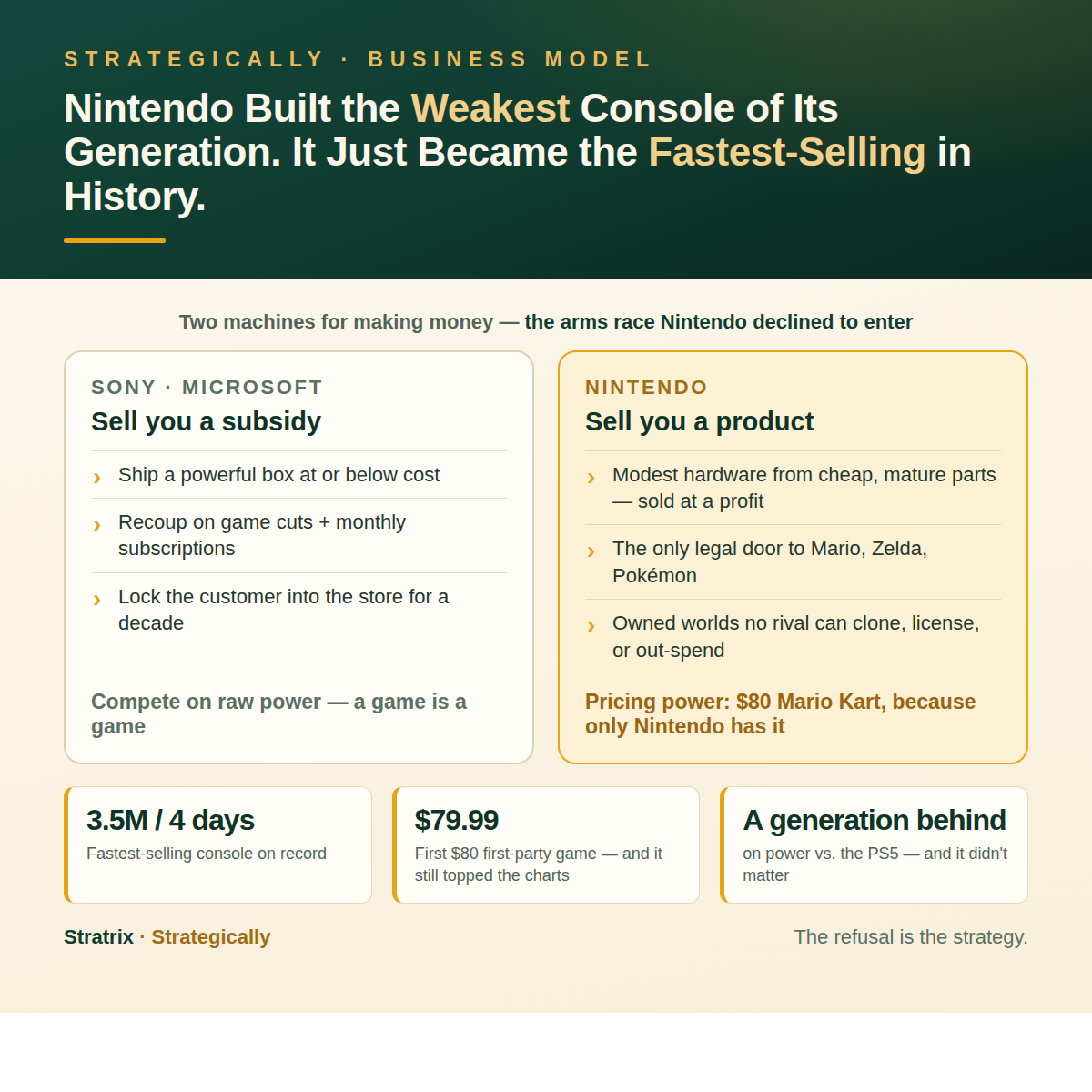
Two companies are selling you a subsidy. One is selling you a product.: the box is a loss-leader for Sony and Microsoft; for Nintendo it's the sale
Sony and Microsoft play razor-and-blades. They sell powerful consoles at or below cost — Sony sold the PlayStation 5 at a loss at launch, and Microsoft has treated Xbox hardware as a loss-leader for years — and recoup it on the back end: a cut of every game sold, and monthly subscriptions.3 The hardware is bait. Its job is to get a store into your living room at a loss so heavy the only way to make it back is to lock you into that store for a decade.
Nintendo runs the opposite machine. It sells its hardware at a profit.4 That single fact changes everything downstream. When the box itself makes money, you are not desperate to trap the customer in a store to recover a subsidy. You are not forced into a subscription war or a race to zero on hardware margin. The pressure that shapes every decision Sony and Microsoft make simply isn't on you.
How does Nintendo sell hardware at a profit when its rivals can't? Because it refuses to buy the most expensive parts. The doctrine dates to the engineer Gunpei Yokoi and a phrase that is the closest thing Nintendo has to a constitution: "lateral thinking with withered technology" — take mature, cheap, well-understood components and use them in a way no one expected.5 The original Game Boy had a worse screen than its color rivals and buried them, on battery life and Tetris. The Wii used inexpensive motion sensors and outsold the far more powerful PlayStation 3 and Xbox 360.5 Every generation, critics call the Nintendo box underpowered. Every generation, it turns out the power was never what people were buying.
The moat isn't the machine. It's the worlds only Nintendo owns.: you can match Sony's spec sheet; you cannot ship Mario
Ask what a customer is actually buying when they buy a Switch, and the strategy resolves. They are not buying teraflops. They are buying the only legal door to Mario, Zelda, Pokémon, Animal Crossing, and Mario Kart — franchises Sony and Microsoft cannot clone, license, or out-spend into existence. That ownership is the pricing power. It is why Nintendo could put an $80 sticker on Mario Kart World and watch it become the best-selling launch game it has ever shipped.12 A more powerful competitor can match Sony's spec sheet. No competitor can ship Mario.
This is the part the horsepower frame misses entirely. In a war fought on specs, a game is a commodity — a game is a game, and price is capped by parity. In Nintendo's model, the game is a piece of a world the customer can get nowhere else, and worlds carry premiums. Sony sells you a powerful box so you'll rent a library that mostly isn't theirs. Nintendo sells you a modest box because the library is the whole point, and it's theirs alone.
| Sony / Microsoft | Nintendo | |
|---|---|---|
| What the console is | A subsidized funnel, sold at a loss | A product that earns money on its own |
| What they compete on | Raw power — teraflops, 4K, the spec sheet | Owned worlds and novel ways to play |
| Where the money comes from | Game cuts + subscriptions recouping the hardware loss | Profit on the hardware and on games no one else can sell |
| Pricing power | Capped by parity — a game is a game | $80 Mario Kart, because only Nintendo has Mario Kart |
| Switch 2 scoreboard | PS5: more powerful, sold at a launch loss | A generation behind on power; fastest-selling console ever |
The honest objection: if the strategy is real, the Switch 2 should have broken it — it didn't
"The Switch 2 breaks your thesis. It runs a real, modern Nvidia chip, costs $450, and carries thinner margins than the old Switch — Nintendo finally joined the arms race." It upgraded the silicon; it did not enter the war. On raw power the Switch 2 still sits well below the PlayStation 5 that shipped four years earlier — Nintendo closed some of the gap, not the strategy behind it, and it still led the launch with owned franchises and a novelty (Joy-Con that double as a mouse, built-in voice chat), not a spec sheet.1 Yes, president Shuntaro Furukawa acknowledged a "lower profit margin than Nintendo Switch hardware" — but he attributed that to tariffs, exchange rates, and component costs, and the hardware is still sold to make money, not to bankroll a store.4 And notice the direction of the real evidence: a company fighting on price does not raise the price of its flagship game to $80. A company with pricing power does. The margin got thinner; the strategy held.
"Owning Mario is just legacy and luck — that's an accident of history, not a strategy you can copy." The library is old; keeping it precious is a live decision, renewed every generation. Nintendo re-invests in the worlds and the feel of play rather than the horsepower, and it protects the scarcity — you will never find Mario on a rival's store. When it forgot this and chased a confused hybrid, the Wii U flopped; the Switch was the correction. The IP compounds because Nintendo refuses to dilute it or trade it for a better spec sheet. That refusal is the strategy.
The read
Sony and Microsoft are locked in a war over who builds the better box, each subsidizing the hardware and hoping to make it back on the blades. Nintendo's quiet, expensive-to-copy insight is that the box was never the point. It sells you a deliberately modest machine at a profit, and the only door to Mario — and lets its rivals bankroll the arms race it politely declined to fight.
The Switch 2 is a generation behind on power and the fastest-selling console ever made. Those two facts don't contradict each other. One of them explains the other.
Before you match a competitor spec-for-spec — or feature-for-feature, or price-cut for price-cut — run three questions. First: is the thing we're racing on the thing customers actually buy for? (For Nintendo, no — they buy for Mario, not teraflops.) Second: do we own something rivals can't copy that we could compete on instead? (Mario, Zelda, Pokémon, Mario Kart.) Third: are we selling the razor at a loss, or can the product stand on its own? (Nintendo's hardware sells at a profit — no subsidy trap.) If you're subsidizing a race on the one axis your rivals have already won, you're funding their war. Find the axis only you can own, and make them fund yours.
Some hardware cost and margin figures here are analyst estimates and management commentary rather than a disclosed bill of materials, and are attributed as such. Unit-sales and launch-record figures are Nintendo's own reporting and market-research tallies as published.
More machines that profit where the money really sits
Profit-Engine Map
A one-page map that pulls a business apart into the hook that gets the customer in the door and the engine that quietly earns the margin. Use it to see where the real profit lives, how the two halves are wired together, and what breaks if the link is cut. Blank to dissect your own P&L; filled as the worked example of a business whose advertised product is not where it makes its money.
Included, filled and blank, in the The Money Machine Casebook. See the set → · Preview the blank →
Sources
Where this comes from — the filings, records, and reporting behind it.
- 1The Nintendo Switch 2 launched on June 5, 2025 at $449.99 and sold more than 3.5 million units worldwide in its first four days — the fastest-selling console on record; it had sold over 19 million units by March 31, 2026. Mario Kart World, its launch title, reached ~14.7 million copies by March 31, 2026, the best-selling launch title in the company's history. On raw power the Switch 2 still sits below the PlayStation 5, which shipped four years earlier; its launch novelties include Joy-Con that double as a mouse and built-in voice chat.Wikipedia, Nintendo Switch 2 ↗ · 2026-07-14
- 2Nintendo priced Mario Kart World at US$79.99 — $20 more than the standard price for original Switch games and above most standard-edition AAA titles — breaking the $60-then-$70 price ceiling and marking the arrival of the first $80 first-party game.GameSpot, $80 Games Are Already Here ↗ · 2025-04-03
- 3Sony sells PlayStation 5 hardware at a loss and recoups it on the back end — a cut of every game sold plus subscription revenue; Microsoft has treated Xbox hardware as a loss-leader for years. This is the razor-and-blades model of console economics.
- 4Nintendo president Shuntaro Furukawa said the company expects its operating profit ratio to decline because Switch 2 hardware carries a "lower profit margin than Nintendo Switch hardware," attributing the thinner margin to tariffs, exchange rates and component costs — while stating Nintendo focuses on profitability on a global basis and traditionally avoids selling hardware at a loss. The Switch 2 is generally produced and sold at a profit.
- 5Nintendo's design doctrine traces to engineer Gunpei Yokoi's principle of "lateral thinking with withered technology" — using mature, cheap, well-understood components in unexpected ways. The Game Boy beat higher-spec color rivals on battery life and software; the Wii used inexpensive motion sensors and outsold the more powerful PlayStation 3 and Xbox 360.GLOBIS Insights, The Story of Nintendo ↗ · 2025-01-01
More like this — beyond Nintendo
New Strategically analyses as they publish: the defining moves in business, checked against the record. No noise, and one click to leave.