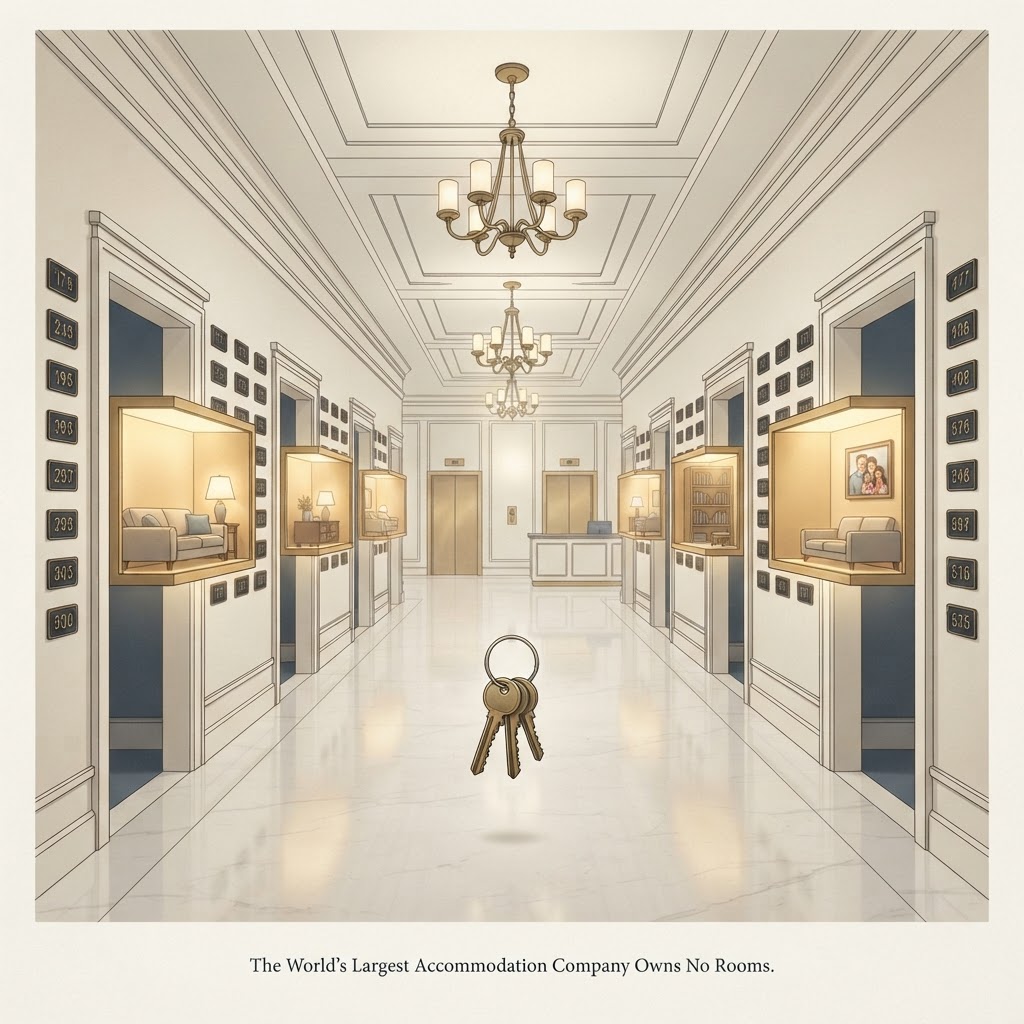
It offers more places to stay than the biggest hotel chains combined - and it has never owned a single one of them. The thing that let it scale at impossible speed is the same thing that can erase it overnight.
Pairs with the Asset-Light vs Asset-Heavy Comparator — a ready-to-use strategy tool, filled for Airbnb. Included in the The Asset-Light Bet Casebook →
Here is a fact that should be stranger than it sounds: one of the largest accommodation companies on earth does not own a single bedroom. Airbnb offers more places to stay than the biggest global hotel chains combined, in more countries, at more price points - and it owns none of them.3 Every listing belongs to a host. Airbnb owns the marketplace, the brand, the trust system, and the software that connects a traveler in one city to a spare room in another. The rooms themselves were never on the balance sheet, and never will be. That isn't a clever accounting trick. It's the whole strategy, and it's the reason a company founded on an air mattress could grow faster than chains that took a century to build.
What owning nothing actually buys you: why severing supply from real estate turns capital into speed
An asset-light model means generating revenue from assets you don't own. A hotel chain, even a franchising-heavy one, lives in a world of real estate: rooms must be built, bought, financed, maintained, and filled, and growth is gated by capital and construction. Airbnb severed accommodation from that constraint entirely. Because each new listing is supplied, furnished, and maintained by a host at the host's expense, Airbnb's supply grows without Airbnb spending a cent of capital on property.1 The consequences compound. The company can enter a new city the moment a few hosts sign up, with no development pipeline. Its costs are software and trust-and-safety, not bricks. And its capital efficiency is structurally different from a hotelier's - it monetizes other people's assets and keeps a cut of every booking, which is why investors valued it near $47 billion when it went public in December 2020, on a footprint no hotel company could replicate at that capital intensity.2
| Hotel chain | Airbnb (asset-light) | |
|---|---|---|
| Who owns the rooms | The chain or its franchisees | Independent hosts - Airbnb owns none |
| Cost of adding supply | Build / buy / finance real estate | A host signs up - near zero to Airbnb |
| Speed of entering a market | Years (development) | Days (a few listings) |
| Capital intensity | High | Low |
| Control over the experience | High - owns the standard | Low - varies host to host |
How do you guarantee a stay you don't own?: the real product isn't a room - it's manufactured trust, and it isn't free
If owning nothing means Airbnb can't guarantee the room, the obvious question is how it guarantees anything at all - and the answer is the real product Airbnb actually builds. In place of the deed a hotel relies on, Airbnb manufactures a synthetic version of trust: two-way reviews that make every host and guest accountable, Superhost status that rewards consistency, identity verification, and guarantee programs that backstop guests when a stay goes wrong. None of it owns the asset, but all of it substitutes for ownership by making bad behavior costly and good behavior visible. This is the hidden capital expenditure of an asset-light company: it doesn't spend on real estate, but it must spend relentlessly on the trust machinery that lets strangers sleep in strangers' homes. The buildings are free; the trust is not.
Owning nothing is also a weakness: the same bet that made expansion frictionless makes contraction frictionless too
The strategist's discipline is to see the cost in the advantage, and asset-light carries a sharp one. When you own none of the supply, you control neither the asset nor the experience. A hotel guarantees that a room in one city meets the same standard as a room in another because the chain owns the standard. Airbnb cannot guarantee that; every stay is a different host, a different apartment, a different level of cleanliness and honesty, and the platform can police that only indirectly, through reviews, ratings, and trust-and-safety systems that substitute for the control a deed would give. The genius and the fragility are the same fact: Airbnb scaled by not owning, and by not owning it gave up the one thing ownership provides - control.
The deeper exposure is regulatory, and it's where the asset-light bet is most vulnerable. Because Airbnb's supply consists of ordinary homes in ordinary neighborhoods, it lives at the mercy of local law in a way a purpose-built hotel does not. When a city decides short-term rentals strain housing or disrupt residents and restricts or bans them, it can erase a chunk of Airbnb's inventory overnight - supply that Airbnb never owned, cannot defend as property, and cannot easily replace. A hotel chain facing a hostile city still owns its building. Airbnb facing a hostile city owns nothing to fall back on. The model that made expansion frictionless makes contraction, when regulators impose it, equally frictionless - in the wrong direction.
It's worth granting that asset-light isn't unique to Airbnb - modern hotel chains are themselves far lighter than they look, having shifted decades ago toward franchising and management contracts rather than owning most of their rooms. But there's a spectrum, and Airbnb sits at its furthest edge. A franchised hotel still operates inside a chain's brand standards, inspections, and operating manual; the franchisee is contractually bound to deliver a controlled experience. Airbnb's hosts are bound to almost nothing beyond the platform's rules and the discipline of reviews. That extra step - from 'we don't own the rooms' to 'we don't even control the operator' - is what makes Airbnb's version both more scalable and more fragile than the asset-light hotel model it disrupted.
Asset-light isn't free leverage - it's a trade. You exchange control and durability for speed and capital efficiency. The model wins spectacularly while the thing you don't own stays plentiful and welcome, and it turns fragile the moment that supply becomes contested - by regulators, by quality problems, or by hosts who can leave for a rival as easily as they joined. Before admiring an asset-light company's growth, ask what happens to it the day the assets it doesn't own decide, or are forced, to walk away.
Airbnb is the defining asset-light company of its era precisely because it pushed the model to its logical extreme: not 'we own less than our rivals' but 'we own none of the product at all.' That extremity is its superpower and its single point of failure. It built the world's largest accommodation network on assets belonging to other people - which is exactly why its strategy will always be, at heart, a continuous effort to keep those people, and the cities they live in, willing to participate.
Asset-Light vs Asset-Heavy Comparator
A side-by-side matrix that pits owning the assets against renting or orchestrating them, dimension by dimension. Blank to weigh your own model choice; filled as the worked example showing why the story's company went capital-light — or planted its money in concrete and steel.
Included, filled and blank, in the The Asset-Light Bet Casebook. See the set → · Preview the blank →
Sources
Where this comes from — the filings, records, and reporting behind it.
- 1Airbnb owns no lodging real estate; independent hosts supply all accommodation on its marketplace. Its 10-K describes a marketplace connecting hosts and guests and a community of over 5 million hosts. (The 10-K does not publish a total-listings count; Airbnb's earnings cite ~8 million active listings as of Q3 2024, and the earliest primary count was 7.4M available / 5.6M active as of Sept 30, 2020, in its IPO prospectus.)
- 2Airbnb priced its IPO at $68/share on Dec 9, 2020, implying a fully diluted valuation near $47B, and began trading on Nasdaq (ABNB) on Dec 10, 2020. Shares opened at $146 (+114.7%) and closed their first day at $144.71 - a first-day market capitalization around $86 billion.
- 3Airbnb's active listings (~8 million as of Q3 2024) exceed the combined room counts of the three largest hotel chains - Marriott (1,706,331), Hilton (1,268,206) and IHG (987,125), about 3.96 million rooms (year-end 2024) - by roughly 2x. (A listing is not the same unit as a hotel room, so this compares counts, not lodging capacity.)
More like this — beyond Airbnb
New Strategically analyses as they publish: the defining moves in business, checked against the record. No noise, and one click to leave.