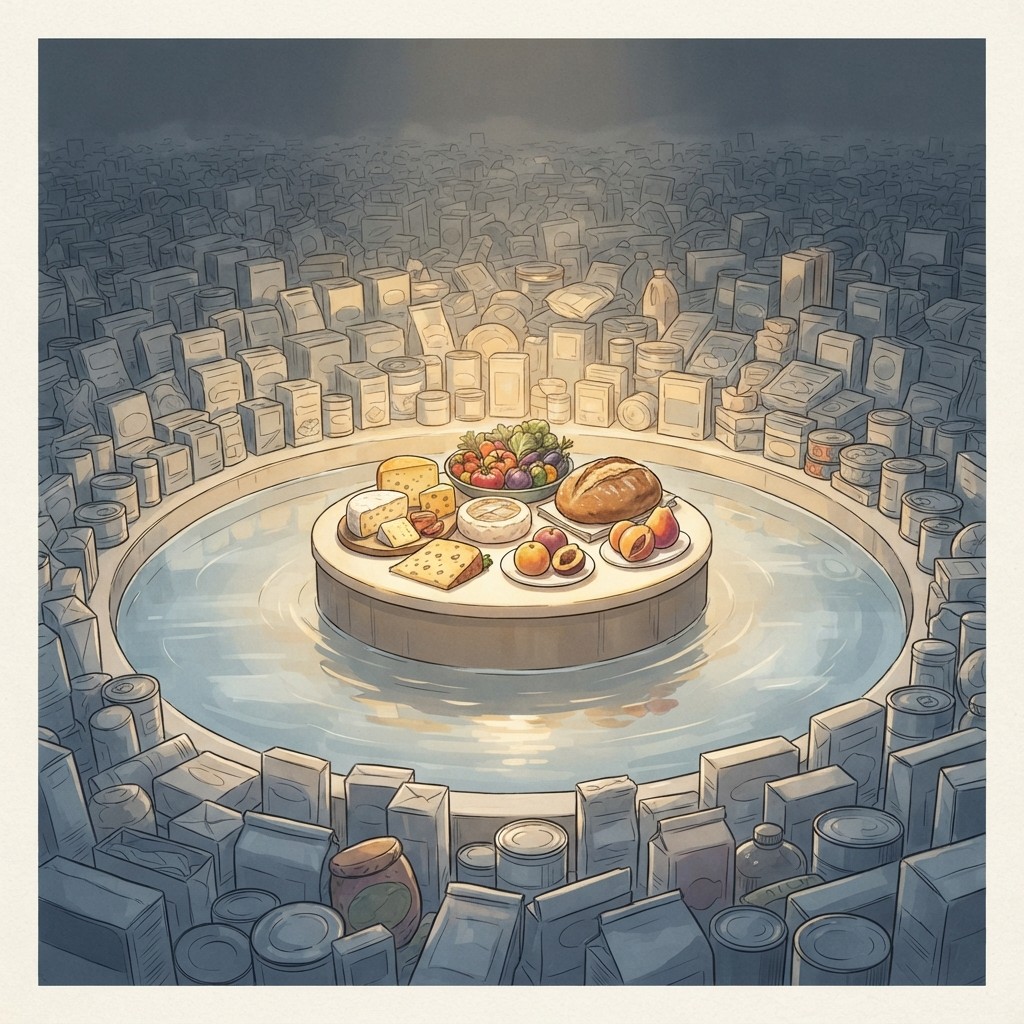
Everyone calls the tiny selection a charming quirk. Run the arithmetic and it flips: the products Trader Joe's refuses to carry are the most valuable thing in the store.
Pairs with the Moat Anatomy Canvas — a ready-to-use strategy tool, filled for Trader Joe's. Included in the Moat Anatomy Casebook →
Walk into a normal American supermarket and you are standing in front of roughly fifty thousand different things to buy. Walk into a Trader Joe's and the number is about four thousand.1 Same job - feed a household for a week - done with a tenth of the inventory. The peanut butter aisle tells the whole story in miniature: a big chain stocks around forty kinds of peanut butter; Trader Joe's stocks ten, picks them for you, and walks away from the other thirty.2 It looks like the store simply decided to offer less. It actually decided to build a machine, and the missing forty thousand products are the machine's most important part.
The official read on Trader Joe's is that the small selection is a charming quirk - a cozy, curated boutique that trades breadth for vibe and cheap wine. That gets the causation exactly backwards. The narrow shelf is not a sacrifice the business makes in spite of itself. It is the engine the entire business runs on - the thing that creates the buying power, the margin, and the moat. Scarcity here is not the cost of the strategy. It is the strategy.
Fewer products isn't the limitation. It's the leverage.: narrow the shelf and demand concentrates onto each item, which is where the buying power comes from
Here is the mechanism, and it runs in one direction only. When you carry ten peanut butters instead of forty, each of the ten sells four times as fast. Multiply that across the whole store and every single item Trader Joe's stocks moves in enormous volume - because there is no long tail of slow sellers splitting the demand. That volume is the lever. A buyer who can promise a supplier the entire chain's peanut-butter business on one SKU walks into the negotiation holding something a buyer spreading orders across forty brands never has: the power to make or break that supplier's year. Joe Coulombe, who founded the company in 1967, called this buyer-oriented retailing and meant it literally - he put the buyers in charge of the company, and treated purchasing not as beating vendors down on price but as 'a creative exercise of developing alternatives.'34 Narrow the shelf, and you concentrate demand. Concentrate demand, and you get leverage. That is the first turn of the flywheel, and nothing else works without it.
“The willingness to do without any given product is one of the cornerstones of Trader Joe's merchandising philosophy.”3
Read that line again, because it is the opposite of how retail thinks. Almost every other grocer treats its assortment as an asset to maximize - more brands, more sizes, more flavors, a 'complete' set so no shopper ever walks out empty-handed. Coulombe treated the willingness to not carry something as the cornerstone. Each item, he wrote, had to stand on its own as a profit center; there were no loss leaders, and nothing rode into the store just to round out a line.3 The discipline of saying no is what keeps the volume concentrated - which is what keeps the leverage real.
How the leverage becomes a shelf nobody can price-check: owning the label instead of renting it to national brands quietly removes the shopper's only weapon
Leverage on its own would just be a discount. Trader Joe's does something far more durable with it: it converts the buying power into ownership of the shelf. More than 80% of what the store sells is its own brand16 - not Skippy, not Heinz, but Trader Joe's. That single fact quietly defuses the one weapon every shopper carries into a store, which is the ability to compare. You know what a jar of Skippy should cost because you have seen it in five other stores. You have no idea what Trader Joe's Organic Peanut Butter 'should' cost, because it exists in exactly one place on earth. The price is whatever Trader Joe's says it is, and there is no reference point to argue with. The store has made itself un-comparable - and a product you cannot compare is a product you cannot accuse of being overpriced.
| A normal supermarket | Trader Joe's | |
|---|---|---|
| Items on the shelf (approx.) | ~50,000 SKUs | ~4,000 SKUs |
| Share that's private label | Roughly 15-25% | More than 80% |
| Volume per item | Split across many brands - low | Concentrated on one - very high |
| Leverage over suppliers | Modest - one of many buyers | High - can promise the whole category |
| Can a shopper price-check it? | Yes - national brands are everywhere | Mostly no - the products exist nowhere else |
Now the same scarcity pays a second dividend, this one inside the shopper's head. A famous field experiment set up a jam tasting booth with either 24 varieties or 6. The big display pulled a bigger crowd - but the small one sold: roughly 30% of the people who saw six jams bought a jar, against just 3% of the people who saw twenty-four.5 Too much choice doesn't delight; it paralyzes, and a paralyzed shopper buys nothing. By pre-deciding which ten peanut butters are worth your attention, Trader Joe's removes the paralysis and quietly takes on a job the shopper used to do alone - sorting the good from the junk. The store stops being a warehouse you pick through and becomes an editor you trust. And trust, once transferred from the brands to the store, is the part competitors cannot simply price below.
Read the moves as a single circuit, not a list of quirks. Carry fewer items, and demand concentrates onto each one. Concentrated demand buys supplier leverage. Leverage lets you own the label instead of renting shelf space to national brands - so 80%+ of the store becomes products that exist nowhere else. Un-comparable products can't be price-checked, and a curated shelf earns the trust a sprawling one never does. Each turn lowers cost and deepens loyalty, which funds the volume that powers the next turn. A rival can copy any one move - a private-label line, a smaller store - but the advantage lives in the loop, and you can't half-build a loop.
Isn't this just a niche store that wins by being small?: the deliberate incompleteness isn't the catch in the model — it is the model
The honest objection is that this looks less like a moat and more like a niche - a format that works only for a particular shopper and caps out fast. Trader Joe's, the argument goes, simply opted out of the real grocery war: it doesn't carry your prescription, your national brands, your favorite cereal, or a deli counter, so it skims the easy, high-margin slice and leaves the hard 90% of a household's needs to Kroger and Walmart. Fair - and it concedes the point rather than refuting it. The deliberate incompleteness is the strategy working as designed. A store that tried to be everything could not run this loop, because volume would scatter back across fifty thousand items and the leverage would evaporate. The proof is in the productivity: those small, deliberately limited stores were estimated to sell around $1,750 per square foot, more than double Whole Foods.1 You don't out-earn a giant per square foot by matching its breadth. You do it by refusing to. Being un-comprehensive is not the flaw in the model - it is the model, and 'we'll just carry more than them' is precisely the move that would break it.
So the next time the small selection reads as a limitation, flip it. Trader Joe's didn't build a great store and accept a narrow shelf as the price. It built the narrow shelf, and the great store fell out of it. The forty peanut butters a normal supermarket is proud to carry are, from this angle, forty admissions that it has no leverage over any of them. Trader Joe's carries ten - and owns all ten. The moat was never the products on the shelf. It was the discipline to leave most of them off.
Moat Anatomy Canvas
A one-page canvas that dissects a moat instead of asserting it: where the advantage comes from, how much of the market it covers, how long it would take to copy, and what keeps it from eroding. Blank to dissect your own claimed edge; filled as the worked example tracing the structure of the story's defensible advantage. Use it to tell a real moat from a head start.
Included, filled and blank, in the Moat Anatomy Casebook. See the set → · Preview the blank →
Sources
Where this comes from — the filings, records, and reporting behind it.
- 1Fortune's 2010 profile states: 'Typical grocery stores can carry 50,000 stock-keeping units, or SKUs; Trader Joe's sells about 4,000 SKUs,' and notes 'about 80% of the stock bears the Trader Joe's brand.' It also reports 'Its stores sell an estimated $1,750 in merchandise per square foot, more than double Whole Foods'.' As a private company, Trader Joe's does not publish these figures, so the SKU count and sales-per-square-foot are Fortune's estimates.Fortune, Inside the secret world of Trader Joe's ↗ · 2010-08-23
- 2Fortune's 2010 profile illustrates the curation discipline with a single item: 'Take peanut butter. Trader Joe's sells 10 varieties. That might sound like a lot, but most supermarkets sell about 40 SKUs.'Fortune, Inside the secret world of Trader Joe's ↗ · 2010-08-23
- 3In his memoir, founder Joe Coulombe writes: 'The willingness to do without any given product is one of the cornerstones of Trader Joe's merchandising philosophy.' He frames each item as having to earn its slot - no 'loss leaders,' each SKU 'a profit center' - and describes shifting the company from 'customer-oriented to buyer-oriented,' with buying treated as 'a creative exercise of developing alternatives' rather than beating suppliers on price. By the time he left in 1989 the chain carried roughly 1,100 to 1,500 SKUs.Joe Coulombe, 'Becoming Trader Joe' (HarperCollins Leadership), Becoming Trader Joe: How I Did Business My Way and Still Beat the Big Guys · ISBN 9781400225422 · 2021
- 4Trader Joe's was founded in 1967 by Joe Coulombe in Pasadena, California, and remains privately held (owned by the family of German retailer Theo Albrecht / Aldi Nord). It does not disclose financial results; revenue is widely estimated at roughly $20 billion (fiscal 2023), and the chain operated more than 600 U.S. stores as of 2025.
- 5In a field experiment at a grocery store, Iyengar and Lepper set up a tasting booth displaying either 24 or 6 varieties of jam. The larger display drew more passersby to stop (60% vs 40%), but shoppers were far more likely to buy from the limited display: about 30% of those who saw 6 jams purchased, versus only 3% of those who saw 24. Reported in 'When Choice Is Demotivating: Can One Desire Too Much of a Good Thing?', Journal of Personality and Social Psychology, vol. 79, pp. 995-1006.
- 6Trader Joe's states on its corporate site and podcast that more than 80% of what it sells is its own brand - 'the store is our brand' - and that keeping products under the Trader Joe's label rather than a national or supplier label is how it controls cost and quality. The own-brand assortment dates to its early private-label products in the 1970s.
More like this — beyond Trader Joe's
New Strategically analyses as they publish: the defining moves in business, checked against the record. No noise, and one click to leave.