The regulator didn't block the $3.7B deal. It repriced it.
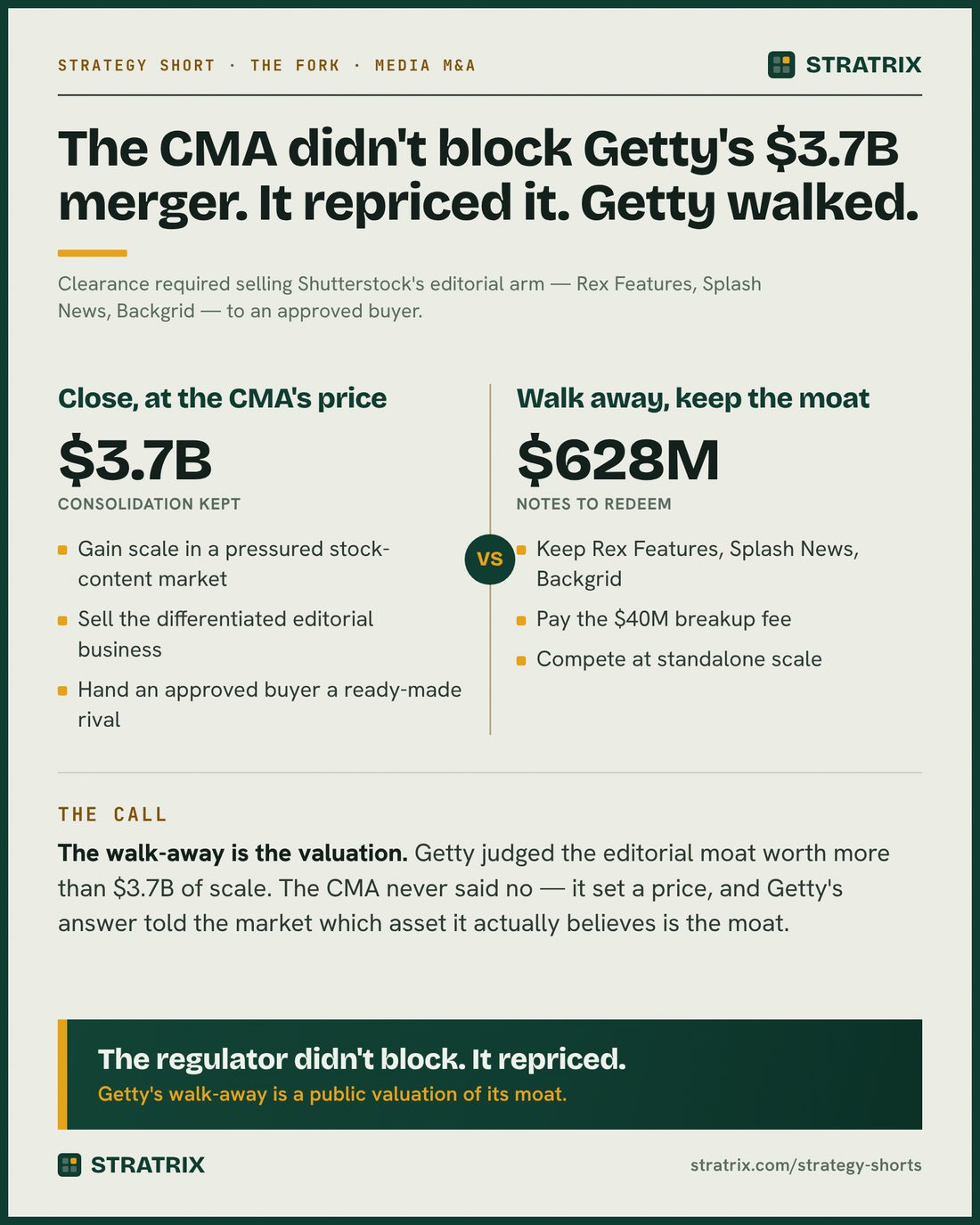
In January 2025, Getty and Shutterstock announced a roughly $3.7 billion merger of equals — consolidation in a stock-content market under real pressure. Then the UK Competition and Markets Authority named its price. In its May 15, 2026 final report, the CMA conditioned clearance on the complete divestiture of Shutterstock's editorial business — including Rex Features, Splash News, and Backgrid — to a buyer it approved. A combined Getty–Shutterstock, it found, would hold an unacceptable share of the editorial photography supplied to UK media.
That turned the merger into a fork. Path one: close the deal, gain the scale — but sell the editorial arm, the differentiated, hard-to-replicate business, and hand a regulator-approved buyer a ready-made rival. Path two: walk away, keep the moat, and absorb the damage — a $40 million breakup fee and $628 million in note redemptions. On June 30, 2026, Getty's board chose the walk. The termination took effect July 7.
Here is the useful way to read it: the CMA never blocked anything. It repriced the deal until Getty had to reveal its own valuation — and Getty decided the editorial business was worth more than $3.7 billion of consolidation. That is what antitrust remedies quietly are: price discovery. The demand forces an acquirer to say, in public, which asset it actually believes is the moat. Getty just said it.
A forced fork is a valuation you can't hide.