Pairs with the Culture Doctrine Canvas — a ready-to-use strategy tool. Included in the Culture Doctrine Casebook →
“What does your doctrine refuse, and can you pay for it in a bad year?”
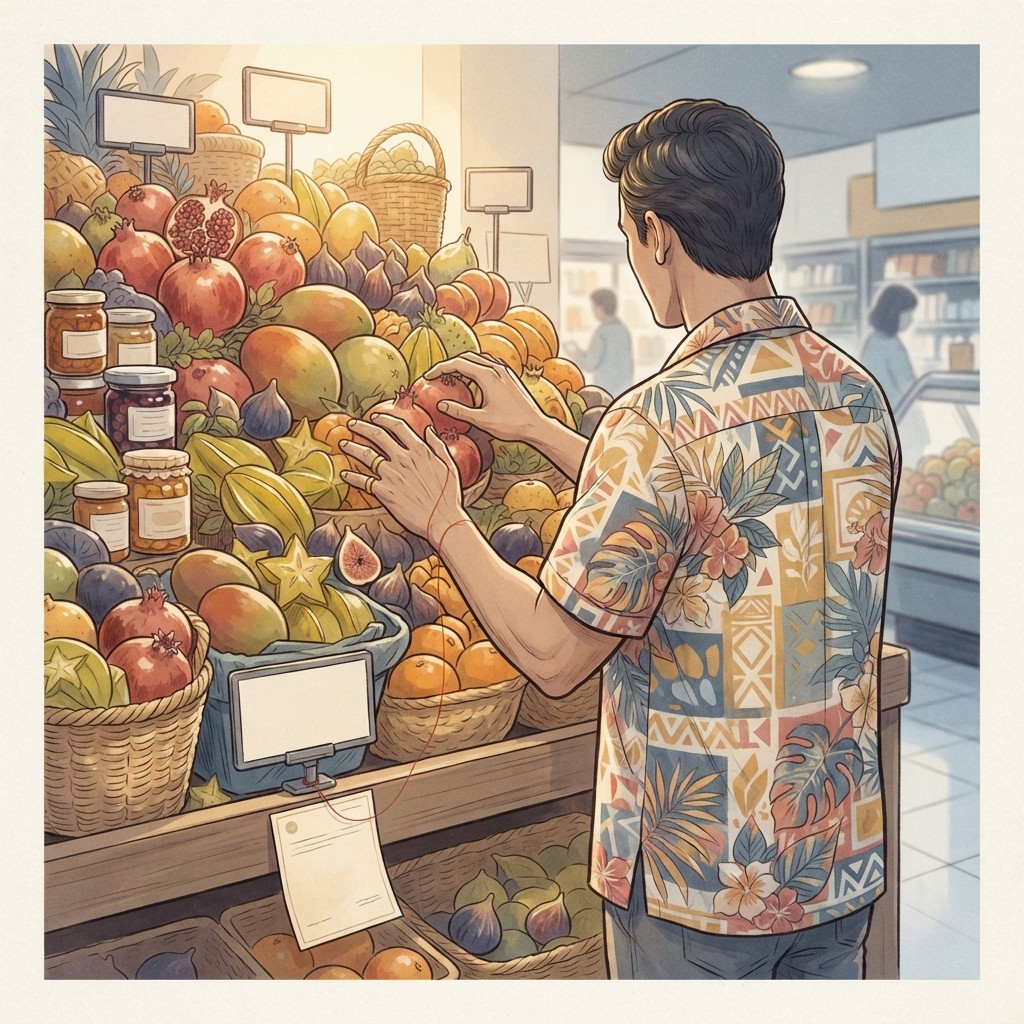
Walk into a Trader Joe's and a person in a Hawaiian shirt rings a brass bell, calls you 'Captain,' tells you which of the four thousand things on the shelves they actually like, and never once points you to a coupon, a loyalty card, or this week's circular - because none of those exist.5 It reads like a quirk. It is in fact one of the most disciplined cost structures in American retail, wearing a costume. The friendliness is not free, and it is not charity. It is a productivity machine.11
The story everyone tells is that Trader Joe's is the rare grocer that treats its people well - pay documented well above grocery industry norms,11 a beloved crew, a folksy culture that just happens to also work commercially. Almost every word of that is true and the conclusion is still wrong. The pay isn't a happy by-product of the model. The pay is the model. And the same paternalism that buys the loyalty has now produced a federal labor finding the brand can't fold into the legend.
The friendly crew is the cheapest grocery store ever built
Start with the number that explains the costume. As of 2024, a Trader Joe's location reportedly does around $2,100 in sales per square foot - roughly double Whole Foods, and among the highest-performing grocery concepts in the country.12 You do not get that by being nice. You get it by removing nearly everything a normal supermarket spends money on. The crew is paid well so that one well-paid, multi-skilled person rotates between the register, the floor, and the stockroom - a single generalist doing the work that conventional stores divide among narrower, cheaper roles.9 The bell and the chatter are not decoration on top of service; they are the service, delivered by people who cost more per hour and far less per dollar of sales.
Now look at what they're not selling. A typical supermarket carries 40,000-plus SKUs; Trader Joe's carries roughly 4,000, and over 80% of them are its own private label.5 That single decision cascades through every line of the income statement. Fewer SKUs means less to stock, less to learn, less to mis-order, and - crucially - the chain isn't paying the slotting fees and promotional allowances that brand-name groceries involve - by its own account, Trader Joe's does not charge producers for shelf space at all, because it largely is the supplier.10 The lean assortment is what makes the lean crew possible. You cannot ask one person to master 40,000 items. You can ask them to master 4,000 they buy themselves.
| Conventional supermarket | Trader Joe's | |
|---|---|---|
| SKU count | 40,000+ | ~4,000 |
| Private label share | A minority of shelf | Over 80% of products |
| Coupons / loyalty / circular | Core of the playbook | None of the three |
| What the labor budget buys | Many narrow roles | Fewer, better-paid, rotating crew |
Coulombe wasn't selling groceries. He was selling to a customer he picked on purpose.
None of this was an accident, and it wasn't always there. The first store to carry the Trader Joe's name opened in Pasadena in 1967, and the model that defines it now was forged a decade later, in 1977, when the end of California's Fair Trade alcohol laws pushed the chain to slash its SKU count, drop most household basics, and pivot hard into private label - a strategy it had begun in 1972 with granola.31 The founder, Joe Coulombe, was explicit about who he was building for. 'Trader Joe's is for overeducated and underpaid people,' he said - 'classical musicians, museum curators, journalists,' and he sited stores near centers of learning to find them.2 That customer wanted interesting food, an honest price, and someone to talk to about it. They did not want a 40,000-SKU warehouse or a coupon book. Coulombe designed a store that gave them exactly the parts they valued and cut everything they didn't.
“Trader Joe's is for overeducated and underpaid people, for all the classical musicians, museum curators, journalists - that's why we've always had good press, frankly!”2
Notice the last clause - 'that's why we've always had good press.' Coulombe understood that his target customer was also the press, the influencers of their day. The crew culture and the no-frills doctrine generated their own marketing. A store with no circular doesn't need one when its shoppers are writers. The nautical theater - the 'Trader' name, the captains and crew, the neighborhood-store framing the company still uses today - turned the absence of advertising into a brand.4 The savings on promotion didn't vanish into margin alone; some of it went into wages, which produced the crew, which produced the loyalty, which produced the press, which replaced the promotion. It's a flywheel that runs on its own thinness.
The instinct is to read above-market pay as a cost a company tolerates for goodwill. Sometimes it's the opposite: the pay is what lets you delete the more expensive things around it. Trader Joe's spends more per worker-hour and far less per sales-dollar, because well-paid, multi-skilled, low-turnover crew let it run a tiny assortment with no advertising machinery. Before you call a perk 'generous,' check whether it's actually a substitute for three line items you'd otherwise be paying. The most efficient cultures often look like the most indulgent ones - that's the tell, not the contradiction.
The system that buys loyalty also assumes it owns it
Here is where the costume slips. A paternalistic system - we'll take good care of you, so you won't need anyone else to - works beautifully right up until the workers test whether the care is conditional. In July 2022, the Hadley, Massachusetts store voted 45-31 to form Trader Joe's United, the first unionized Trader Joe's; by 2023, four stores had followed.8 The company's response did not look like the bell-ringing brand. It retained Littler Mendelson, a firm known for union avoidance, and as of early 2024 not one of the four unionized stores had won a first contract.8 The friendliness, it turned out, had a boundary, and the boundary was organized labor.
Then the boundary became a legal finding. On November 8, 2024, an NLRB administrative law judge ruled that Trader Joe's had unlawfully barred Hadley workers from wearing union insignia and had provided less favorable retirement benefits to unionized employees than to non-union employees nationwide.7 That last part is the quiet bombshell. The brand's worker-friendly mythology rests on benefits like retirement contributions; a judge found the company using exactly those benefits as a lever against the workers who organized. The paternalism revealed its grammar: the generosity is offered, not owed - and what is offered can be withheld.
Isn't this just a great culture with a few bad weeks?
The fair objection is that every large employer eventually faces a union drive, that an NLRB ruling at a handful of stores out of more than six hundred is a rounding error, and that the underlying culture is genuinely good - the pay is real, the loyalty is real, the productivity is the highest in the business.12 All true. But that's exactly why the violation matters more, not less. A company that openly underpaid and mistreated its crew would face a union drive as a predictable cost of doing business. Trader Joe's built its entire model - and its entire brand - on the premise that it treats people so well they'd never want a third party in the room. The judge's finding doesn't say the culture is fake. It says the culture is contingent: warm while you're grateful, withholding the moment you ask for the warmth in writing. That's not a few bad weeks. That's the operating system showing its terms.
Trader Joe's is one of the most efficient retailers in America, and the efficiency runs straight through the people in the Hawaiian shirts. The pay isn't a soft cost grudgingly carried; it's the hard mechanism that deletes the assortment, the advertising, and the slotting fees a normal grocer can't live without. That's the genius. The lawsuit is the bill. A culture engineered to make workers feel cared for is a remarkable asset - right up until the workers ask whether the care is a gift or a wage, and the company answers, in federal filings, that it always reserved the right to decide.
When the culture is the business model
Culture Doctrine Canvas
A one-page canvas for the unwritten rules that actually run a company: the core beliefs, the behaviors they reward and punish, the lines it won't cross, and the moments that prove the doctrine is real. Blank to articulate your own operating culture before it drifts; filled as the worked example that decodes why the story's company behaves the way it does — even when it costs them.
Included, filled and blank, in the Culture Doctrine Casebook. See the set → · Preview the blank →
Sources
Where this comes from — the filings, records, and reporting behind it.
- 1The first store branded 'Trader Joe's' opened in 1967 in Pasadena, California; Coulombe sold his ownership stake to Aldi Nord's Theo Albrecht in 1979 but remained CEO until retiring in 1988.Wikipedia, Joe Coulombe ↗ · 2026
- 2Coulombe's stated target customer: 'Trader Joe's is for overeducated and underpaid people, for all the classical musicians, museum curators, journalists - that's why we've always had good press, frankly!' He located stores near centers of learning deliberately.
- 3In 1977, responding to the end of California Fair Trade alcohol laws, Trader Joe's slashed SKU count, eliminated most household basics, and moved to largely selling private-label items. The private label strategy began with granola in 1972.
- 4Trader Joe's own podcast states the company holds customers to an 'elevated expectation' of private label products, bars MSG and artificial flavors from its products, and describes itself as 'a national chain of neighborhood stores.'
- 5Over 80% of Trader Joe's products are private label; the chain carries approximately 4,000 SKUs versus 40,000+ in a typical supermarket; it operates with no loyalty program, no coupons, and no weekly circular.
- 6As of 2024, Trader Joe's locations estimated ~$2,100 in sales per square foot - roughly double Whole Foods - placing it among the highest-performing AUV grocery concepts in the U.S. The chain had approximately 608 stores across 43 states as of 2025.[[cite:s13]]
- 7An NLRB administrative law judge ruled November 8, 2024 that Trader Joe's unlawfully prohibited workers at the Hadley, MA store from wearing union insignia and provided less favorable retirement benefits to unionized employees than to non-union employees nationwide.
- 8The Hadley, MA store voted 45-31 in July 2022 to form Trader Joe's United, becoming the first unionized Trader Joe's. By 2023, four stores had unionized. Trader Joe's retained Littler Mendelson (a union-avoidance firm) as legal representation. As of early 2024, none of the four unionized stores had won a first bargaining agreement.
- 9Trader Joe's crew members rotate all tasks across a store, from running cash registers to stocking shelves and cleaning — a single generalist role rather than multiple narrow ones.
- 10Trader Joe's does not collect slotting fees from the producers of the products it sells, and does not charge them for shelf space.
- 11Trader Joe's full-time crew members earned between $40,000 and $60,000 per year as of a 2010 Fortune report, compared to a U.S. grocery worker median annual wage of $25,410 in 2009 per BLS — compensation roughly 60–140% above the industry median. Joe Coulombe's pay philosophy dates to the chain's founding.
- 12As of 2024, Trader Joe's locations achieved an estimated average of $2,100 in gross sales per square foot, placing it among the highest-performing AUV grocery concepts in the U.S. and roughly double Whole Foods.
- 13Trader Joe's had 608 stores as of 2025, growing to 637 as of early 2026 after opening 34 new locations in 2024.
Weighing outside help with a decision like this? Hiring a post-merger integration consultant
More like this — beyond Trader Joe's
New Strategically analyses as they publish: the defining moves in business, checked against the record. No noise, and one click to leave.