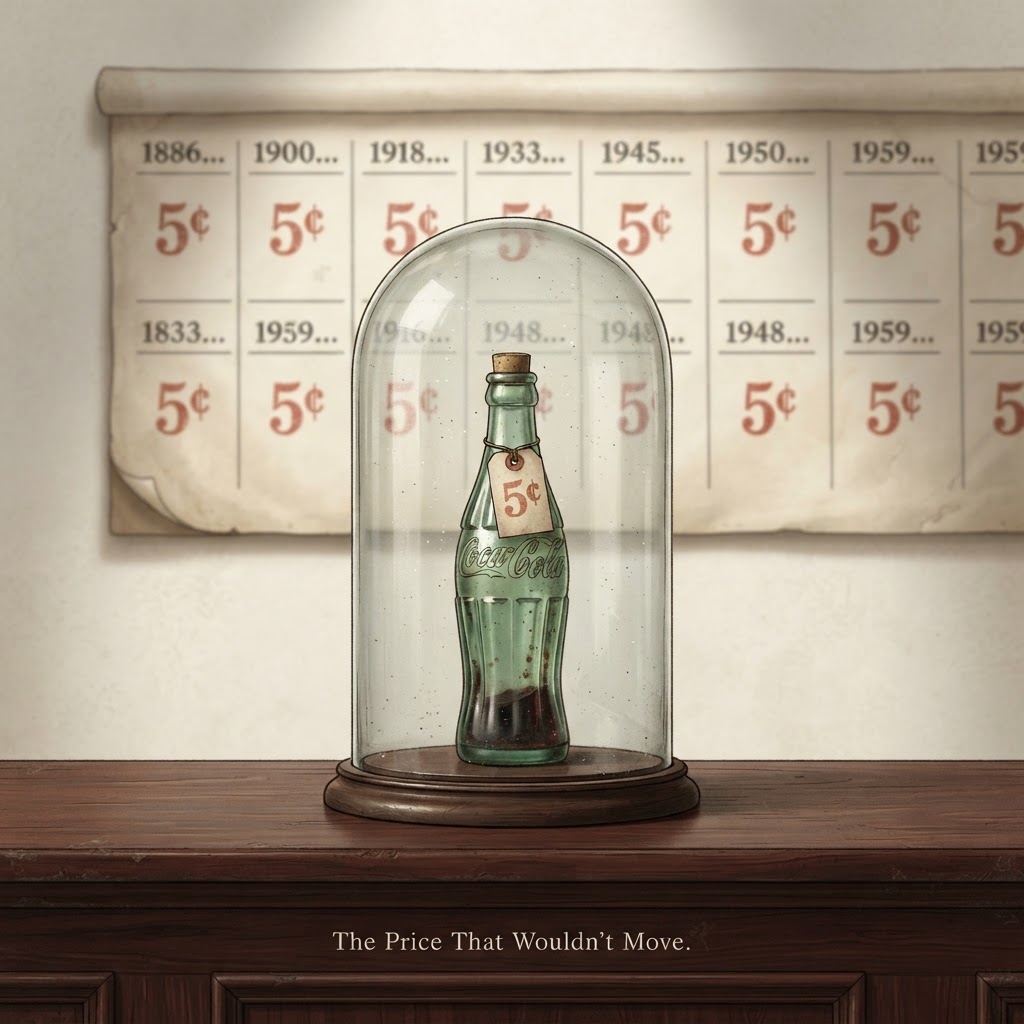
Coca-Cola spent seven decades unable to charge six cents for a Coke. The reason wasn't strategy — it was three things the company built for entirely different purposes.
Pairs with the Pricing Power Diagnostic — a ready-to-use strategy tool, filled for Coca-Cola. Included in the The Pricing Lens Casebook →
For 73 years - from 1886 to 1959 - a 6.5-ounce bottle of Coca-Cola cost five cents.1 Not 'roughly five cents.' Five cents, full stop, through the Spanish flu, the Great Depression, two world wars, and decades of creeping inflation that doubled and redoubled the price of nearly everything else. Economists Daniel Levy and Andrew Young, who documented the episode in detail, call it a nominal price rigidity that lasted more than 70 years - one of the most remarkable ever recorded.1 And the reasons it happened are a near-perfect lesson in a truth most companies learn too late: you don't always set your price. Sometimes the machinery you built to sell the product sets it for you. Coca-Cola's nickel wasn't chosen so much as constructed - out of a contract it signed, a machine it deployed, and a slogan it broadcast, each rational in its moment, all of them a cage in aggregate.
Trap one: the contract Coca-Cola signed away: how a distribution deal meant to dodge risk quietly pinned the shelf price
In 1899, Coca-Cola's leadership made a decision that looked shrewd and became a multi-decade handcuff. Wanting to expand into bottling without taking on the capital risk, the company sold nationwide bottling rights to a pair of entrepreneurs - and structured the arrangement so that it supplied syrup to those bottlers under fixed terms. Levy and Young identify this contract between the company and its parent bottlers as the first of the three forces holding the price down, because it encouraged retail price maintenance across the system.1 This is the part that matters mechanically: when the bottling system's economics are pinned by contract, the incentive to push the shelf price up largely evaporates, and the whole distribution chain settles into the nickel as its natural resting point. The company spent years, and real legal effort, contending with the consequences of the bottling contracts it had signed - a reminder that the terms you set to win distribution early can quietly imprison your pricing later, long after the executives who signed them are gone.
Trap two: the machine that only ate nickels: when hardware gets a louder vote on price than the executives do
Then came the vending machine, and with it the most physical pricing constraint imaginable. Coke spread through machines engineered to accept a single five-cent coin, and Levy and Young single out this single-coin vending technology as the second force locking the price - the available price-adjustment alternatives were limited and unreliable.1 To raise the price to six cents, the entire installed base of machines would have had to be re-engineered to take a second coin or make change - an enormous capital cost spread across the country. To jump straight to a dime was a 100% increase, commercially unthinkable for an everyday impulse purchase. The hardware had effectively cast a vote, and it voted for a nickel. The constraint was binding enough that in 1953 Coca-Cola's president, Robert Woodruff, asked his friend President Eisenhower to have the U.S. Treasury mint a 7.5-cent coin - a price between a nickel and a dime that the machines might accept.2 Eisenhower forwarded the request to the Treasury, which declined; the coin was never made. For a stretch of the twentieth century, a vending machine had more practical say over Coca-Cola's price than its own executives did.
Trap three: the price became part of the brand: the marketing that sold the price made it almost impossible to abandon
The third trap was psychological, and the most powerful of the three. For decades, Coca-Cola advertised the nickel price directly - 'Coca-Cola, five cents' was practically part of the visual identity, plastered across signage and print. Entire generations grew up believing a Coke was a nickel, the way the sky is blue: a fact about the world rather than a commercial decision. The company had spent a fortune welding the price into the brand's meaning. Unwelding it meant breaking a promise customers didn't consciously know they'd been made - and risking the sense of betrayal that comes when a fixed point in everyday life suddenly moves. (Levy and Young frame this in economic terms as a customer 'inconvenience cost,' the third of their three forces.1) The marketing that so effectively sold the nickel had, in the same motion, made the nickel almost impossible to abandon. Coca-Cola had advertised its price into the customer's identity, and thereby advertised away its own freedom to change it.
| Constraint | What locked it | Why it resisted change |
|---|---|---|
| Contractual | Fixed-term syrup supply to bottlers (from 1899) | The bottling system faced little pressure to raise the retail price |
| Physical | Single-coin vending machines | Any change meant re-engineering the installed base nationwide |
| Psychological / transactional | Decades of '5 cents' advertising; single-coin habit | The price had become part of the brand promise, and a one-coin transaction was frictionless |
The interpretation: a price is the sum of its constraints: pricing freedom is something you can lose without ever deciding to
Here is the argument worth taking away. We habitually talk about pricing as a decision - a number a strategist selects to optimize margin against demand. The nickel Coke is the great counterexample, and its value is precisely that it shows the limits of that frame. Coca-Cola's price was not so much chosen as accreted: built up, layer by rational layer, out of a contract, a machine, and a slogan, until it hardened into something leadership no longer controlled. Each individual decision made sense on the day it was made. Together they removed pricing from the set of levers management could pull and turned it into a fact management had to live inside. The deeper point is that none of the three traps was a pricing decision at the time - they were a distribution decision, a capital-equipment decision, and a marketing decision. The price cage was assembled by people who thought they were doing something else entirely.
That's what makes this more than a historical curiosity. The same trap is laid, in modern form, every time a company signs a long fixed-cost contract, builds infrastructure that silently assumes one price point, or trains customers to expect a specific number rather than a value. Subscription businesses that advertise '$9.99 forever,' hardware ecosystems built around a price tier, platforms whose whole pitch is a free service - all are quietly welding bars onto a cage they may someday need to open. The nickel's lesson is not that fixed prices are bad. It's that pricing freedom is something you can lose without ever deciding to, one sensible step at a time.
Before assuming your price is a free variable, map its cage. What contracts fix your costs, or your partners' incentives, in ways that resist a change? What physical or technical infrastructure quietly assumes the current price point? What have you trained customers - and your own marketing - to expect as a fixed fact? The strongest pricing power comes not from picking the right number, but from never letting these three forces silently harden around a number you'll later need to move.
When the nickel finally broke at the end of the 1950s, it wasn't because Coca-Cola made a bold pricing decision. It was because inflation and new machine technology finally bent bars the company had spent seven decades building for itself. The most expensive thing Coca-Cola ever sold for a nickel was its own freedom to charge six cents.
The Coca-Cola & pricing set
Pricing Power Diagnostic
A scored diagnostic of pricing power: brand pull, switching costs, substitutes, and how critical the product is to the buyer. Each dimension rated 1-5 so you can see, at a glance, whether a price rise sticks or sends customers running. Blank to grade your own offer; filled as the worked example scoring a story's business on its real ability to charge more.
Included, filled and blank, in the The Pricing Lens Casebook. See the set → · Preview the blank →
Sources
Where this comes from — the filings, records, and reporting behind it.
- 1A 6.5-oz Coca-Cola sold for 5 cents from 1886 to 1959; the rigidity is best explained by (1) a bottler contract encouraging retail price maintenance, (2) single-coin vending-machine technology, and (3) single-coin monetary-transaction costs.
- 2In 1953 Coca-Cola president Robert Woodruff asked President Eisenhower to have the U.S. Treasury mint a 7.5-cent coin, to allow a price between a nickel and a dime in single-coin vending machines; the request was declined. Documented in Levy & Young (2004), citing Kahn (1969, p.133) and Allen (1994).
More like this — beyond Coca-Cola
New Strategically analyses as they publish: the defining moves in business, checked against the record. No noise, and one click to leave.