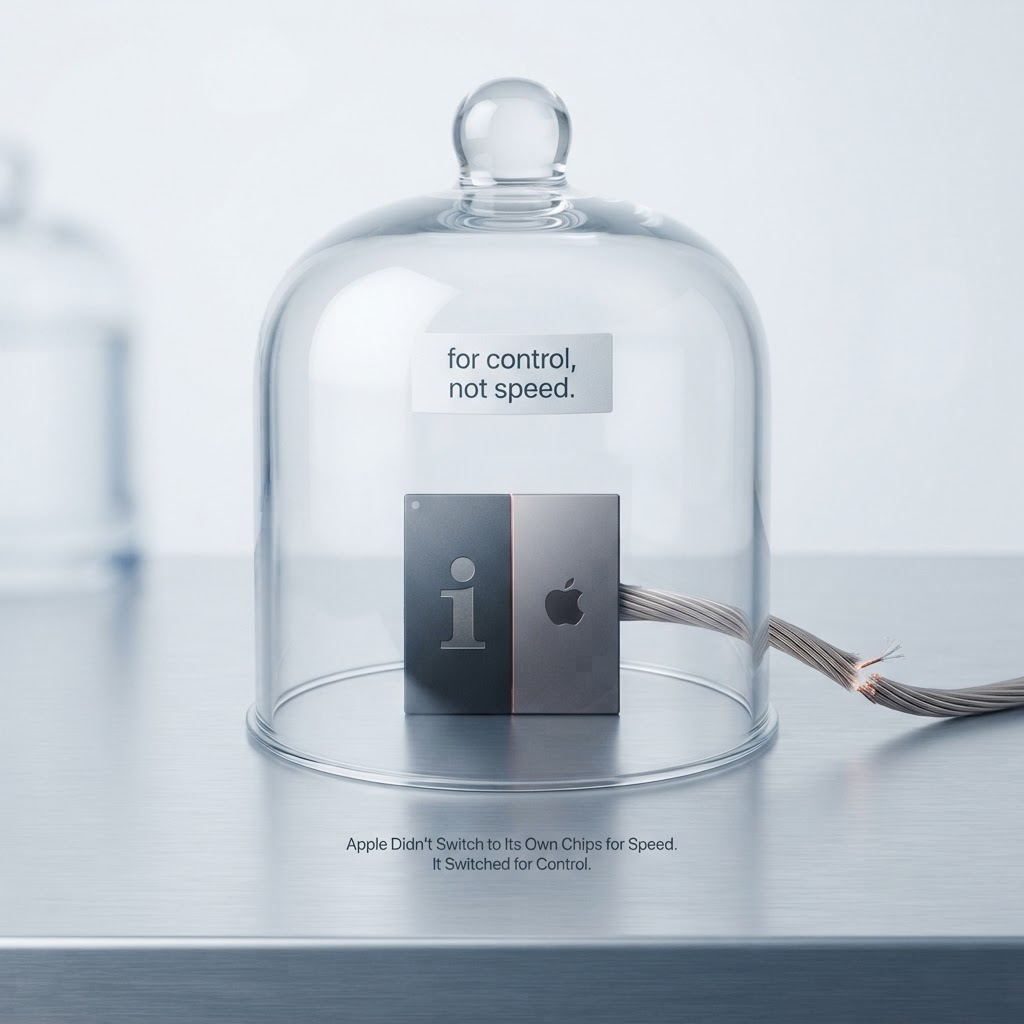
Everyone measured the new chip in benchmarks. Apple was measuring something the reviews never thought to check: who got a vote on what its computer could become.
Pairs with the Fork Decision Tree — a ready-to-use strategy tool, filled for Apple. Included in the The Fork Casebook →
In June 2020, Apple announced it would stop putting Intel processors in its Macs and start designing the chips itself.1 After fifteen years of buying the best silicon Intel made,3 it was walking away to build its own. When the first of those chips, the M1, arrived that November, the reviews fixated on one thing: it was astonishingly fast, and astonishingly efficient.2 That was true, and it was the least interesting thing about the decision. Apple did not spend a decade and a fortune learning to make processors in order to win a benchmark. It did it to take back something it had given away in 2006 - the right to decide what the most important part of its computer would be.
The official story is that Apple switched to its own chips because they were better. The real story is that Apple switched because it could no longer tolerate the one thing every customer of a chip supplier has to accept: that the most consequential component in your product is designed by someone else, on someone else's schedule, for someone else's priorities. The M1's speed was the proof. Control was the point.
When you buy the brain, you buy someone else's roadmap: every supplier sells you their cadence and their priorities along with the part
Buying a processor from Intel is buying more than a chip. It is accepting Intel's release cadence, Intel's design priorities, and Intel's problems - and Intel, by the late 2010s, had problems. Its manufacturing roadmap stalled for years, and the cost showed up in the numbers: by one independent analysis, over the five years before the M1, Intel's single-thread performance improved about 28% while Apple's mobile chips improved about 198%.5 Apple was watching the part it depended on improve at a seventh of the rate of the part it controlled. Worse, Intel's chips were designed to serve every PC maker on earth, which meant they were optimized for no one in particular - certainly not for the specific machine, operating system, and ambitions Apple had in mind. This is the build-versus-buy fork in its sharpest form. Buying is safe, proven, and cheap. Building costs years and billions and might fail outright. But buying means your ceiling is set by a supplier whose interests only partly overlap with yours - and Apple had decided its ambitions for the Mac no longer fit inside Intel's roadmap.
The bet wasn't made in 2020. It was made in 2008.: the leap looked sudden only because the setup had been running for a decade
Here is what makes the decision look brave rather than reckless, and it is the part the 'Apple builds a fast chip' coverage missed entirely. Apple was not a computer assembler that suddenly decided to become a chip company. It had quietly been one for over a decade. It bought the chip designer P.A. Semi in 2008, and in 2010 shipped its first self-designed processor, the A4, in the original iPad.4 Every iPhone and iPad since has run on Apple's own silicon, which means that by 2020 the company had spent ten years and a billion units learning to design world-class, low-power chips - on products where a failure would have been survivable. The Mac transition was not a leap into the unknown. It was Apple pointing a decade of accumulated, battle-tested capability at a new target. The fork looked sudden from outside; inside, it was the cashing-in of the longest setup in the industry.
| Buy from Intel | Build your own | |
|---|---|---|
| Optimized for | Every PC maker at once | Exactly one product line - yours |
| Your roadmap | Set by the supplier's cadence | Set by you |
| Hardware/software/silicon | Designed separately, then bolted together | Designed as one |
| Risk | Low - proven, off the shelf | High - years and billions, may fail |
| Your ceiling | The supplier's ceiling | Your own |
The bet only looks obvious because it worked: the genius wasn't the courage to leap, it was the patience to make the leap small
It looks obvious now, the way every successful bet does. Two honest objections cut against the easy version. First, the risk was real and large: designing a desktop-class processor is a different problem from a phone chip, the industry is littered with companies that tried to build their own silicon and failed, and a stumble would have meant shipping Macs slower than the Intel ones they replaced. Second, didn't Apple just get lucky that Intel faltered at the same moment? Partly - but it mistakes timing for cause. Apple did not bet the Mac on a chip it hoped it could build; it bet the Mac on a chip-design muscle it had already spent a decade proving on a billion iPhones. The genius was not the courage to leap. It was the patience to make the leap small - to have already done the hard, risky part on products where failure was cheap, so that by the time the Mac's turn came, the outcome was closer to inevitable than brave. Luck favored a company that had spent ten years removing the luck.
Buy a component when it's a commodity, or when the market can simply out-design anything you'd make yourself - most of the time, that's the right call. Build it when two things are both true: the component gates your roadmap (a supplier's pace is capping your ambition), and owning it unlocks integration a buyer can't replicate (you can design it together with everything around it). And de-risk the way Apple did - prove the capability somewhere failure is survivable before you bet the flagship on it. The question isn't 'can we make this?' It's 'is this part the thing our product is actually about?'
For most of its modern life Apple was the best in the world at one thing: assembling other people's finest components into something better than the sum of them. Apple silicon was the moment it stopped being an assembler of the most important part and became its designer. The M1 was fast, and the laptops were great, and the batteries lasted all day - but the durable win was quieter and larger. For the first time in fifteen years, no one outside Cupertino got a vote on what the Mac could become. Apple had bought back its own future, one chip at a time, and the price of admission was the willingness to spend a decade earning the right to pay it.
Fork Decision Tree
Take the either/or in front of you and draw it out: the question at the fork, the two branches, and what each one triggers two and three moves later. Blank, it forces you to spell out consequences before you commit instead of after. Filled, it replays the story's fork so you can see exactly where each path led — and which downstream node actually decided the outcome.
Included, filled and blank, in the The Fork Casebook. See the set → · Preview the blank →
Sources
Where this comes from — the filings, records, and reporting behind it.
- 1At WWDC on June 22, 2020, Apple announced the Mac would transition from Intel processors to its own 'Apple silicon,' planning to ship the first such Mac by the end of 2020 and 'complete the transition in about two years.'
- 2Apple unveiled the M1 - 'Apple's first chip designed specifically for the Mac' - on November 10, 2020, claiming up to 3.5x faster CPU performance and 'the world's best CPU performance per watt' versus the previous Intel generation.Apple Newsroom, Apple unleashes M1 ↗ · 2020-11-10
- 3Apple had used Intel x86 processors since the 2005-2006 transition away from PowerPC (announced June 6, 2005; first Intel Macs shipped January 2006), making the 2020 move the end of roughly a fifteen-year Intel era.
- 4Apple's Mac silicon grew out of a decade of designing its own mobile chips: its first self-designed system-on-a-chip, the A4 ('Designed by Apple'), debuted in the original iPad in January 2010 and then the iPhone 4 - the start of the in-house silicon effort that began with its 2008 acquisition of chip designer P.A. Semi.Apple Newsroom, Apple Launches iPad ↗ · 2010-01-27
- 5Independent analysis found the M1 to be the fastest laptop CPU available at launch, drawing roughly 5 watts where comparable Intel chips drew 20-50; over the preceding five years, Intel's single-thread CPU performance improved about 28% while Apple's improved about 198% - the cadence gap behind the switch.
- 6Apple completed the transition at WWDC 2023: on June 5, 2023 it brought Apple silicon (M2 Ultra) to the Mac Pro, stating 'the new Mac Pro completes the Mac transition to Apple silicon' - about three years after the announcement, longer than the targeted two.
More like this — beyond Apple
New Strategically analyses as they publish: the defining moves in business, checked against the record. No noise, and one click to leave.