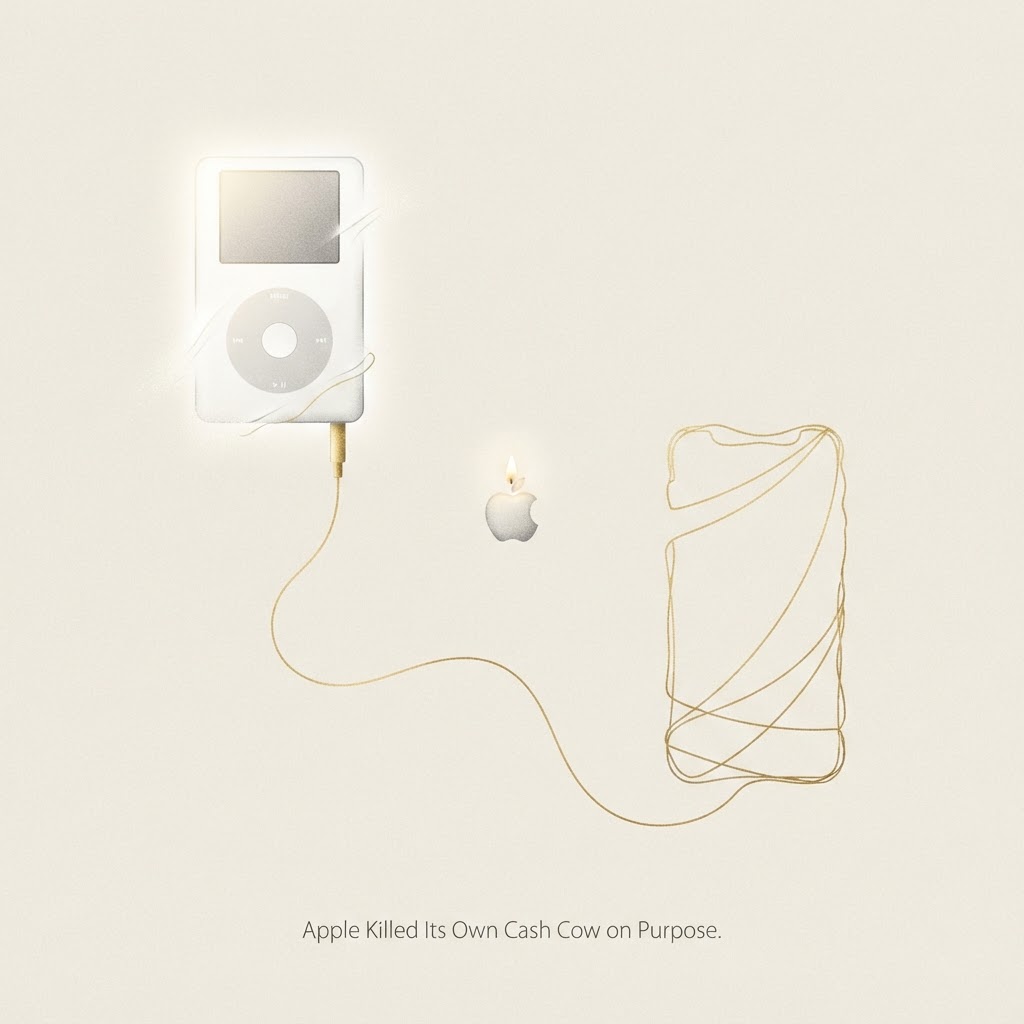
Apple looked at the product that saved the company — the one minting nearly half its revenue — and decided to be the one holding the knife. On purpose.
Pairs with the Cannibalization Decision Tree — a ready-to-use strategy tool, filled for Apple. Included in the Cannibalization Choice Casebook →
In 2007, the iPod was not a product in decline that needed replacing. It was one of the most successful consumer-electronics products ever made - the device that had rescued Apple, defined a decade of music, and grown to account for around 40 percent of the company's entire revenue (in fiscal 2006).2 By every conventional instinct, you protect a product like that. You defend it, extend it, and milk it for as long as humanly possible. Apple did the opposite. It built the iPhone - a device with an iPod built directly into it, expressly designed to make the standalone iPod obsolete. Apple looked at its own crown jewel and chose to put a knife in it. The decision looked reckless to outsiders and was, in fact, the most disciplined strategic move in the company's modern history, governed by a single rule Steve Jobs repeated like a creed: if you don't cannibalize yourself, someone else will.1
“If you don't cannibalize yourself, someone else will.”1
The choice most companies flinch at: why the prudent-looking instinct to protect a winner is usually how incumbents die
A cannibalization choice is the decision to release a product that will eat the sales of one of your existing products. Most companies face it eventually, and most companies flinch, because the math looks insane in the short term: you're spending money to build something whose success is measured partly by how much it destroys a business you already have. Every internal incentive argues against it. The team running the profitable existing product fights to protect it; the finance models show near-term revenue loss; the safe move is always to wait. And so the default corporate behavior is to delay the cannibalizing product, hobble it so it doesn't hurt the cash cow, or refuse to build it at all. This instinct feels like prudence. It is usually how companies die.
The choice isn't whether you get cannibalized — it's by whom: when disruption is certain, the only open question is who gets to build your replacement
The insight that makes Jobs's rule more than bravado is this: for a product facing real disruption, the cannibalization isn't optional - only the identity of the cannibal is. Apple could see what was coming. Phones were going to absorb the music player; a single device that made calls, browsed the web, and played your music was obviously where the world was heading. Given that, the iPod's days were numbered no matter what Apple did. The only real question was who would build the device that replaced it. If Apple refused to cannibalize the iPod, it wouldn't save the iPod - it would simply hand the replacement market to a competitor, and lose both the iPod and the future. By choosing to cannibalize, Apple converted an inevitable loss into a deliberate transition: it captured the very disruption that would otherwise have destroyed it. This is the reframe that dissolves the apparent recklessness. Apple wasn't risking a healthy business. It was choosing to be the one holding the knife instead of the one on the table.
| Protect the cash cow | Cannibalize yourself (Apple) | |
|---|---|---|
| Short-term revenue | Preserved | Sacrificed deliberately |
| Who builds the replacement | A competitor | You do |
| Long-term outcome | Lose the product AND the future | Capture the future |
| Emotional difficulty | Feels safe | Feels reckless |
| Archetypal example | Kodak and film | Apple and the iPod |
Cannibalization is right, but timing is everything: the discipline lives in judgment, not the slogan — the same move can be survival or self-harm
It would be too easy to draw the lesson as 'always cannibalize yourself,' and that would be wrong - the discipline is more demanding than the slogan. Cannibalization is correct only when the existing product genuinely faces disruption and the new product is genuinely the future; done in those conditions, it's survival. But the same move made carelessly is just value destruction. Cannibalize too early, before the new product is good enough or the market is ready, and you've killed a profitable business to feed an immature one, leaving money on the table for no strategic gain. Cannibalize a product that wasn't actually going to be disrupted, and you've simply harmed yourself. What made Apple's choice brilliant rather than foolish was judgment about the specific situation: the iPod was facing certain disruption, the iPhone was unmistakably the future, and the replacement was being built in-house by the same company. Strip any of those conditions away and the calculus flips. The rule isn't 'cannibalize yourself.' It's 'when disruption is coming and you can be the disruptor, don't let anyone else have the job.'
History supplies the control case. Kodak, famously, invented the digital camera and then buried it for decades to protect its enormously profitable film business - the textbook refusal to cannibalize. It didn't save film; it just ensured Kodak wasn't the company that captured what came after, and the disruption arrived anyway, on someone else's terms. Apple ran the experiment the other way and got the opposite result: by killing the iPod itself, it didn't just survive the transition to smartphones - it owned it, and the iPhone became the most profitable product in the history of business. The iPod, meanwhile, faded gracefully on Apple's own schedule, the last model finally retired in 2022, long after it had served its real purpose: being the thing Apple was brave enough to replace.3
When a new product threatens your existing one, don't ask 'will this hurt our current sales?' - that question always says no, and following it is how incumbents lose. Ask instead: 'Is our current product going to be disrupted regardless?' and 'Can we be the one who disrupts it?' If both answers are yes, build the cannibal yourself and build it without compromise - a hobbled cannibalizing product is the worst of both worlds. The companies that endure aren't the ones that protect their best products longest. They're the ones willing to kill their own winners a moment before someone else would have.
The iPod story endures because it inverts our instincts about courage in business. We imagine the brave move is the bold new launch. Often the truly brave move is the willingness to destroy something you already love and profit from - to look at your best, most beloved product and decide, while it's still winning, that you'll be the one to end it. Apple's greatest act of discipline wasn't inventing the iPhone. It was being willing to let the iPhone kill the iPod.
The cannibalization & growth set
Cannibalization Decision Tree
A decision tree for the moment the new thing threatens the cash cow: is the disruption real, will someone else do it if you don't, and can you afford to bleed your own margin to own the future? Blank to run on your own line; filled as the worked example tracing how the story's incumbent chose to cannibalize — or flinched and got cannibalized.
Included, filled and blank, in the Cannibalization Choice Casebook. See the set → · Preview the blank →
Sources
Where this comes from — the filings, records, and reporting behind it.
- 1Steve Jobs held it as a rule never to fear cannibalizing Apple's own products: 'If you don't cannibalize yourself, someone else will' - applied to the iPhone cannibalizing the iPod and the iPad the Mac.Walter Isaacson, 'Steve Jobs' (biography), Steve Jobs (Simon & Schuster, 2011) · ISBN 9781451648539 · 2011
- 2The iPod launched October 23, 2001; in Apple's fiscal 2006 the iPod device segment was about 40% of revenue ($7,676M of $19,315M) - not half (the broader iPod/iTunes ecosystem reached ~49%). The iPhone, announced Jan 9, 2007 and shipped June 29, 2007, had iPod functionality built in.
- 3Apple wound the iPod line down over the following years; the iPod Touch, the last model, was discontinued in 2022.
More like this — beyond Apple
New Strategically analyses as they publish: the defining moves in business, checked against the record. No noise, and one click to leave.