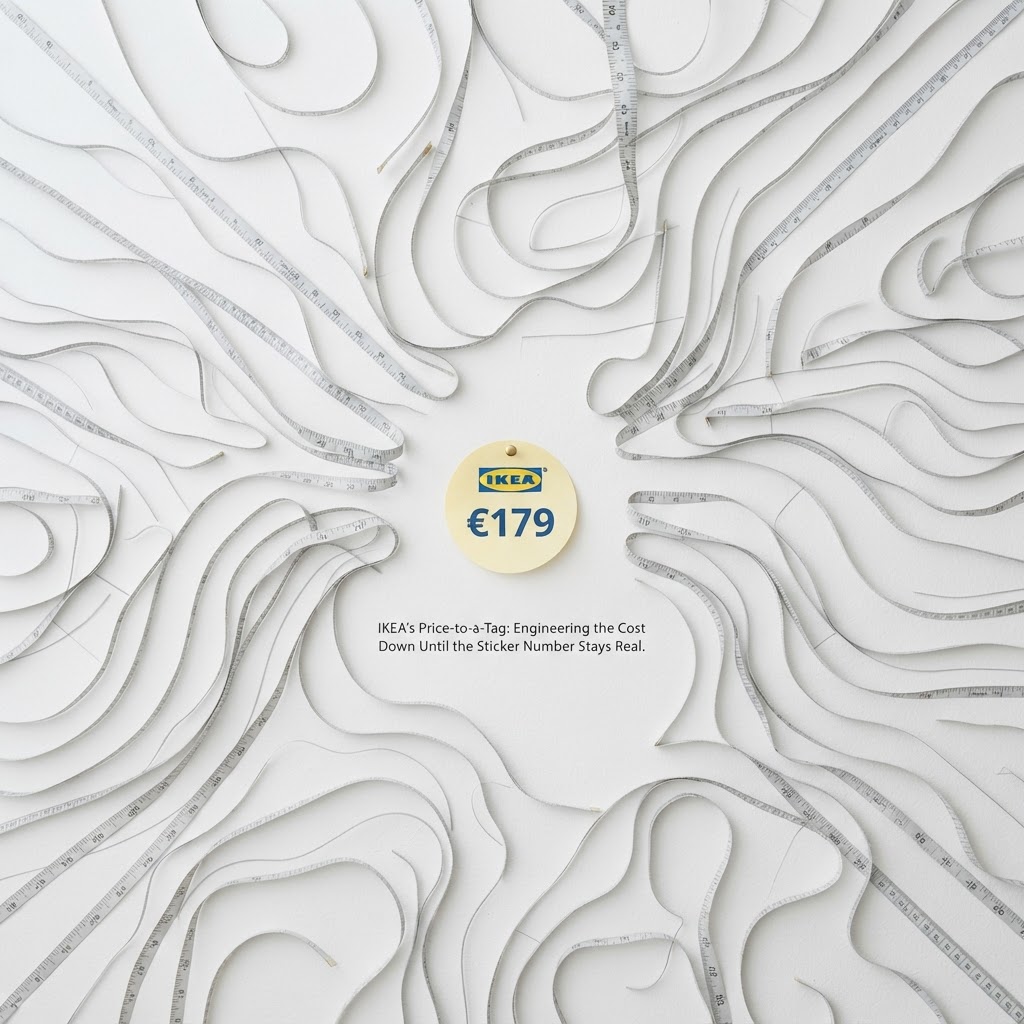
Most companies build a product, then ask what it should cost. IKEA writes the price first - and then bends a factory, a store, and your Saturday afternoon into shape to honour it.
Pairs with the Profit-Engine Map — a ready-to-use strategy tool, filled for IKEA. Included in the The Money Machine Casebook →
Somewhere in Sweden, before a single board is cut, before a designer sketches a leg or chooses a wood, a sofa already has a price. Not an estimate, not a target margin - a firm number on a tag, decided first. Then the work begins: build a sofa that can be sold for that, profitably, and survive being shipped across the world in a flat cardboard box and assembled on a living-room floor by someone who has never held an Allen key. IKEA does not design a sofa and then ask what it should cost. It decides what it costs and then designs a sofa that can live there.
The official story is that IKEA is a discount furniture retailer - cheap stuff, sold cheaply, in big blue boxes off the motorway. That framing quietly misses the engine. The low price is not a markdown IKEA generously declines to charge you. It is a constraint it imposes on itself, up front, and then reorganises the entire company to obey. The flat box, the wrench in the bag, the warehouse you pick from yourself, the mile-long path through the store - none of it is thrift for its own sake. It is what designing to a fixed price forces you to build.
“The first thing we design is the price tag.”1
The whole process runs backwards on purpose: the price is fixed first, and every gram of material after that is subtraction toward it
Almost every product company works in one direction: design the thing, cost it up, add a margin, arrive at a price, then hope the market accepts it. IKEA runs the arrow the other way. The price comes first, and it is treated as fixed - a wall the product is not allowed to cross. Everything after that is subtraction. A designer handed a target price and a target sales volume cannot make the number work by wishing; they make it work by removing - a part here, a gram of material there, a centimetre of packaging that lets one more unit fit on the pallet. The constraint is the brief. How cheaply can this be made and still be good is not a question asked at the end to protect margin; it is the question the design exists to answer.
This is why IKEA insists that designing the packaging is part of designing the product, 'not an afterthought,' and why it talks about refusing to 'transport air.'1 Air is the enemy because air is cost - empty space in a box is freight you pay for and shelf you rent to move nothing. So the product is shaped, from the first sketch, to collapse into the smallest, flattest, most stackable rectangle that still becomes furniture at the other end. The aesthetic and the economics are the same decision. A thinner profile is not only cleaner-looking Scandinavian design; it is more units per truck.
A single lamp shows the machine at work. IKEA redesigned one of its lamps by stripping out the bulk of its components, almost halving its weight, and shaving the packaging down by roughly a quarter - which let it fit 128 lamps on a pallet where 80 had gone before.9 More on the pallet means less freight per lamp, which means the price tag - already low - could fall again. Notice the order of operations: the goal was a lower price, and the redesign was the means to reach it. The product was edited to meet the number, not the other way around.
How a transport headache became the business model: the flat box doesn't just cut shipping cost - it quietly hires you as the last station on the line
The flat box is so central it has a creation myth. In 1956 an IKEA co-worker named Gillis Lundgren was photographing a small table called Lövet for the catalog, couldn't fit it in his car, and sawed the legs off to get it home - then reassembled it.67 Treat the anecdote as exactly what it is: a story IKEA likes to tell, true in spirit and repeated everywhere. What matters is not whether one man's Volvo started it, but what IKEA did with the idea afterwards. It turned an accident of logistics into a deliberate doctrine - and the doctrine is the actual product.
Here is the move most people miss. Flat-pack does two cost-shifting things at once, and both land on you. First, it slashes IKEA's own cost: a flat box is dramatically cheaper to warehouse, stack, and ship than an assembled chair, and it travels without paying to move air.1 Second - and this is the quiet genius - it transfers the assembly labour from IKEA's payroll to your Saturday afternoon. The factory does not finish the chair; you finish the chair. You are not merely a customer at the end of the line; you are the last station on the production line, working for free. The low price you pay is partly a wage you are paying yourself, in time and mild swearing, and never see itemised.
| Step | A normal furniture retailer | IKEA |
|---|---|---|
| Set the price | Last - after costing the product | First - the product is designed to it |
| Final assembly | Factory (paid labour) | The customer (unpaid) |
| Shipping & storage | Bulky finished goods | Flat packs - more per truck, no 'air' |
| Picking from the warehouse | Staff fetch and deliver | You walk the racks and carry the box |
| The low price is mostly... | A thinner margin | Cost engineered out of the product |
Pull the camera back and the same logic runs through the building you're standing in. The self-service warehouse is the store equivalent of flat-pack: instead of paying staff to fetch your wardrobe, IKEA prints an aisle and bin number on the tag and you fetch it, lift it, and haul it to the till. The checkout, the loading, the drive home, the assembly - one by one, the expensive last steps of getting furniture into a home have been handed to the person who wanted the furniture. Each transfer shaves cost off the tag. The customer is cheaper than an employee, and IKEA designed a whole retail format around quietly hiring you.
The maze isn't bad design. It's the most profitable design.: the low price is the bait that gets you inside a building engineered to grow your basket
Then there is the path. IKEA stores are famously a one-way labyrinth: you enter, and a marked route walks you past nearly every department in the catalog before it releases you to the warehouse and the tills. People complain that you can't just grab a lamp and leave. That complaint is the feature. The layout is a textbook case of what retailers call the Gruen effect - named for architect Victor Gruen - in which a deliberately immersive, disorienting space loosens a shopper's grip on their original errand and nudges them toward buying things they never came for. Alan Penn, an architecture professor at University College London who has studied IKEA's layout, estimates that around 60% of what people buy at IKEA was never on their list.8 You came for shelf brackets; you leave with tea lights, a plant pot, a lamp, and a EUR 1 hot dog.
This is where the doctrine completes itself. The low price is the bait - the 'welcome committee,' as IKEA puts it1 - that gets enough people through the doors and onto the path. The path then converts that traffic into a basket far larger than the one item the price advertised. Low margins on each product are fine if the price pulls in the volume and the maze grows the basket. The cheap sofa is not where the money is made; it is the reason you are inside a building engineered to sell you eleven other things. Loss-leader thinking, turned into architecture.
The strategic trick is to stop treating price as the last number you calculate and start treating it as the first number you obey. When the price is fixed in advance, it becomes a forcing function: every gram of material, every component, every centimetre of packaging, every step of fulfillment has to justify its cost or get designed out. That pressure is what produces flat-pack, self-assembly, and the self-service warehouse - not frugality for its own sake, but the only ways to keep a real product alive under a deliberately brutal price ceiling. Most companies design a thing and discover its price. The harder, more profitable discipline is to declare the price and design a thing that can survive it.
Isn't this just 'cheap furniture, sold cheaply'?: the line between engineering a cost out and simply slashing a margin is the whole argument
The fair objection is that this is an elaborate way of saying IKEA makes cheap stuff and passes some savings on - dress it up as 'design to a price tag' if you like, but it's discount retail with good branding. There's a grain of truth there, and it's worth conceding: plenty of retailers are cheap, and cheapness alone is no moat. But the distinction is real and it's the whole point. A discounter lowers the price of a product it took as given; IKEA lowers the cost of a product it designed expressly to be lowerable, and bakes the saving into the object before it exists. Kamprad drew exactly that line in 1976: the price 'had to be a low price with a meaning' - low without surrendering function or quality - which is precisely the discipline that separates engineering a cost out from simply slashing a margin.4 The same Testament is where IKEA's cost dogma lives: 'Waste of resources is a mortal sin at IKEA.'5 That is not a discounter's slogan. It is a design constraint elevated to a moral code.
The proof is in the numbers, and they're stark. In its FY24, IKEA says it 'substantially lowered prices across all 63 markets' - and franchisee retail sales fell 5.3%, to EUR 45.1 billion, partly because the prices themselves were cut.2 A normal retailer cutting price into a soft year would be bracing for a bloodbath in profit. Instead, Inter IKEA Group - the franchisor and design-and-supply heart of the system - still booked EUR 2.2 billion of net profit on EUR 26.5 billion of revenue.3 You cannot deliberately drop prices across every market you operate in and stay comfortably profitable unless the low price was engineered into the product, not subtracted from your margin. That is the difference between a discount and a doctrine, stated in euros.
So the next time you're wedged in the warehouse aisle hunting for bin 17, the flat box biting into your fingers, the half-built bookcase waiting at home - understand that none of it is an accident, and none of it is IKEA being stingy. It is the visible end of a single decision made before the product existed: the price was set first, and then a company, a factory, a store, and a Saturday afternoon were all bent into shape to honour it. IKEA didn't find a way to sell furniture cheaply. It decided what cheap meant, wrote it on a tag, and built everything else - including you - around the wrench.
More machines that profit from where the money really sits
Profit-Engine Map
A one-page map that pulls a business apart into the hook that gets the customer in the door and the engine that quietly earns the margin. Use it to see where the real profit lives, how the two halves are wired together, and what breaks if the link is cut. Blank to dissect your own P&L; filled as the worked example of a business whose advertised product is not where it makes its money.
Included, filled and blank, in the The Money Machine Casebook. See the set → · Preview the blank →
Sources
Where this comes from — the filings, records, and reporting behind it.
- 1IKEA states on its own value-chain page: 'The first thing we design is the price tag.' It adds that 'the low price serves as the welcome committee of IKEA,' that 'to arrive at a low price, we strive for low costs in everything we do,' and that a flat-pack product 'costs less because you assemble it yourself, it's well-protected and it's been transported in the most efficient way possible,' noting IKEA dislikes 'wasting resources by transporting air.'
- 2In FY24 (year ended 31 August 2024), total IKEA retail sales of franchisees reached EUR 45.1 billion, a decrease of 5.3% (4.0% adjusted for currency) versus FY23, and IKEA states it 'substantially lowered prices across all 63 markets, making IKEA more affordable for the many people.'
- 3Inter IKEA Group reported FY24 total revenues of EUR 26.5 billion (EUR 29.1 billion in FY23) and net profit of EUR 2.2 billion, and states that 'price reductions across all 63 markets resulted in a decrease of 5.3% (4.0% when adjusted for currency impact) compared to FY23' in total IKEA retail sales of EUR 45.1 billion.
- 4Ingvar Kamprad's 'The Testament of a Furniture Dealer' (1976) defines IKEA's aim and pricing doctrine: the price 'had to be a low price with a meaning' - one that does not compromise function or quality - and the document is the source of the maxim that wasting resources is a mortal sin at IKEA. The IKEA Museum confirms the Testament was published in 1976.
- 5Ingvar Kamprad wrote in 'The Testament of a Furniture Dealer' (1976): 'Waste of resources is a mortal sin at IKEA.' The line is widely reproduced from the Testament as a statement of IKEA's cost doctrine.Ingvar Kamprad, 'The Testament of a Furniture Dealer' (Inter IKEA Systems B.V.), The Testament of a Furniture Dealer · 1976
- 6IKEA's first flat-pack product is traced to the 'Lövet' (leaf) side table, launched in 1956. As the founding story is told, IKEA co-worker Gillis Lundgren was photographing the table for the catalogue, found it would not fit in his car, and sawed off the legs to transport it - reassembling it on set - an episode credited with kick-starting IKEA's flat-pack approach.
- 7IKEA relaunched its first flat-pack table, the 1956 Lövet (as Lövbacken), and the design's flat-pack origin - Gillis Lundgren removing the legs to fit it in a car - is recounted as the moment that started IKEA's flat-pack thinking.Dezeen, IKEA relaunches first flat-pack table ↗ · 2013-07-22
- 8Alan Penn, professor of architecture at University College London who has studied IKEA's store layout, estimates that around 60% of IKEA purchases are impulse buys - items not on the shopper's original list. The one-way 'maze' layout is associated with the 'Gruen effect,' named after architect Victor Gruen, whereby a disorienting layout encourages unplanned purchases.
- 9An example of designing backward from a price: IKEA redesigned a lamp (the TEXTUR/VIDJA) by cutting components and weight - eliminating roughly two-thirds of the parts, nearly halving the lamp's weight, reducing packaging weight by about 28%, and fitting 128 lamps on a pallet instead of 80 - enabling a further price cut on an already low price.
More like this — beyond IKEA
New Strategically analyses as they publish: the defining moves in business, checked against the record. No noise, and one click to leave.