Pairs with the Vertical-Integration Assessment — a ready-to-use strategy tool. Included in the The Vertical Integration Casebook →
Pull up almost any case study, marketing blog, or business-school slide on Zara and you will find the same astonishing number: two weeks, from a designer's sketch to a hanger in a store. It is repeated so often and so confidently that it has stopped feeling like a claim and started feeling like a fact. There is just one problem. The original source — the Harvard Business School case that everyone is quoting at three removes — does not say that.5 It says four to five weeks for a genuinely new design, and two weeks only for tweaking or restocking something already in production.4 The legend kept the impressive half of the sentence and quietly deleted the rest.
The official story is that Zara wins on raw speed. The real story is that Zara wins on a far more deliberate piece of engineering: it runs two factories at once, at two different speeds, for two different purposes — and the boring one pays for the glamorous one. Strip away the two-week mythology and you find a model that is harder to copy, not easier, because the part everyone admires is the part that loses money on its own.
“4–5 weeks for entirely new designs, two weeks for modifications or restocking of existing products.”5
One company, two completely different supply chains
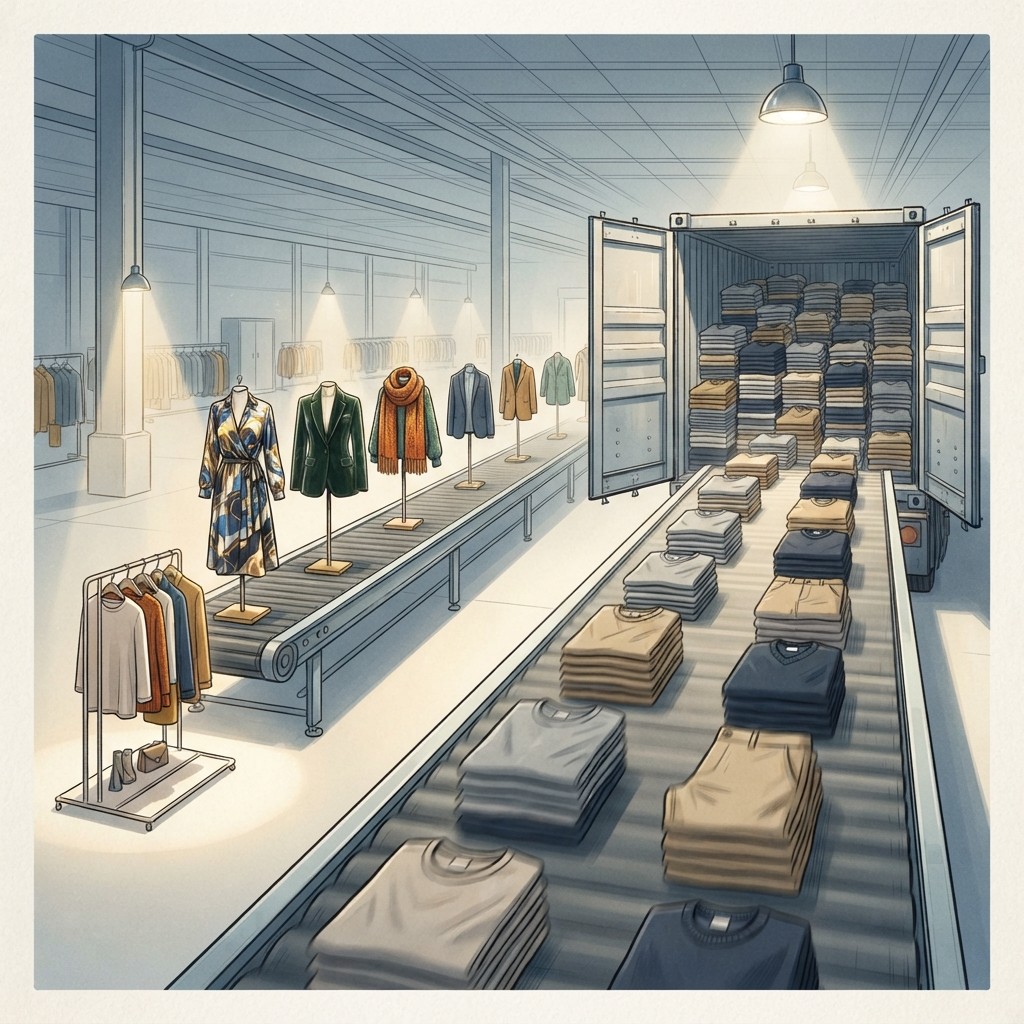
Here is the move almost everyone misses when they retell the story. Zara does not have a supply chain. It has two, bolted together inside one company, doing opposite jobs. The first is built for speed and proximity: roughly half of Zara's merchandise — its most fashionable, fastest-rotting items — is produced at company-owned and closely managed factories clustered in Spain, Portugal, and Turkey.4 These are the items where being three weeks late means missing the trend entirely, so Zara pays the premium of making them close to home, in small batches, and replenishes only what actually sells. The second chain is built for cost: basic items with long shelf lives — the plain tees, the staples that look the same this season and next — are outsourced to low-cost suppliers, mainly in Asia.4 A white cotton crew-neck does not need to be near A Coruña. It needs to be cheap.
The accounting trick hidden inside this is the whole game. Nearshore production is expensive — Galician and Portuguese labor is not Asian labor — and small-batch trend manufacturing forgoes the economies of a long production run. On its own, the fast half would be a margin disaster. But the basics, made cheaply and far away, carry a thick enough margin to subsidize it. The slow, dull chain funds the fast, exciting one. A competitor who studies Zara, falls in love with the speed, and tries to nearshore everything will replicate the costly half and skip the half that pays for it — and wonder why the spreadsheet never closes.6
| Fast chain (trend items) | Slow chain (basics) | |
|---|---|---|
| Roughly | Half of merchandise | The rest |
| Made | Nearshore: Spain, Portugal, Turkey | Outsourced, mainly Asia |
| Built for | Speed and small batches | Low cost, long runs |
| Cycle | 4–5 weeks new; 2 weeks restock | Long, planned ahead |
| Role in the model | Captures the trend | Pays for the speed |
What integration actually buys — and what it costs to keep
The other myth to retire is that Zara is vertically integrated because it owns its factories. It owns some of them. The more accurate picture is a web of company-owned plants plus tightly controlled independent workshops and suppliers — particularly across Galicia, northern Portugal, Turkey, and Morocco.4 What Inditex actually owns end to end is the chain that matters most for speed: design, production planning, logistics, distribution, and a centralized IT backbone that ties them together.6 That stack is what lets a store manager's daily sales data flow back to design, lets design decide on Tuesday to cut a slow style and double a fast one, and lets the proximity network turn that decision into hangers within weeks rather than seasons. The integration is informational and logistical first, and physical second.
Because trend items are made in small runs and replenished only when they sell, Zara carries less of the unsold inventory that forces end-of-season markdowns across the rest of the industry. In FY2023 inventory fell 7% even as net sales rose 10.4% to €35.9 billion and net income jumped 30.3% to €5.4 billion.1 The speed is not just glamour — it shows up as the discounts that never happened.
Isn't the two-week number close enough to be true?
The fair objection is that we are nitpicking. Two weeks, four weeks — either way Zara is dramatically faster than a traditional fashion house whose calendars run in months, and the legend gets the spirit right even if the digits are wrong.4 That is partly true, and it deserves an honest answer. But the loose number does real damage, because it teaches the wrong lesson. If you believe the moat is 'two weeks,' you go looking for a faster cutting room. If you understand the moat is a two-speed architecture cross-subsidized between proximity and Asia, you realize there is no single lever to pull — you have to rebuild both halves at once and run them against each other, which is exactly what took Inditex decades and a network it cannot buy off a shelf. The honest caveat in the other direction: Inditex itself publishes no single design-to-shelf KPI in its annual accounts, and the precise 'industry average' Zara is being compared against has never been pinned to one primary benchmark. The right posture is humility about the exact stopwatch, and conviction about the architecture.
When a company is famous for one spectacular capability, ask what quietly pays for it. Zara's speed is real, but speed alone would bleed margin; the cheap, distant, unglamorous basics are what make the fast, nearshore, small-batch trend items affordable to run. The lesson for any operator copying a celebrated model: identify the boring profit pool funding the exciting capability, because if you replicate the capability without the subsidy, you've copied the cost and left the cash behind. And beware the laundered number — when a figure travels through five secondary sources before it reaches you, check what the first source actually said. 'Two weeks' was a restock figure wearing a new-design costume for twenty years.
Zara's genius was never a stopwatch reading two weeks. It was the decision to build two opposite supply chains and let them lean on each other — the slow one feeding the fast one, the cheap one funding the quick one, the planned half buying the freedom for the responsive half. The number got laundered through a thousand retellings until the model itself disappeared behind it. But the model is the durable thing. You can admire the speed all you like; you cannot copy it without also copying the unglamorous half that quietly writes the check.
When the famous fact hides the real machine
Vertical-Integration Assessment
A make-vs-buy assessment for a single stage of the value chain: rate the forces that argue for owning it and the forces that argue for renting it, then read the verdict off the gap. Blank to run on a stage you're deciding now; filled as the worked example showing why the story's company pulled a stage in-house — or pushed it out.
Included, filled and blank, in the The Vertical Integration Casebook. See the set → · Preview the blank →
Sources
Where this comes from — the filings, records, and reporting behind it.
- 1Inditex FY2023 (year ended 31 Jan 2024): net sales €35.9 billion (+10.4%), net income €5.4 billion (+30.3%), net cash position €11.4 billion (+13.3%), inventory 7% lower year-on-year.
- 2Inditex Consolidated Annual Accounts FY2023 (IFRS): primary statutory financial filing covering the period 1 February 2023 – 31 January 2024, filed with Spanish CNMV. Inditex is listed on all four Spanish stock exchanges; its registered office is Avenida de la Diputación s/n, Arteixo, A Coruña.
- 3Inditex Group Annual Report 2023 (Non-Financial Information Statement): covers supply chain, sustainability, workforce, and governance disclosures for FY2023.
- 4Zara could originate an entirely new design and have finished goods in stores within four to five weeks; it could modify or restock existing items in as little as two weeks. Zara manufactures its most fashionable items — roughly half of all merchandise — at company-owned factories in Spain, Portugal, and Turkey; basic items with longer shelf lives are outsourced to low-cost suppliers mainly in Asia.
- 5The full text of HBS Case 703-497 (Ghemawat & Nueno) states the two-speed timeline: '4–5 weeks for entirely new designs, two weeks for modifications or restocking of existing products' — the earliest and most-cited primary academic source for Zara's speed claim, revised December 2006.
- 6Academic literature corroborates that Inditex's vertical integration — ownership of design, production, logistics, and distribution — combined with proximity sourcing and a centralized IT infrastructure, is the structural source of its supply-chain flexibility and speed.
- 7A 2004 Harvard Business Review article characterised Zara's model as combining 'fashionable clothes with very short shelf lives and factory economics that don't require large production runs' — corroborating the dual-speed, small-batch production logic.
- 8The claim that Zara manufactures approximately 57% of its products nearshore in Spain, Portugal, Morocco, and Turkey is attributed to Modaes (a Spanish fashion industry publication) via a secondary marketing blog; no direct primary source URL or Inditex disclosure corroborates this specific percentage.
More like this — beyond Zara (Inditex)
New Strategically analyses as they publish: the defining moves in business, checked against the record. No noise, and one click to leave.