Pairs with the Flywheel Designer Canvas — a ready-to-use strategy tool. Included in the The Flywheel Casebook →
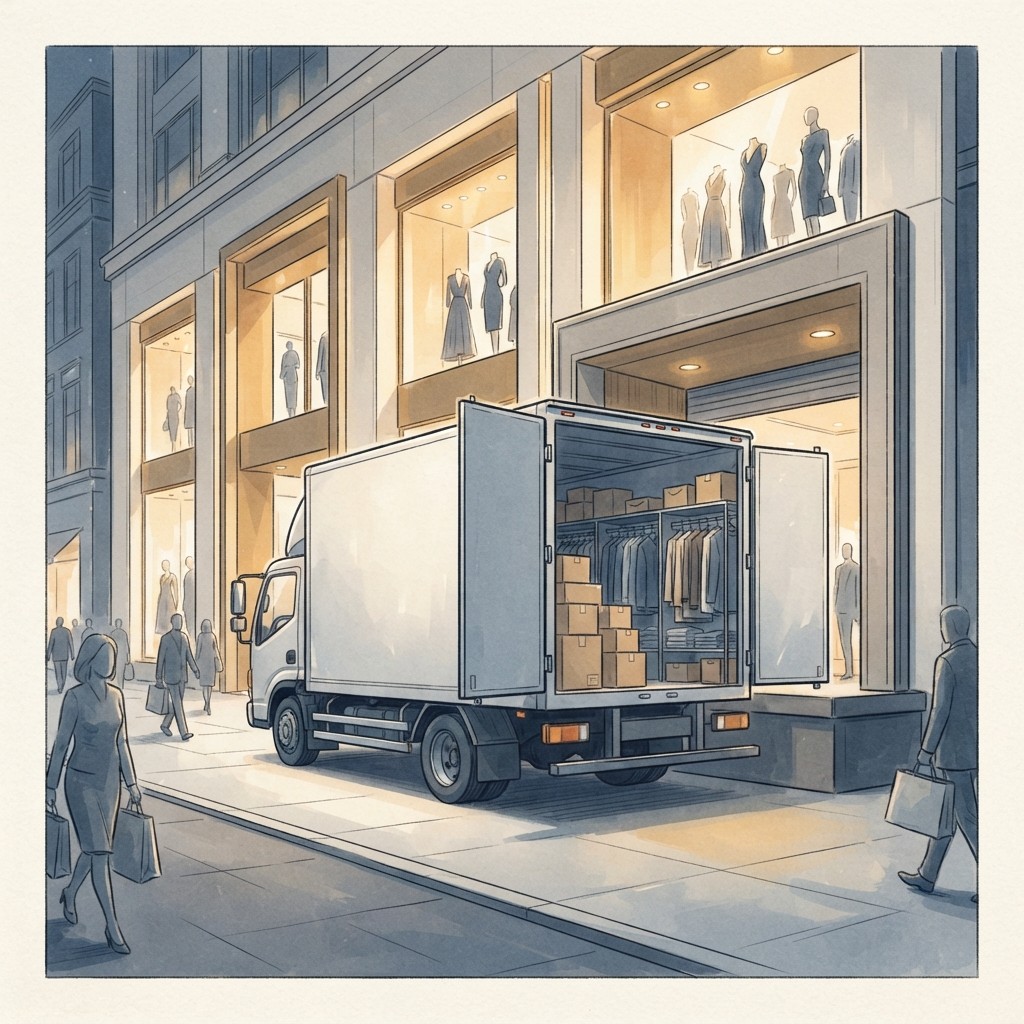
Twice a week, every week, a truck pulls up to a Zara store and unloads a small batch of clothes. Not a seasonal flood. A trickle. Some of it is new; some of it is just more of what already sold.2 That truck is the most underrated object in fashion. It is not glamorous, it does not appear in any case study's title, and it is the actual engine behind €38.6 billion in net sales and €5.9 billion in profit for the year.1 The famous part of Zara — the two-week design legend — is the part that gets the headlines. The truck is the part that gets the money.
The official story is that Zara conquered fashion by designing a garment and putting it on a shelf in two weeks. That story is mostly wrong, and the way it is wrong is the whole point. A brand-new garment takes Zara about four to five weeks, and the full design-to-retail cycle is roughly five weeks — fast, but not magic.84 The two-week number is real only for reorders and modifications of items already in stores.8 The legend credits the wrong gear. The defensible engine isn't peak speed. It's the cadence that never stops.
The loop that feeds itself
Here is the flywheel, traced one push at a time. Stores place orders twice a week, and those orders set the factory schedule rather than the other way around.7 Because over half of production sits in proximity countries — Spain, Portugal, Turkey, Morocco — Inditex can answer those signals fast, getting goods from distribution centre to store in an average of 36 hours within Europe.82 Fresh goods land, the assortment changes, and a changing assortment pulls people back into the store more often. More visits generate more real-time demand data, which sharpens the next twice-weekly order, which fills the next truck. Each turn of the wheel makes the next turn cheaper and smarter. The speed is impressive; the self-reinforcement is what compounds.
The mechanism only works because Zara owns the stores. Frequent assortment changes raise store traffic specifically when the apparel maker controls its own shops — when the same company sees the demand signal and acts on it without a wholesaler in between.6 A brand that sells through department stores cannot do this; the feedback dies at the loading dock. Zara keeps the loop inside one company, so the signal that a jacket is selling in Bilbao becomes a factory instruction within days, not a quarterly buy negotiated six months out.
| Zara | The traditional retailer | |
|---|---|---|
| Season committed 6 months ahead | 15–39% of the line | 80–90% of the line |
| Distinct items per year | ~11,000 | 2,000–4,000 |
| Inventory turns per year | ~12 | 3–4 |
| Sold at full price | ~85% | ~60% |
| Design refresh cadence | Every ~2 weeks | Every 2–3 months |
Read that table as a single bet, not five facts. By committing only 15 to 39% of a season's line in advance, versus 80 to 90% for rivals, Zara keeps most of its production capacity uncommitted — free to chase whatever is actually selling.5 That is why it can carry around 11,000 distinct items a year against a competitor's 2,000 to 4,000,7 and why those items turn about twelve times a year against three or four.7 The wheel spins faster because it was never weighed down by a six-month-old guess.
The advertising budget that became a storefront
Most retailers spend their way back into the customer's mind. Inditex spends about 0.3% of revenue on advertising, against an industry average near 3.5%.4 That is not zero — the 'Zara spends nothing on ads' line is folklore — but it is a fraction of what rivals pay. The savings don't vanish; they get redirected. The money that would buy a magazine spread buys a window on the best corner of the best shopping street, and the constantly refreshed assortment inside that window does the advertising for free. Every fresh delivery is a new ad, displayed to people already walking past, paid for once in rent rather than repeatedly in media. The store is the marketing, and the truck keeps it current.
The trap in copying Zara is treating its parts as a checklist: fast factories, frequent drops, low ad spend, owned stores. But the power is in where the money flows. The 3-plus points of revenue not spent on advertising fund the prime real estate; the prime real estate generates the traffic; the traffic generates the demand signal; the signal drives the twice-weekly order; the full-price sell-through funds the next lease. Cut any single spoke and you don't get a slower Zara — you get a different, worse company. Rivals can buy a fast factory. What they cannot buy is the closed circuit that lets one function quietly pay for another.
Isn't this just speed, and can't anyone buy speed?
The fair objection is that none of these pieces is secret. The Rapid-Fire Fulfillment model has been documented in peer-reviewed detail for two decades; the twice-weekly cadence is on Inditex's own website; the proximity-sourcing strategy is in every case study.52 So why hasn't it been cloned? Because the components are copyable and the loop is not. A competitor can build a Turkish factory and still lose, because it doesn't own the stores that generate the demand signal, or it owns the stores but commits 85% of its line six months out, or it keeps the line flexible but funds it with the same heavy ad spend that leaves no room for prime rent. The pieces have to reinforce each other in one company's books and one company's logistics. Buy one spoke and you've bought a spoke.
And the honest counter to our own thesis: the loop is not as airtight as the legend implies, and we shouldn't pretend it is. Zara does hold end-of-season sales like everyone else; it discounts less often and less deeply, not never.5 Its unsold inventory runs around 10% annually against an industry 17 to 20% — a real edge, but a difference of degree, not a different universe.5 The flywheel is defended, not invincible. What makes it durable is precisely that it is unglamorous. There is no single trick to steal. There is only a decades-old machine where the design studio, the proximity factory, the twice-weekly truck, the owned store, and the tiny ad budget have been tuned to feed each other — a system Inditex grew from 41 stores in 1985 to thousands today, one delivery at a time.41
“Stores receive small deliveries twice a week; the design-to-retail cycle is five weeks versus the industry standard of five to six months.”4
The two-week legend survives because it is a number, and a number is easy to repeat. The truth is harder to package: Zara didn't win by being faster than everyone at one thing. It won by building a loop where being fast, being local, owning the store, spending almost nothing on ads, and selling at full price all paid for each other. The speed was always the part you could see in a window. The cadence — that quiet truck, twice a week, forever — was the part that compounded into €38.6 billion.1 Copy the headline and you get a slower flywheel. Copy the loop, and you'd have to become Zara to do it.
Loops that get stronger the more they spin
Flywheel Designer Canvas
A one-page canvas for mapping a business's flywheel: the reinforcing loop, how it was started, the second-order loops it spins off, the moat it creates, and how it could spin backward. Use it to diagnose whether you have a real flywheel or a funnel drawn in a circle — and to design one of your own.
Included, filled and blank, in the The Flywheel Casebook. See the set → · Preview the blank →
Sources
Where this comes from — the filings, records, and reporting behind it.
- 1Inditex FY2024 net sales grew 7.5% to €38.6 billion; net income increased 9.0% to €5.9 billion; PBT increased 10.3% to €7.6 billion; net cash position €11.5 billion; 5,563 stores operated at year-end.
- 2Inditex distributes to all stores twice a week; from receipt of order at distribution centre to delivery at store is an average of 36 hours for European centres, up to 48 hours for Americas or Asia. 1,790 direct suppliers in 44 markets using 8,756 factories, clustered mainly in Spain, Portugal, Turkey, Morocco.
- 3Inditex Annual Consolidated Accounts for FY2023 (year ended 31 January 2024), prepared by Board of Directors 12 March 2024, covering financial position, revenue, earnings, and store network.
- 4Inditex's design-to-retail cycle is five weeks (vs. the industry standard of five to six months); the company needs only two weeks for reorders or modifications; stores receive small deliveries twice a week. Ad spend is approximately 0.3% of revenues vs. H&M's 5% and an industry average of 3.5%. Inditex stores mushroomed from 41 in 1985 to 2,717 in 2006.
- 5Zara's 'Rapid-Fire Fulfillment' supply chain (Ferdows, Lewis & Machuca 2004) compresses design-production-delivery cycle lead time within 15 days; Zara creates as many as 20 'seasons' per year vs. the traditional 2-season model; commits only 15–39% of a season's line 6 months in advance vs. 80–90% by competitors; unsold inventory ~10% annually vs. industry 17–20%.
- 6Zara's fast fashion model relies on two operational pillars: Quick Response (QR) production and dynamic assortment planning. Store offerings are updated as often as daily. These constant changes have been proven to increase store traffic. Frequent assortment changes work specifically when apparel makers control their own stores.
- 7Zara sells approximately 85% of items at full price vs. the industry average of 60%; achieves ~12 inventory turns per year vs. competitors' 3–4; carries about 11,000 distinct items per year vs. competitors' 2,000–4,000; stores place orders twice a week driving factory scheduling. Zara's distribution centre ('The Cube') is the operational hub.
- 8Zara designs new products and modifies existing items as frequently as every two weeks (for modifications); new-to-store product development takes 4–5 weeks; this shortens the product life cycle. Over 50% of production occurs in proximity countries (Spain, Portugal, Turkey, Morocco). Zara's flywheel: designs refresh every ~2 weeks on average; competitors change designs every 2–3 months.
More like this — beyond Zara (Inditex)
New Strategically analyses as they publish: the defining moves in business, checked against the record. No noise, and one click to leave.