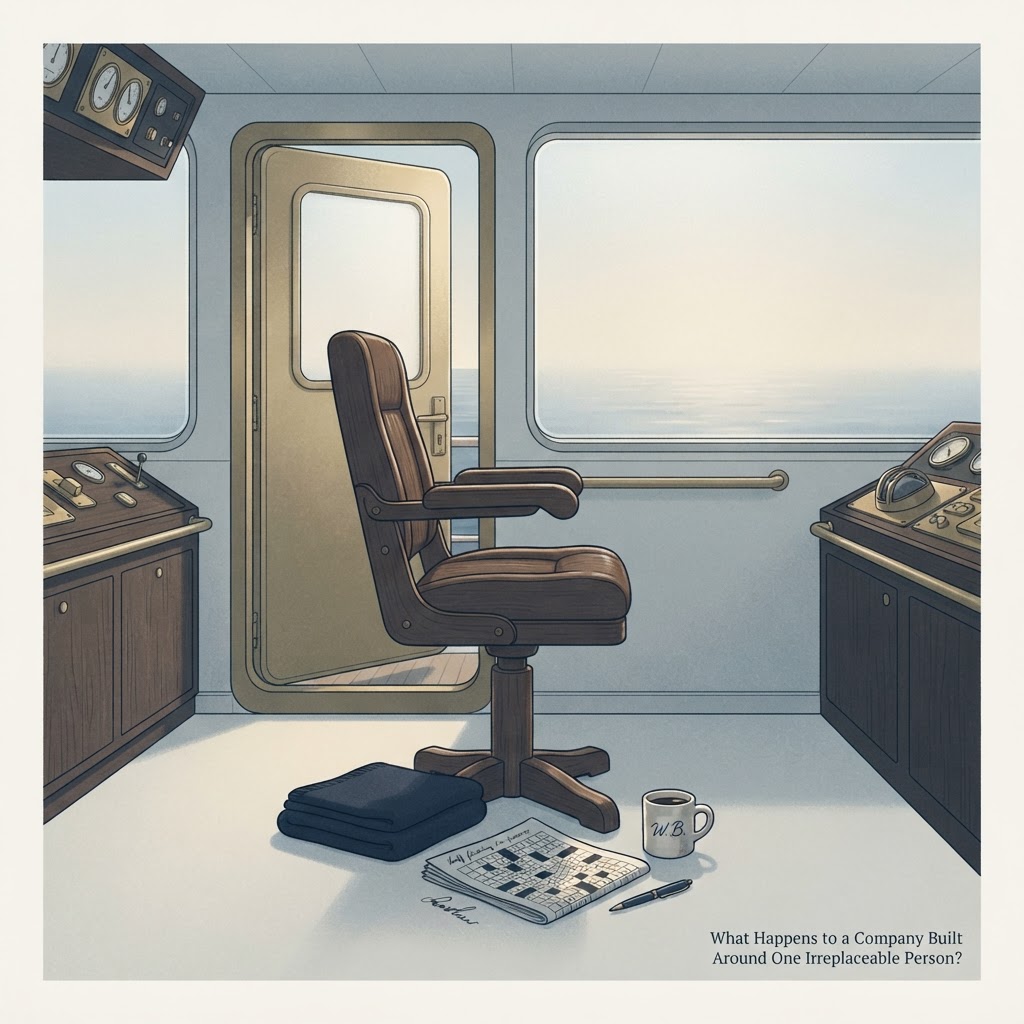
He spent sixty years building a company that was, in effect, his own mind. Then he spent decades engineering it to no longer need him.
Pairs with the Succession Readiness Scorecard — a ready-to-use strategy tool, filled for Berkshire Hathaway. Included in the The Succession Question Casebook →
For sixty years, Berkshire Hathaway and Warren Buffett were close to the same thing. He took control of a failing textile maker in the mid-1960s and turned it into one of the most valuable companies on earth, compounding shareholder wealth at a rate - roughly 19.9% a year from 1965 through 2024, against the S&P 500's ~10.4% - that made him the most celebrated investor in history.3 The company was, in a real sense, his mind expressed as a balance sheet. Which raised the question that hung over Berkshire for decades and that every founder-defined company must eventually face: what happens to a masterpiece when the master is gone? On January 1, 2026, Berkshire stopped being a hypothetical and became the live experiment, as Greg Abel took over as chief executive.1 The succession question is the hardest in business, and Berkshire is its most important test case.
Why succession is so dangerous for a founder-defined company: when the founder is the strategy, you can't put a person in escrow
The peril of succession scales with how much a company's success is attributed to one person, and few companies have ever been as identified with an individual as Berkshire was with Buffett. The danger comes in several forms at once. There's the skill problem: can anyone replicate the specific judgment - in Berkshire's case, a near-mythical talent for capital allocation and for staying disciplined when others panic - that drove the results? There's the trust problem: Buffett's reputation was itself an asset, drawing deals and shareholder loyalty that a successor cannot simply inherit. And there's the culture problem: a founder-defined company often runs on the founder's instincts rather than written systems, so when they leave, the operating system leaves with them. Most great founder-led companies stumble at the handover precisely because the founder was the strategy, and you can't put a person in escrow.
How Buffett spent decades de-risking himself: converting "the company is Warren Buffett" into "the company is a system Warren Buffett built"
What makes Berkshire instructive is that Buffett, more self-aware than most founders about his own mortality, spent decades engineering the transition rather than denying it. His central move was structural: Berkshire's famously decentralized model, in which dozens of subsidiaries run themselves with almost no interference from headquarters. This is succession insurance disguised as a management philosophy - because the operating businesses never depended on Buffett's day-to-day involvement, they don't need his replacement to provide it. He also refused to leave the identity of his successor to chance or to a post-mortem scramble: Abel was publicly named as the heir apparent in 2021, had joined Berkshire in 2000 and run its sprawling non-insurance operations as vice chairman since 2018, and was seasoned in the open for years.2 And Buffett telegraphed the actual handover deliberately, announcing in May 2025 that Abel would become CEO at year-end - giving the market, the managers, and the successor himself time to absorb it rather than face a shock.1 Each of these was a way of converting 'the company is Warren Buffett' into 'the company is a system Warren Buffett built.'
The questions the structure can't fully answer: the real test isn't the first year of reverence but the first downturn
Here the honest counter-argument matters, because de-risking is not the same as eliminating risk. Two big questions remain genuinely open. The first is the investment portfolio: the decentralized model insulates the operating companies, but allocating Berkshire's vast capital and stock holdings was Buffett's singular art, and it's far less obvious that this can be systematized or handed off cleanly - a company can teach managers to run a railroad more easily than it can teach someone to be Warren Buffett. The second is cultural discipline. Berkshire's edge included the freedom, born of Buffett's stature, to sit patiently on enormous cash and resist the pressure to 'do something,' to refuse fashionable deals and wait years for the right one. A successor without Buffett's untouchable reputation may face exactly the impatient, activist, do-something pressure Buffett was uniquely shielded from - and the real test of the succession won't be the first year, when reverence protects Abel, but the first downturn, when the market asks whether Berkshire without Buffett will still hold its nerve.
The succession question can't be solved at the moment of handover - by then it's too late. It's solved over years, by converting the founder's personal genius into durable structure: decentralize so the business doesn't need the founder daily; name and season the successor in public, long in advance; and telegraph the transition so it's an evolution, not a shock. Buffett did all three. What no structure can fully transfer is judgment and reputation - so the deeper lesson is to build a company that needs as little of the irreplaceable thing as possible, because the part of a founder that can't be inherited is exactly the part you must engineer the company to stop depending on.
Berkshire's transition is the rare case of a founder taking the succession question as seriously as the building of the company itself - treating his own indispensability as a problem to be solved rather than a compliment to be enjoyed. Whether it worked is now being decided in real time, on Greg Abel's watch. But the framework Buffett leaves behind is the answer every great founder-led company eventually needs: you cannot make yourself replaceable, but you can spend years making your company need you less - and that, not the search for a second Buffett, is what gives the masterpiece a chance to outlive the master.
The succession & control set
Succession Readiness Scorecard
A scorecard that turns 'we'll figure out succession later' into a number you can argue with. It rates the four things that decide whether a handover lands — bench strength, board alignment, knowledge transfer, and whether the incumbent can actually let go. Blank to grade your own readiness honestly; filled as the worked example diagnosing why the story's company was (or wasn't) ready when the moment came.
Included, filled and blank, in the The Succession Question Casebook. See the set → · Preview the blank →
Sources
Where this comes from — the filings, records, and reporting behind it.
- 1On May 3, 2025 Buffett announced he would recommend Greg Abel as CEO effective January 1, 2026; the board voted unanimously to appoint Abel on May 4, 2025. Buffett remained Chairman; Abel became CEO on January 1, 2026.
- 2Abel (b. ~1962) joined Berkshire in 2000, became vice chairman of non-insurance operations in 2018, and was publicly named Buffett's successor in 2021. Charlie Munger died in 2023. Howard Buffett is slated to become non-executive board chair.
- 3From 1965 through 2024, Berkshire delivered a compounded annual gain of 19.9% in per-share market value, nearly double the S&P 500's 10.4% (dividends included), per its 2024 annual report. (The 1964 base year applies only to the separate overall-gain line.) Its decentralized structure leaves operating managers highly autonomous.
More like this — beyond Berkshire Hathaway
New Strategically analyses as they publish: the defining moves in business, checked against the record. No noise, and one click to leave.