Pairs with the Vertical-Integration Assessment — a ready-to-use strategy tool, filled for Intel. Included in the The Vertical Integration Casebook →
In March 2021, a new CEO stood up and told the world that Intel would do the one thing the modern chip industry had spent two decades convincing everyone was foolish: it would design chips, manufacture chips, and — the new part — build factories to manufacture other companies' chips, all under one roof. He called it IDM 2.0, pledged an estimated $20 billion for two new fabs in Arizona, and spun up a fresh business unit, Intel Foundry Services, to court the customers it had spent thirty years competing against.1 Three and a half years later, the foundry had lost $13 billion in a single year5, the board had pushed the CEO out the door8, and the headline government check had quietly shrunk. The plan was sold as a trillion-dollar comeback. The receipts tell a smaller, stranger story.
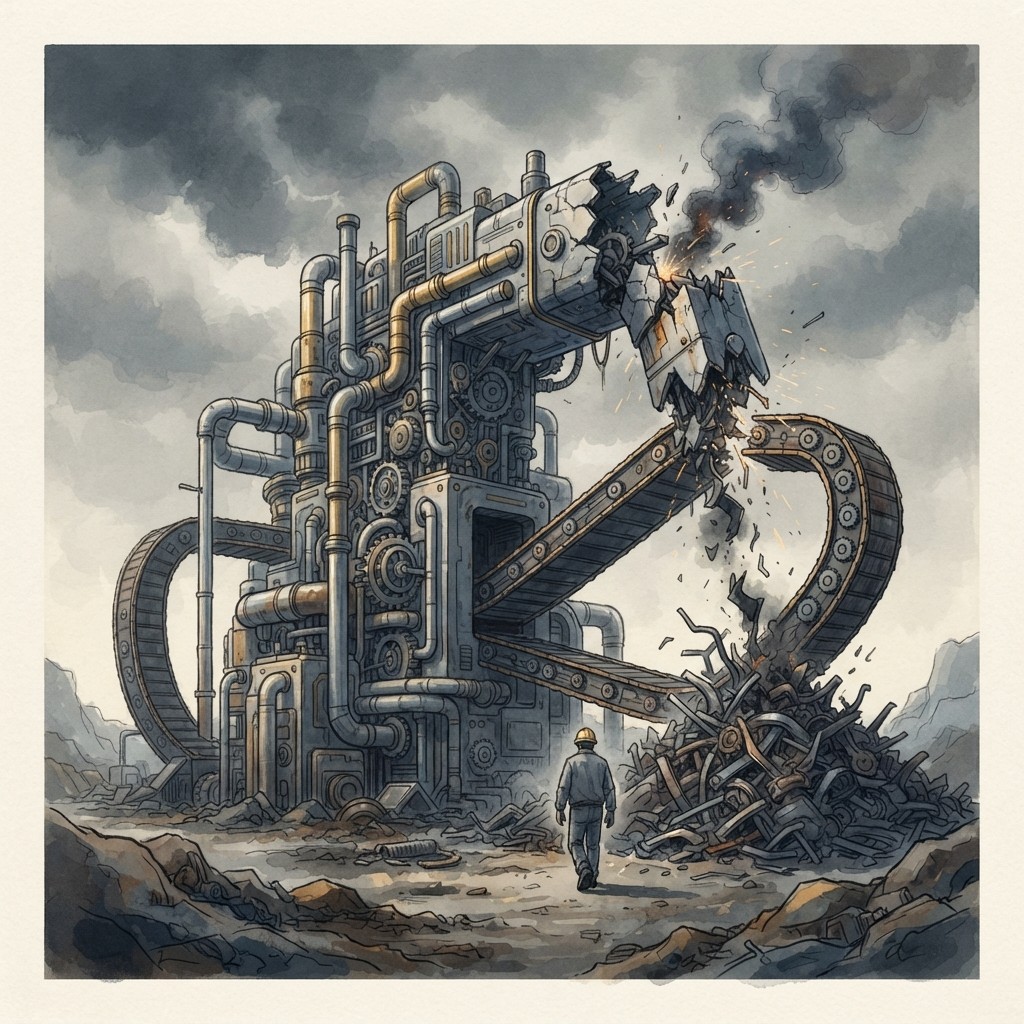
The official narrative is that IDM 2.0 is a bold, patriotic bet to reclaim manufacturing leadership and bring chipmaking home. The truer reading is that it is a capital-intensive identity crisis — a company spending roughly $95 billion to become its own largest customer while hoping strangers would show up too, and discovering that the strangers, and the math, were both in short supply.
The bet was to own everything — and the cost of owning everything is everything
Vertical integration is seductive because it promises control. Design and fab under one roof means the chip team and the factory team optimize together, the way Intel did when it ruled the 1990s. But the model only pays when you fill the factories. A leading-edge fab costs a fortune whether it runs at 100% utilization or 40%, so the entire economic case for a foundry rests on one variable: volume from people who are not you. That is why TSMC wins — it manufactures for everyone and bears almost none of the design risk. IDM 2.0 asked Intel to be TSMC and Intel at the same time, funding fabs sized for an external customer base it did not yet have, using its own product roadmap as the anchor tenant. The capex came first; the tenants were supposed to follow.
The capex came, all right. Intel spent $20.3 billion in 2021, $24.8 billion in 2022, $25.75 billion in 2023, and $23.9 billion in 2024 — roughly $95 billion across the four build-out years.3 To soften the blow to its own balance sheet, Intel invented financial engineering: in August 2022 it brought in Brookfield Asset Management to co-invest up to $30 billion in the Ocotillo campus in Arizona, with Intel funding 51% and Brookfield 49% under a program it branded 'Smart Capital.'2 Read that twice. The same Arizona campus that was announced at 'approximately $20 billion' in 2021 was, eighteen months later, a 'up to $30 billion' project — and Intel was now splitting the bill with an asset manager because it could not, or would not, carry the full weight alone. The number grew in the retelling. The strategy was already straining under its own ambition.
| As announced | What followed | |
|---|---|---|
| Arizona Ocotillo campus | ~$20B for two fabs (Mar 2021) | Up to $30B with Brookfield, Intel funding 51% (Aug 2022) |
| CHIPS Act direct funding | Up to $8.5B preliminary (Mar 2024) | $7.865B finalized (Nov 2024) |
| Foundry economics | Path to leadership | ~$7B operating loss (2023), $13B (2024) |
| The CEO | Author of the turnaround | Pushed out, Dec 2024 |
The $13 billion loss is real — and it's not the loss most people think it is
Here is the part that gets reported wrong constantly. When Intel introduced its new internal foundry operating model in April 2024, it disclosed that Intel Foundry had 2023 revenue of $18.9 billion and an operating loss of roughly $7 billion, sitting atop approximately $100 billion in capital assets.4 The next year was worse: a $13 billion operating loss in 2024, the first fully reported year under the new segment structure.5 Most coverage treats those losses as the cost of chasing outside foundry customers. They are not — or not mostly. That number includes the cost of manufacturing Intel's own products. The accounting change forced Intel to charge its product divisions for the fabs they use, and suddenly the manufacturing arm had to look profitable on its own merits, the way an external foundry must. It couldn't. The loss exposes a structural truth the integrated model had been hiding for years: Intel's factories were never as cheap to run, relative to revenue, as the world assumed, because the product side had always quietly absorbed their inefficiency.
That distinction matters enormously, because it reframes IDM 2.0 from a growth story into a confession. Splitting the foundry out as its own reporting segment was meant to instill discipline and attract outside customers who needed to trust that Intel's fab arm could stand alone. Instead, the spotlight revealed a manufacturing operation losing money at staggering scale while carrying $100 billion of assets it had to keep filling.4 You cannot ask a prospective customer to trust their next-generation chip to a factory that is bleeding $13 billion a year — and you certainly cannot do it while your own design teams, the captive demand the whole thing depends on, are themselves losing share.
When the headline check shrank, so did the story
The political theater peaked in March 2024, when President Biden flew to the Ocotillo campus in Arizona to announce 'up to $8.5 billion in direct funding along with $11 billion in loans' for Intel under the CHIPS and Science Act.7 That $8.5 billion figure became the number everyone repeated. It was also non-binding — a preliminary memorandum of terms, explicitly subject to change. By the time the U.S. Department of Commerce finalized the legally binding award on November 26, 2024, the direct funding had been cut to $7.865 billion, partly because Congress required some of the money go to a separate $3 billion Secure Enclave program.6 Roughly $635 million evaporated between the photo op and the signature. The gap is small against $95 billion of capex — but it is a tell. The most-quoted proof point of Intel's foundry future was a number announced for the cameras and then trimmed in the fine print.
“Up to $8.5 billion in direct funding along with $11 billion in loans.”7
The endgame arrived on December 1, 2024. Gelsinger stepped down — framed publicly as a retirement, the gentle word for what was reported as a board that had run out of patience and handed him the choice to leave or be removed.8 He chose to leave. David Zinsner and Michelle Johnston Holthaus took over as interim co-CEOs.8 The man who authored the most expensive industrial bet in Intel's history was gone before its central question — would anyone other than Intel fill the factories — had an answer. The architect was fired with the building half-built.
But maybe a national champion has to look like this
The fair objection is that this is too tidy a verdict on a bet that needs a decade to judge. Leading-edge fabs take years to build and years more to fill; TSMC and Samsung were not built in four-year windows either. The losses, on this view, are the upfront cost of an asset that only pays once it scales, and Intel's own target is foundry break-even by the end of 20275 — three years after the worst figures. There is real force here. A fab is the most patient capital in industry; reading its first three years as a verdict is like judging a tunnel by the dirt you dig in year one. And the strategic logic is sound at the country level: a world with a single dominant leading-edge foundry on a contested island is a fragile world, and the United States genuinely needs a second source. The $7.865 billion of public money exists precisely because the bet is too important to be left to quarterly logic.6
All true — and all beside the point of the critique. The problem with IDM 2.0 was never that it was patient. It was that it was incoherent about who it was for. A national-champion foundry can absorb a decade of losses if the demand is real and growing. Intel's foundry had to lean on captive demand from product divisions that were themselves losing ground, court external customers while showing them a $13 billion hole, and finance the whole thing with co-investors and a government check it had to trim. The timeline can be patient. The strategy still has to make sense. Naming the foundry a separate segment was supposed to force that clarity — and the clarity it produced was a number nobody wanted to see.
Vertical integration sells itself as control — own the factory, own your destiny. But a fab, like any heavy asset, controls nothing if you can't fill it. The economics live entirely on the demand side: utilization, not ownership, is the variable that decides whether integration is a moat or an anchor. Before you spend $95 billion building capacity, prove the demand isn't just you. Captive demand from your own products feels like a guarantee; it's actually the thing that lets a money-losing factory hide inside a profitable company until an accounting change drags it into the light. The most dangerous integration is the one where you're your own biggest customer — because then you can't tell whether the business works, or whether you're just buying from yourself.
Intel set out to own the whole stack and ended up owning the whole risk. The $95 billion bought real factories, real silicon, and a genuinely important hedge against a world that makes its most advanced chips in one fragile place.3 What it could not buy was the one thing a foundry actually runs on: customers who aren't you. The trillion-dollar framing was always borrowed grandeur — Intel's own ambition was around $100 billion4, and even the headline government check came in light. The real lesson of IDM 2.0 is quieter and harder. You can integrate everything you touch. You cannot integrate the demand. And a factory that only its owner can fill isn't a foundry — it's a very expensive way to find out you were always buying from yourself.
When a company bets the building on owning more
Vertical-Integration Assessment
A make-vs-buy assessment for a single stage of the value chain: rate the forces that argue for owning it and the forces that argue for renting it, then read the verdict off the gap. Blank to run on a stage you're deciding now; filled as the worked example showing why the story's company pulled a stage in-house — or pushed it out.
Included, filled and blank, in the The Vertical Integration Casebook. See the set → · Preview the blank →
Sources
Where this comes from — the filings, records, and reporting behind it.
- 1On March 23, 2021, Intel CEO Pat Gelsinger announced IDM 2.0 — a major evolution of Intel's integrated device manufacturing model — including an estimated $20 billion investment for two new fabs in Arizona and the creation of Intel Foundry Services (IFS) as a standalone business unit led by Dr. Randhir Thakur.
- 2In August 2022, Intel and Brookfield Asset Management announced a co-investment agreement to jointly invest up to $30 billion in Intel's manufacturing expansion at its Ocotillo campus in Chandler, Arizona, with Intel funding 51% and Brookfield 49% under Intel's 'Smart Capital' / SCIP program.
- 3Intel's capital expenditures were $20.3B (2021), $24.8B (2022), $25.75B (2023), and $23.9B (2024) — totaling roughly $95 billion across the four IDM 2.0 build-out years.
- 4Under the new internal foundry operating model first reported in April 2024, Intel Foundry's 2023 revenue was $18.9 billion (down 31% from $27.5B in 2022) and its operating loss was approximately $6.95 billion ($7B rounded). Intel also disclosed the foundry held approximately $100 billion in capital assets.
- 5Intel Foundry lost $13 billion in operating income in 2024, its first fully reported year under the new segment structure; the company targets foundry break-even by end of 2027.
- 6On November 26, 2024, the U.S. Department of Commerce finalized Intel's CHIPS and Science Act award at $7.865 billion in direct funding (reduced from the March 2024 preliminary figure of up to $8.5 billion, partly due to a congressional requirement to use CHIPS funding for a $3 billion Secure Enclave program) for fab and R&D projects in Arizona, New Mexico, Ohio, and Oregon.
- 7The preliminary CHIPS Act memorandum of terms announced March 20, 2024 cited 'up to $8.5 billion in direct funding along with $11 billion in loans'; President Biden traveled to Intel's Arizona Ocotillo campus to announce it. The preliminary MoT was described as non-binding and subject to change.
- 8Pat Gelsinger resigned on December 1, 2024 after the Intel board lost confidence in his turnaround plan; the board gave him the choice to retire or be removed and he chose to step down. David Zinsner and Michelle Johnston Holthaus were named interim co-CEOs.
More like this — beyond Intel
New Strategically analyses as they publish: the defining moves in business, checked against the record. No noise, and one click to leave.