Pairs with the Asset-Light vs Asset-Heavy Comparator — a ready-to-use strategy tool, filled for Mars. Included in the The Diversifier Casebook →
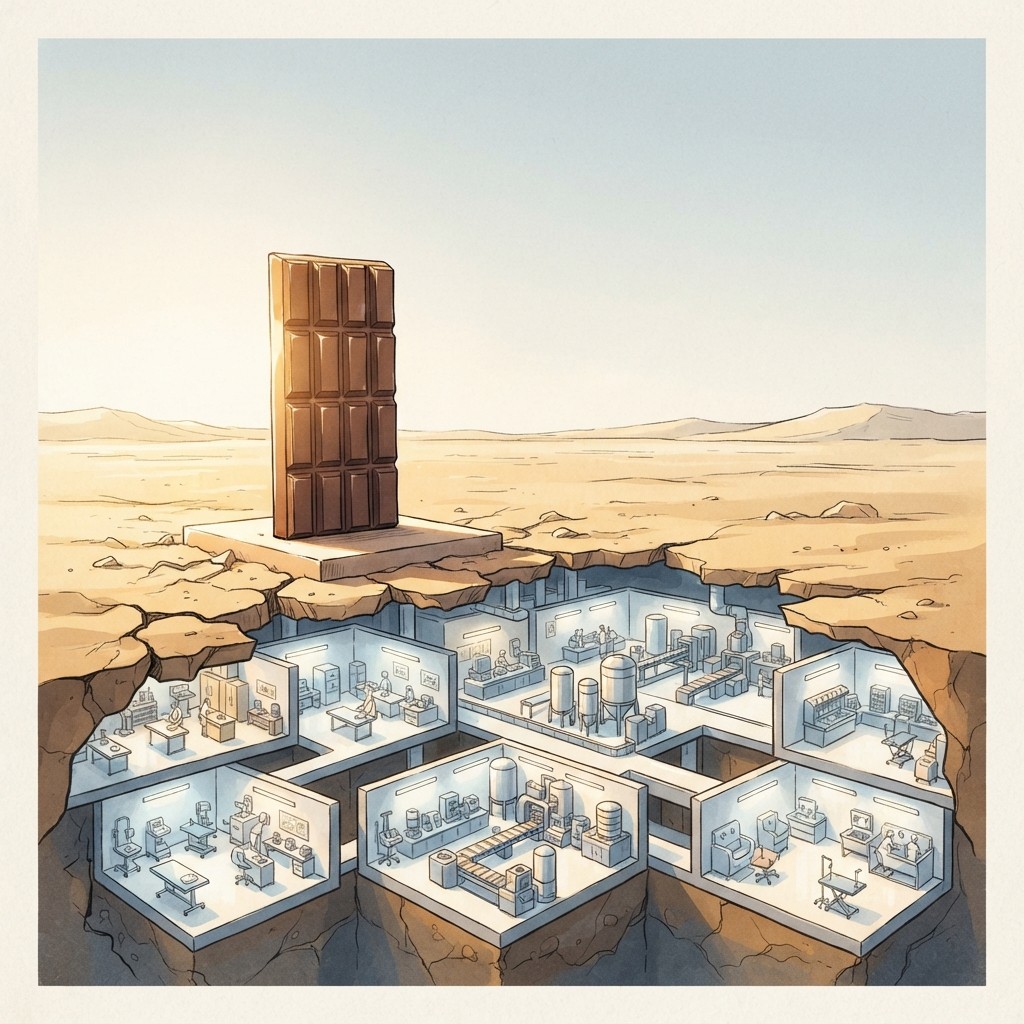
In 1935, while it was still building the chocolate bar empire most people associate with its name, a privately held confectioner bought a small British canner of dog food called Chappell Brothers - maker of a tinned product called Chappie.6 It was an odd purchase for a candy company. Nine decades later it is the reason Mars exists at the scale it does. Pet care now accounts for roughly 59% of the company's revenue - about $29.5 billion of more than $50 billion8 - which means the most famous chocolate maker in the world is, by the only measure that counts, a pet-care company that happens to sell candy.
The story usually told about Mars is one of bold, reactive deal-making: a daring $23 billion grab for Wrigley in the teeth of the 2008 crisis, a late pivot into pet hospitals. Nearly every beat of that telling is wrong. The Wrigley deal was struck before the crisis. The pet-care 'pivot' is older than the Mars bar's grandparents. And the real arc is far less dramatic and far more instructive: patient, sequential category-building, made possible by an ownership structure that never has to explain itself to a public market.
The Wrigley deal was not a crisis bet - the calendar says so
Here is the part the legend gets backwards. Mars announced its agreement to acquire Wm. Wrigley Jr. Company on April 28, 2008, at $80 cash per share - a 28% premium to Wrigley's pre-announcement price of $62.45, and 4.3 times Wrigley's 2007 net sales.13 Wrigley's stockholders approved it on September 25, 2008.2 Lehman Brothers collapsed on September 15. So the agreement was signed five months before the panic, and approved by shareholders ten days after it - this was a deal being executed through the crisis, not because of it. The closing on October 6 is the only piece that lands after the crash, and a closing is paperwork, not a decision.2 You cannot opportunistically pounce on distressed assets in April for collapses that arrive in September.
The Berkshire Hathaway detail is misremembered the same way. Warren Buffett did not become a co-owner of Mars. Berkshire provided a $4.4 billion subordinated loan and a $2.1 billion minority equity investment in the newly created Wrigley subsidiary - financing structure, ring-fenced to the gum business, not a partnership in Mars itself.1 Mars stayed exactly what it has always been: private, unlisted, and answerable to a family rather than a market. That fact is not a footnote. It is the whole mechanism.
“$80.00 per share in cash... in a transaction valued at approximately $23 billion.”1
Why a private company can build categories one decade at a time
A public company that bought a dog-food canner in 1935 and didn't reach the US pet market until 1968 would have been torn apart by analysts. Thirty-three years between the UK entry and the American expansion via Kal Kan; another twenty after that before the US product even wore the Pedigree name, in 1988.67 That timeline only survives inside a company that never had to defend a quarter. Mars's permanent private ownership is what let it treat pet care not as a bet that had to pay off on a schedule, but as a habit it could compound for the length of a human lifetime.
And it kept compounding into the most capital-intensive corner of the category: not just feeding pets but treating them. In January 2017 Mars agreed to buy VCA Inc. - the largest US chain of animal hospitals - for $93 a share, roughly $9.1 billion including debt.4 The deal closed that September, after the FTC required Mars to divest twelve hospitals from a combined network of more than 1,900 US locations.5 A candy company that needs antitrust clearance to own enough veterinary clinics is no longer, in any meaningful sense, a candy company. It is a pet-care platform that started with chocolate cash flow and never stopped feeding the other end.
| The legend | What actually happened | |
|---|---|---|
| Wrigley deal | A 2008-crisis power grab | Agreement signed April 28, 2008 - before Lehman |
| Buffett's role | Co-investor in Mars | Loan + minority equity in the Wrigley subsidiary only |
| Pet care | A recent pivot | Began in 1935; deepened with VCA in 2017 |
| What Mars is | A candy company | ~59% of revenue is pet care |
Isn't this just a conglomerate getting lucky with timing?
The fair objection is that hindsight flatters Mars. Maybe the 1935 dog-food buy was a small, near-random diversification that happened to land in a category that grew enormous as pets became family members - and the patient-genius framing is just survivorship bias painted on an accident. There is real force here. Mars did not foresee in 1935 that pet humanization would make veterinary care a premium consumer business worth platform-scale capital. Nobody did. The 1988 US rebrand and the 33-year gap to Kal Kan look less like a master plan than like a company that simply never sold the asset.
But that is exactly the point, and it is the part the steelman quietly concedes. The skill on display is not prophecy - it is the refusal to exit. A public owner facing two decades of underwhelming pet-care returns would have spun it off to juice the chocolate multiple, and would have done so years before pet humanization made the category extraordinary. Mars's edge was never knowing which adjacency would win. It was being structured so it never had to prove that any of them would, and so it still held every chip when one finally paid. Patience isn't a forecast. It is the ability to hold a hand long enough for the cards to turn.
Sequential category-building - buy a small adjacency, hold it for a generation, deepen it when the market finally rewards it - looks obvious in a timeline and is nearly impossible in practice, because the years of mediocre returns in the middle are exactly when public markets force a divestiture. Mars's real moat isn't chocolate or kibble or clinics. It's an ownership structure that converts time into an asset other companies can't access: it can wait out a 33-year gap, ride a deal through a financial crisis, and treat a 1935 dog-food can as a 2023 platform. The lesson for an operator isn't 'diversify' - everyone diversifies. It's that the value of patience is only redeemable by whoever cannot be made to lose their nerve.
Strip away the legend - the crisis bet, the Buffett partnership, the late pet-care pivot - and what remains is stranger and better than the myth. A family company put $80 a share on a gum business while the world was about to end, and held a dog-food can for ninety years until it grew larger than the chocolate that paid for it. Mars didn't out-predict anyone. It out-waited them. The candy was always the cover story; the patience was the product.
When the real business hides behind the famous one
Asset-Light vs Asset-Heavy Comparator
A side-by-side matrix that pits owning the assets against renting or orchestrating them, dimension by dimension. Blank to weigh your own model choice; filled as the worked example showing why the story's company went capital-light — or planted its money in concrete and steel.
Included, filled and blank, in the The Diversifier Casebook. See the set → · Preview the blank →
Sources
Where this comes from — the filings, records, and reporting behind it.
- 1Mars, Incorporated agreed to acquire Wm. Wrigley Jr. Company at $80 cash per share in a transaction valued at approximately $23 billion, announced April 28, 2008, with Berkshire Hathaway providing a $4.4 billion subordinated loan and $2.1 billion minority equity investment in the Wrigley subsidiary.
- 2Wrigley stockholders approved the Mars merger on September 25, 2008, and the merger was completed on October 6, 2008 — Wrigley delisted from NYSE that day.
- 3The Wrigley deal price represented a 28% premium to the April 25, 2008 closing share price of $62.45, and 4.3x Wrigley's 2007 net sales.
- 4Mars, Incorporated agreed to acquire VCA Inc. for $93 per share in an all-cash transaction valued at approximately $9.1 billion (including $1.4 billion in outstanding debt), announced January 9, 2017 and completed September 12, 2017.
- 5Mars completed the VCA acquisition on September 12, 2017; the FTC cleared it on August 30, 2017 after Mars agreed to divest 12 specialty or emergency animal hospitals from the combined total of over 1,900 U.S. locations.
- 6Mars entered pet care in 1935 (some sources say 1934) by acquiring UK-based Chappell Brothers Ltd., maker of Chappie canned dog food; the entity was renamed Pedigree Petfoods in 1957. Mars expanded to the US by acquiring Kal Kan Foods of Los Angeles in 1968.
- 7Wikipedia's Pedigree Petfoods article dates the Chappell Brothers acquisition to 1934 (not 1935), and dates the US Kal Kan acquisition to 1968; the US dog food was rebranded from Kal Kan to Pedigree only in 1988.
- 8As of 2023, Mars generated over $50 billion in revenue, with approximately 59% from its Petcare segment (~$29.5 billion), 38% from Snacking, and ~3% from Food & Nutrition; Mars stated approximately $55 billion in annual net sales for 2024.
More like this — beyond Mars
New Strategically analyses as they publish: the defining moves in business, checked against the record. No noise, and one click to leave.