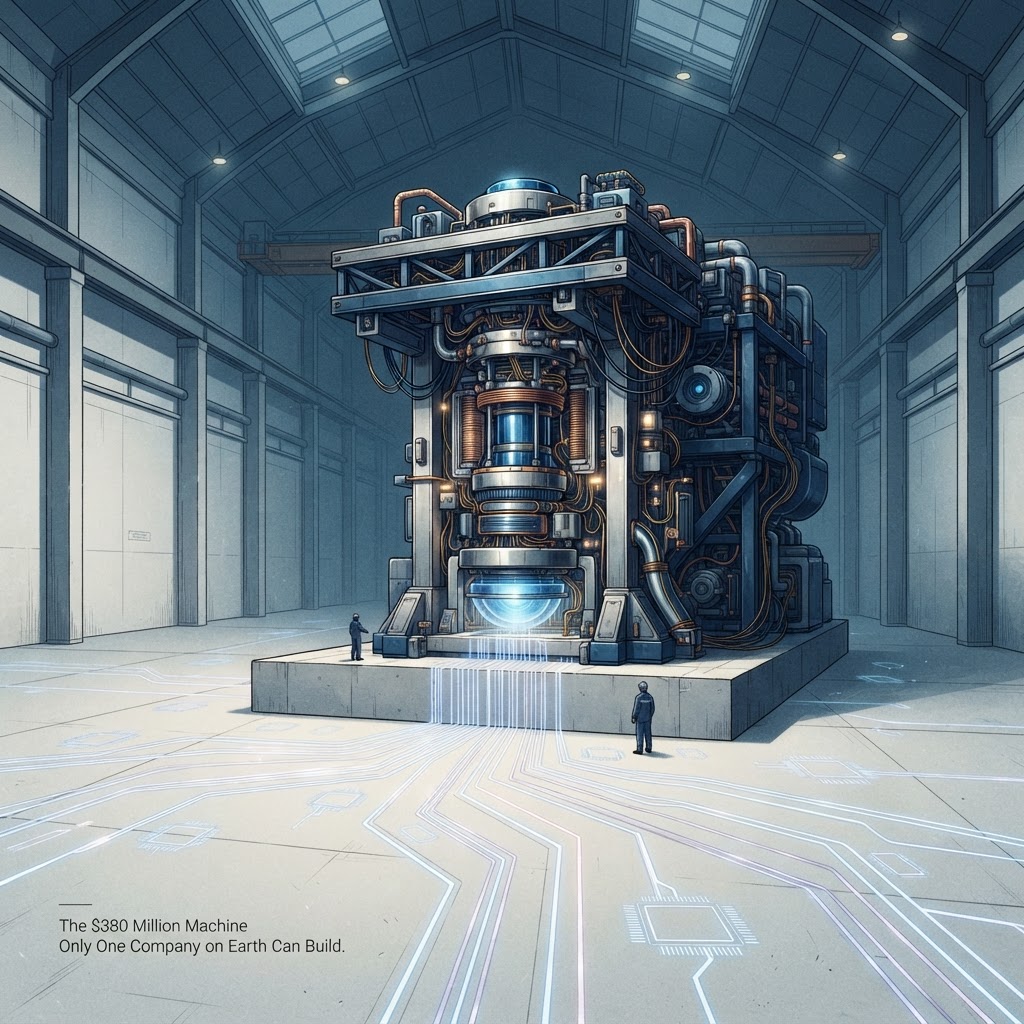
One Dutch company makes a machine no rival can build, no fortune can copy, and no shortcut can shorten. The mystery isn't its monopoly - it's why two decades of money still can't break it.
Pairs with the Moat Anatomy Canvas — a ready-to-use strategy tool, filled for ASML. Included in the Moat Anatomy Casebook →
Somewhere right now, the most advanced computer chip you will ever use is being printed by a machine that only one company on the planet knows how to build. It is the size of a bus, weighs as much as a couple of fully loaded trucks, and costs more than most office towers. It is made by ASML, a Dutch company most people have never heard of, in a town most people can't find on a map - and without it, the AI boom, the modern smartphone, and the leading edge of computing simply stop. ASML is the sole maker of EUV lithography machines, the tools required to etch the finest features onto silicon.1 That is about as pure a monopoly as exists in the global economy. The interesting question isn't that ASML has a monopoly. It's why no one can break it - and the answer is a near-perfect anatomy of a moat.
The first layer: a head start measured in decades: the climb wasn't just made - it was abandoned by everyone else who tried
Most moats are described as a single thing - a patent, a brand, a network. ASML's is better understood as a stack of layers, each of which would be hard to overcome and which together are effectively insurmountable. The base layer is time. EUV took more than two decades and many billions of dollars of research to make work at all - bending 13.5-nanometer light, generating it by blasting droplets of molten tin with a laser, and bouncing it off mirrors polished to near-atomic smoothness. Two of ASML's rivals, Nikon and Canon, looked at that mountain and walked away from EUV entirely.1 That's the first thing to understand about this moat: it wasn't only built, it was abandoned by the competition, which means a new entrant wouldn't be racing peers - it would be starting a twenty-year climb alone, against a company already at the summit and still climbing.
The second layer: a supply chain no one else can buy from: where the moat turns uncopyable, because the key suppliers are already spoken for
The deeper and less obvious layer is the supply chain - and this is where ASML's moat becomes genuinely uncopyable. ASML does not make most of an EUV machine itself; a large majority of the roughly 100,000 components come from outside suppliers, and ASML's true genius is integrating them.4 But it has spent years making sure those suppliers are exclusive to it. The optics - the most precise mirrors ever manufactured - come from Carl Zeiss, and ASML didn't just buy from Zeiss; in 2016 it took a 24.9% stake in Zeiss's semiconductor unit for €1 billion and funded its R&D specifically to develop the next-generation High-NA optics.3 The light source came from Cymer, which ASML acquired outright in 2012 to control it. CEO Peter Wennink captured the resulting interdependence memorably, saying the supplier relationships were 'worse than being married because you cannot divorce.'5 A would-be competitor doesn't just need to invent EUV. It needs a Zeiss and a Cymer of its own - and the real ones are already spoken for.
| Layer | What it is | Can a competitor copy it? |
|---|---|---|
| Time & R&D | 20+ years, billions invested in EUV | Not quickly - it's a two-decade climb |
| Exclusive suppliers | Zeiss optics, Cymer light source - locked up | No - the key suppliers are taken or owned |
| Integration know-how | Assembling ~100,000 parts into a working machine | No - it's tacit, learned, not documented |
| Customer entanglement | TSMC, Samsung, Intel depend entirely on ASML | No - switching means there's nowhere to switch |
| Abandoned competition | Nikon and Canon quit EUV | There are no peers left to partner with |
The third layer: knowledge that can't be written down: the part a rival with infinite money still couldn't purchase
The subtlest layer is the one a rival with infinite money still couldn't buy: tacit knowledge. Integrating 100,000 components from hundreds of suppliers into a machine that prints features a few atoms wide, reliably, in high volume, is not a thing you can learn from a manual - because the manual doesn't exist. It lives in the accumulated, hands-on experience of thousands of ASML engineers and their suppliers, built up over decades of solving problems no one had solved before. This is why 'just throw money at it' fails as a strategy against ASML. You can fund a competing program; you cannot fund your way to twenty years of having already made, and fixed, every mistake. The moat isn't only what ASML knows. It's the time it would take anyone else to know it - by which point ASML has moved further ahead.
Patents expire and brands fade, but the strongest moats are built from things that resist being bought: accumulated tacit knowledge, exclusive control of scarce inputs, and a head start so long that catching up means a rival must out-invest you for decades while you keep moving. When you assess a moat, don't ask 'what protects them today?' Ask 'what would it take to replicate this from scratch, and how far ahead will they be by the time you finish?' For ASML, the honest answer is: longer than anyone is willing to try.
The one vulnerability money can't fix either: the crack isn't competitive - it's the fault line that comes with being indispensable
The honest counter-point is that ASML's near-perfect moat has one crack, and it's not competitive - it's political. A monopoly this absolute on a technology this strategic makes ASML a chokepoint in the U.S.-China contest over advanced chips, and its EUV machines have been kept out of China by export controls. The same dependence that gives ASML its power makes it a lever others want to pull: governments can constrain who it sells to, and any future restriction or retaliation lands directly on a single company with no substitute. That's the irony of the deepest moats - when you become truly indispensable, you stop being merely a business and become infrastructure, and infrastructure attracts the attention of states. ASML has built a fortress no competitor can storm. The risk it can't engineer away is that its fortress sits on a geopolitical fault line.
Moat Anatomy Canvas
A one-page canvas that dissects a moat instead of asserting it: where the advantage comes from, how much of the market it covers, how long it would take to copy, and what keeps it from eroding. Blank to dissect your own claimed edge; filled as the worked example tracing the structure of the story's defensible advantage. Use it to tell a real moat from a head start.
Included, filled and blank, in the Moat Anatomy Casebook. See the set → · Preview the blank →
Sources
Where this comes from — the filings, records, and reporting behind it.
- 1ASML is the only company in the world that manufactures EUV lithography machines; rivals Nikon and Canon exited EUV development, leaving ASML in a monopoly position for the tools needed to make the most advanced chips.
- 2Next-generation High-NA EUV machines are reported to cost about $380 million each; standard (Low-NA) EUV systems sell for roughly €180 million.
- 3ASML acquired a 24.9% stake in Carl Zeiss SMT for EUR 1 billion in 2016 and committed to support its R&D/capex, to develop the High-NA optical system for next-generation EUV.
- 4ASML acts mainly as a system integrator: it makes only ~15% of an EUV machine's components in-house and sources the other ~85% from external suppliers, integrating around 100,000 parts per machine. It acquired its EUV light-source maker Cymer in a deal announced Oct 17, 2012 (EUR 1.95B / ~$2.5B), which closed May 30, 2013.
- 5ASML CEO Peter Wennink described the supplier-customer interdependence as 'worse than being married because you cannot divorce.'CNBC, Inside ASML (Wennink interview) ↗ · 2022-03
More like this — beyond ASML
New Strategically analyses as they publish: the defining moves in business, checked against the record. No noise, and one click to leave.