Pairs with the Pricing Power Diagnostic — a ready-to-use strategy tool. Included in the The Pricing Play Casebook →
In 1975, in a shop in central A Coruña, two founders named Amancio Ortega and Rosalía Mera set the price of a coat by asking a single, almost heretical question: not 'what did this cost us to make?' but 'what does the shopper down the street pay for the look she wants?'34 Fifty years later that question has scaled into one of the most profitable garment-making machines on earth. The clothes still chase the trend. The price still chases the customer. What changed is which customer Zara decided to chase.
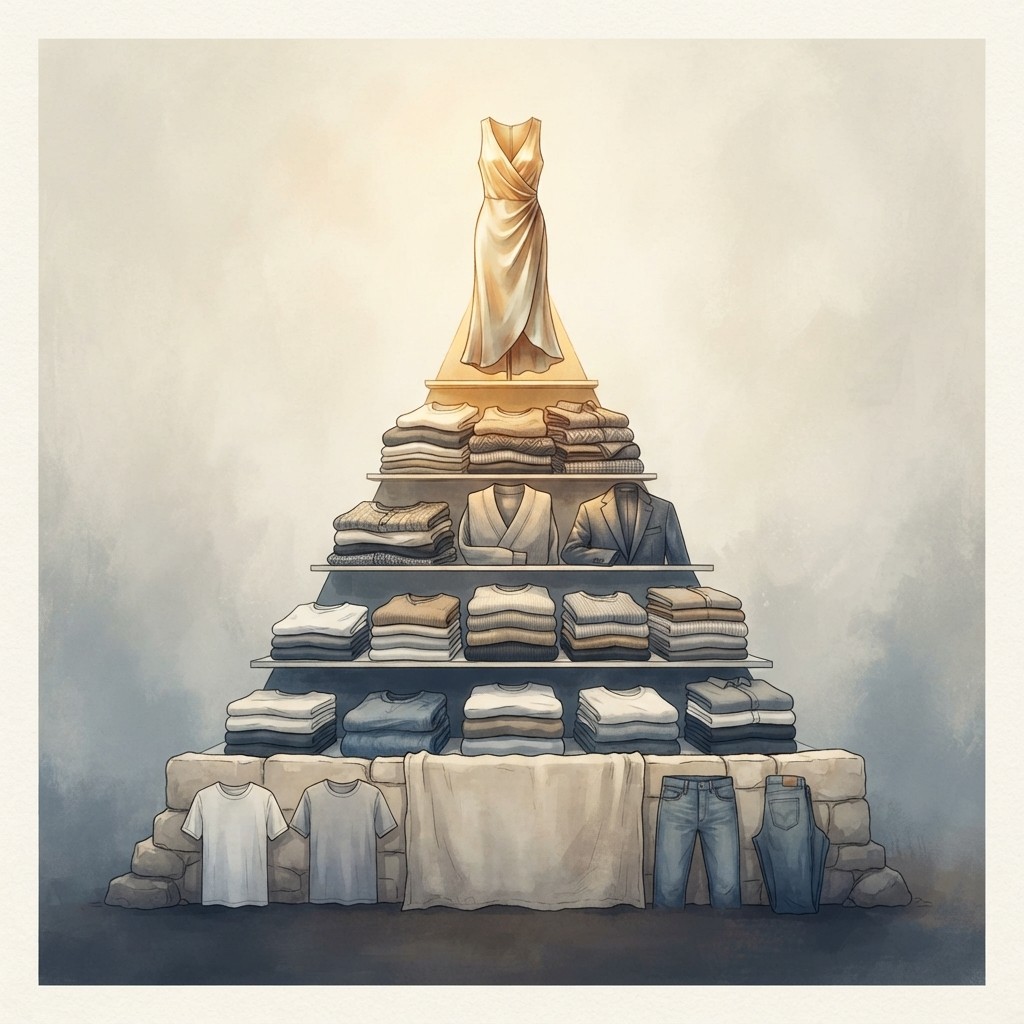
The story you'll hear is that Zara is premiumizing - graduating from cheap-and-cheerful to a more upscale label, the way brands do as they mature. That framing is too soft. This isn't a brand growing up. It's a company climbing a pricing pyramid on purpose, lifting the floor under every price tag and refusing to lower it again - because its entire profit model now depends on staying up there.
Here is the thesis a smart friend could repeat: Zara's pricing evolution isn't premiumization, it's margin discipline. Inflation gave Inditex cover to raise prices; gross-margin math gave it the reason never to take them back.
The price was never about the cost
Most retailers price from the inside out: tally the cost of cloth and labor and shipping, add a markup, print the tag. Zara has always done the reverse. From the founding, it set prices not according to costs but to the target price point it wanted to compete with - it picked the slot on the shelf first and engineered the garment to fit the slot.4 That sounds like a footnote. It's the whole engine. Because if your price is anchored to what the customer will pay rather than to what you spent, then every euro you can shave off the cost side, or add to the perceived-value side, flows straight to margin. Inditex's gross margin has sat above 57% consistently across recent years — 57.1% in FY2021, 57% in FY2022, 57.8% in FY2023, and 57.8% again in FY2024.961 You don't get there with a thin markup. You get there by deciding, item by item, exactly how much value the shopper believes she's holding. You don't get there with a thin markup. You get there by deciding, item by item, exactly how much value the shopper believes she's holding.
| Cost-plus pricing | Zara's demand-anchored pricing | |
|---|---|---|
| Starts from | What the item cost to make | What the shopper will pay |
| Markup | Fixed percentage on top | Whatever the gap allows |
| When costs fall | Price falls with them | Price stays; margin widens |
| When costs rise | Margin gets squeezed | Price moves up to defend margin |
How 2022 became a permanent shelf-lift
Inflation is supposed to be a problem for retailers. For Inditex it was an opening. In September 2022, with input costs surging across the industry, the company confirmed a further mid-single-digit average price increase for the second half of the year - and UBS research showed Inditex had raised prices more than its rivals.5 That's the move worth pausing on. Everyone was raising prices; Inditex raised them harder, under the same cover. Customers, conditioned by headlines about inflation everywhere, accepted it. The new tags didn't read as a brand getting greedy - they read as the cost of living going up. And the result showed immediately: gross margin in the first half of 2022 hit 57.9%, the highest in seven years.5
The genuinely strategic part came next, and it's a thing the company did by not doing something. When input costs eased, Inditex didn't walk the prices back. The inflation-era hike quietly became the new floor. A temporary justification turned into a permanent shelf-lift - and the margin line proves it. FY2022 closed at 57%; FY2023 rose to 57.8%; profit grew faster than sales, the unmistakable signature of pricing power rather than just selling more units.61 The price went up because of inflation. The margin data suggest it stayed up because the math was too good to reverse — though Inditex has not publicly framed the decision in those terms.
“Inditex's philosophy is to be relevant, not just big.”6
Climb up, but don't abandon the basement
Raising prices solves one problem and creates another. Every euro you add at the top is a shopper you risk losing at the bottom - the price-conscious customer who came to Zara precisely because it wasn't expensive. Inditex's answer is the most telling part of the whole strategy, because it reveals the move was structural, not accidental. Rather than let Zara stretch to cover everyone, it split the work across brands. Zara closed 60 stores and poured investment into high-end flagships and designer collaborations with names like Narciso Rodríguez and Pierpaolo Piccioli - the apparatus of 'affordable luxury,' hardening the perception that justifies the higher tag. Meanwhile its budget brand Lefties was expanded to 213 stores and reportedly grew revenue over 17% in its most recent fiscal year - built to catch exactly the price-sensitive Gen Z shopper that Zara's climb upmarket is leaving behind.7
Read those two moves together and the pyramid snaps into focus. Zara doesn't have to be cheap to keep the cheap customer, because Lefties keeps her. That frees Zara to climb without looking over its shoulder. Same parent, opposite ends of the ladder - and Inditex collects on both rungs.
Isn't this just every brand getting more expensive over time?
The fair objection is that none of this is special. Prices drift up everywhere; brands always try to move upmarket; calling it 'strategy' dresses up ordinary drift in a clever costume. And there's truth in it - plenty of retailers raised prices in 2022. But the evidence cuts against the lazy reading in two specific ways. First, the asymmetry: Inditex raised prices more than rivals and, crucially, kept them up after the justification expired - margin went to a decade-high rather than reverting.58 Ordinary drift doesn't produce a 62.2% gross margin; deliberate pricing power does. Second, the basement brand: a company merely riding inflation has no reason to scale a separate budget label to 213 stores at the exact moment it pushes its flagship upmarket.7 You only do that if you're deliberately segmenting the pyramid - lifting one brand while staffing the floor beneath it with another. The honest caveat is that this position has to be earned every season; an 'affordable luxury' tag that the clothes don't justify is just an expensive sweater. The risk isn't that the strategy is fake. It's that the climb depends on shoppers continuing to believe the higher price buys something real.
When everyone's costs rise at once, customers stop attributing your price increase to you and start attributing it to the world. That's a rare window: raise harder than the moment requires, and when the storm passes, don't roll it back. The temporary becomes the permanent if you simply decline to lower it. Two cautions. First, a higher price has to be defended with genuine perceived value - the flagship, the collaboration, the experience - or it reads as a grab and the customer leaves. Second, every step up abandons someone at the bottom, so either accept losing them or build a separate brand to catch them. Capture both ends; don't stretch one brand across both, because a single label that tries to be premium and cheap at once ends up trusted at neither.
Inditex finished FY2024 with €38.6 billion in net sales and €5.9 billion in net income across 5,563 stores - a machine that now makes more money on each garment than at almost any point in its history.1 The founders' original instinct never changed: price to the customer, not the cost. What changed is the answer to a quieter question - which customer is worth standing next to on the shelf. Zara decided the answer was the one willing to pay a little more, parked everyone else in the building next door, and turned an inflation scare into a margin that may outlast the prices that earned it. The price was never about the cost. It was always about how high the company believed it could stand - and whether it could keep believing once the climb was done.
Pricing Power Diagnostic
A scored diagnostic of pricing power: brand pull, switching costs, substitutes, and how critical the product is to the buyer. Each dimension rated 1-5 so you can see, at a glance, whether a price rise sticks or sends customers running. Blank to grade your own offer; filled as the worked example scoring a story's business on its real ability to charge more.
Included, filled and blank, in the The Pricing Play Casebook. See the set → · Preview the blank →
Sources
Where this comes from — the filings, records, and reporting behind it.
- 1Inditex FY2024: net sales grew 7.5% to €38.6 billion (10.5% in constant currency); net income increased 9.0% to €5.9 billion; gross margin was 57.8%; Inditex operated 5,563 stores at year-end.
- 2Inditex FY2023: PBT increased 28.2% to €6.9 billion; net income increased 30.3% versus FY2022 to €5.4 billion; net cash position grew 13.3% to €11.4 billion; inventory 7% lower YoY.Inditex, FY2023 Results ↗ · 2024-03-13
- 3Zara was established by Amancio Ortega Gaona and Rosalía Mera Goyenechea in 1975; their first shop was in central A Coruña, Galicia, Spain; the store was initially called 'Zorba' after the 1964 film, renamed 'Zara' after discovering a nearby bar had the same name.Wikipedia, Zara (retailer) ↗ · 2024
- 4From the earliest days, Zara's pricing strategy set prices not according to costs but adjusted to the target price point they wanted to compete with — a demand-anchored model stated as a founding principle.
- 5In September 2022, Inditex CFO Ignacio Fernandez confirmed a further mid-single-digit average price increase for H2 2022; UBS research showed Inditex raised prices more than rivals; gross margin in H1 2022 reached 57.9%, the highest in seven years.
- 6Inditex's gross margin in FY2022 was 57%; it rose to 57.8% in FY2023; profit growth outpaced sales growth; Chairwoman Marta Ortega stated the company's philosophy was to be 'relevant' not just big, consistent with a profitability-over-volume pricing pivot.
- 7Zara has closed 60 stores while investing in high-end flagships; Inditex expanded budget brand Lefties to 213 stores (17.44% revenue growth, over $750M in last fiscal year) to capture price-conscious Gen Z shoppers that Zara's upmarket repositioning is abandoning; designer collaborations include Narciso Rodríguez and Pierpaolo Piccioli.
- 8Inditex Q3 FY2025 (Aug–Oct 2025) gross margin reached 62.2%, the highest in more than a decade, compared to 61.5% in Q3 FY2024 and 61.7% in Q3 FY2023, confirming sustained margin expansion at the top of the pricing cycle.
- 9Inditex FY2021 gross margin reached 57.1%, up 123 basis points from 2020, marking the highest level in six years.
More like this — beyond Zara (Inditex)
New Strategically analyses as they publish: the defining moves in business, checked against the record. No noise, and one click to leave.