Pairs with the Vertical-Integration Assessment — a ready-to-use strategy tool. Included in the The Vertical Integration Casebook →
Walk into a 7-Eleven in Tokyo at 6 a.m. and the rice balls were assembled overnight. The egg sandwich on the chilled shelf is delivered to that store three times a day; by lunch a fresh batch will replace what didn't sell.3 None of this feels like logistics. It feels like a brand promise - 'Japanese convenience stores just do food better.' That framing is the most expensive mistake a competitor can make, because it suggests the gap is about taste, and taste can be matched. The gap is not taste. It is a 45-year-old supply machine, and you cannot taste your way into it.
The official story is that 7-Eleven Japan wins on freshness. The real story is that 'freshness' is the visible output of a vertical infrastructure that nobody can rent, license, or buy a shortcut into - because the thing being copied isn't a product. It's three decades of poured concrete and exclusive contracts.
The freshness you see is the supply chain you don't
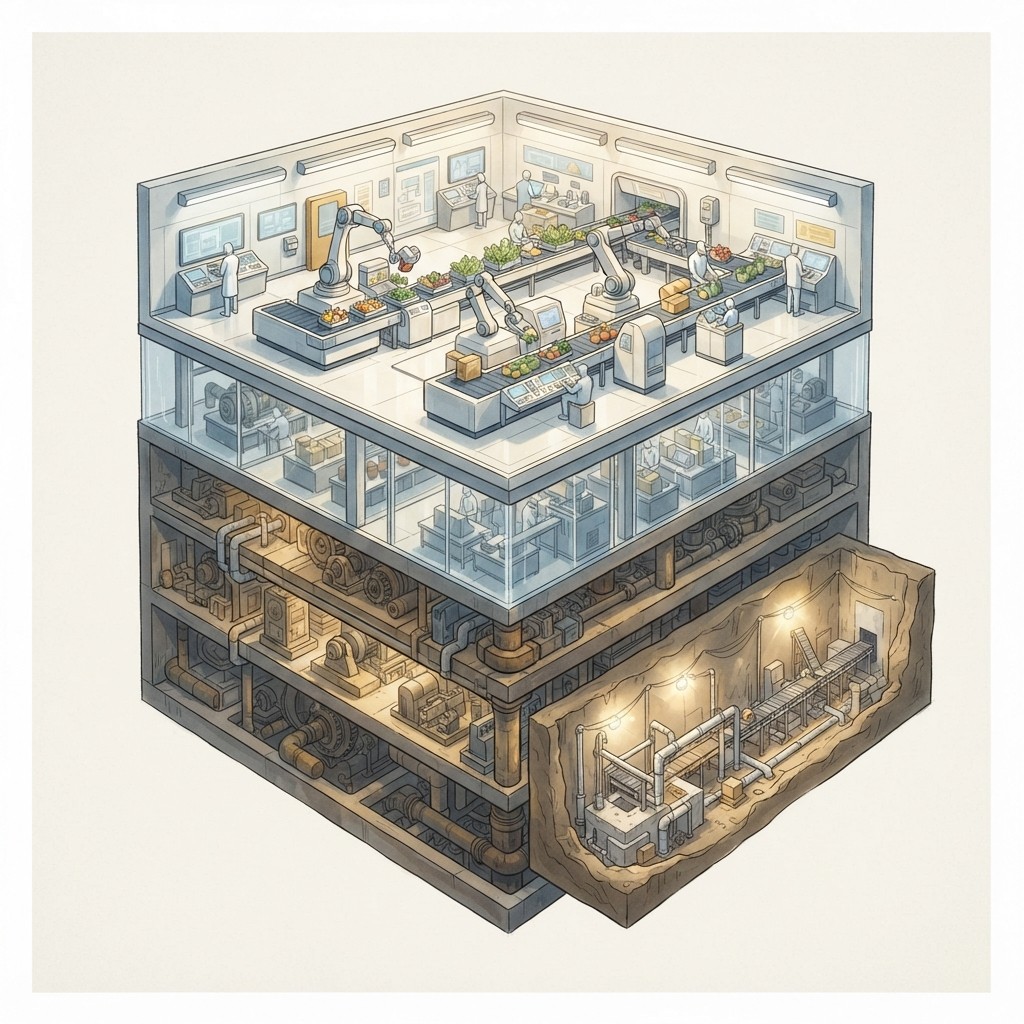
Here is the thesis in one line: 7-Eleven Japan does not sell fresh food - it operates a dedicated production-and-distribution network whose only customer is itself, and freshness is what that network looks like from the shelf. The foundation is NDF, the Nihon Delica Foods Association, established in 1979 to standardize hygiene and erase regional quality differences. As of early 2024 it spans 172 factories across Japan, whose members jointly develop products, manage quality, and procure ingredients exclusively for Seven-Eleven Japan.1 That last word does the work. These are not contract manufacturers selling to whoever calls. They are a parallel food industry pointed at a single retailer.
And critically, Seven & i does not own them. Its own filings are precise about this: the daily food products are made in specialized facilities 'operated by independent collaborating companies.'2 So this is vertical integration without the vertical asset - no balance sheet full of factories, no manufacturing capex to defend. The integration is contractual and relational: exclusive supply, shared product development, common quality standards. It captures the coordination benefits of owning the chain while leaving the plants on someone else's books. That is the elegant part - and the part that makes it harder to copy, not easier, because a rival can't simply outbid 7-Eleven for a factory that exists only to serve 7-Eleven.
“Original daily food products are made in specialized facilities operated by independent collaborating companies and delivered from combined distribution centers... that serve only Seven-Eleven Japan.”2
Four temperatures, four chains, one store
Output a fresh product and you still have to move it without spoiling the freshness you just built. This is where the model stops being a supplier story and becomes a physics problem. 7-Eleven Japan runs four separate temperature-controlled distribution categories - frozen, chilled, warm, and room-temperature - each with its own distribution centers and trucks. Warm and chilled foods reach stores three times a day; room-temperature processed goods once a day; frozen products three to seven times a week, the cadence flexing with the weather.3 The popular shorthand of 'fresh food three times a day to every store' is wrong in the way most flattering shorthands are wrong: it collapses a deliberate, category-by-category schedule into a slogan. The schedule is the moat; the slogan is just the smell of it.
| Category | Delivery frequency | What it carries |
|---|---|---|
| Warm foods | Three times daily | Hot prepared meals |
| Chilled foods | Three times daily | Sandwiches, rice balls, salads |
| Room-temperature | Once daily | Processed shelf goods |
| Frozen | 3-7 times weekly (weather-dependent) | Frozen products |
Why run four chains instead of one cold truck? Because a single temperature optimizes for none of the products. A salad held at frozen temperatures isn't fresh - it's ruined. By splitting the chains and combining deliveries by zone, 7-Eleven minimizes the trucks rolling to each store while maximizing how recently each item left the line. The result is the thing rivals describe as 'freshness' and customers experience as 'it's always good.' It is really just a logistics tree that someone spent decades pruning.
The most durable moats are the ones that disguise themselves as a quality, because a quality invites competitors to try matching it head-on - and they aim at the wrong target. 7-Eleven Japan's rivals heard 'better food' and tried to make better food. The actual asset was 172 dedicated factories feeding four temperature-separated supply chains, assembled since 1979. You can hire a chef next week. You cannot summon four decades of exclusive supplier relationships and combined distribution centers next week, at any price. When an advantage looks like taste but is actually time, the competitor who treats it as taste is already beaten.
What the fresh food is actually buying
All this machinery would be an expensive hobby if fresh food were a low-margin loss leader. It isn't - it's the draw. Seven & i states plainly that there is a 'strong correlation between the sales composition ratio of fresh food and the number of customers drawn.'7 In other words, the fresher the food mix, the more feet through the door, and the feet buy everything else too. The financial scale is real: the domestic convenience-store segment reported revenues from operations of about ¥914.6 billion and operating income of roughly ¥222.5 billion in the period under review.6 Freshness isn't the product line. It's the magnet for the whole store.
The company knows exactly what the asset is, which is why it is now trying to export it. Since 1989 it has built a fresh-food value chain in Hawaii through the NDF-affiliated producer Warabeya Nichiyo, treating it as a template for going global.7 That same supplier has committed roughly $81.5 million to build a third continental U.S. plant to feed American 7-Eleven stores8 - and 7-Eleven International is openly repositioning the overseas business as a 'food-focused convenience store,' with fresh food named as the key to winning customers.6 The strategy abroad is not 'sell snacks.' It is 'rebuild the Japanese machine, one dedicated plant at a time.' That tells you the machine, not the menu, is the prize.
Couldn't a rival with enough cash just build it?
The fair objection: this is just a supply chain, and supply chains can be bought. Capital is patient and abundant; a determined competitor could fund factories, buy refrigerated trucks, and hire away the talent. True in principle - and it misreads what's hard. The hard part isn't the trucks; it's the exclusivity and the loops. The NDF factories exist to serve one retailer, which means their scale, their recipes, and their economics are co-developed with 7-Eleven over decades; a challenger can't simply contract for capacity that was purpose-built and spoken for. The honest counter is sharper still: 7-Eleven itself proves a network can be acquired - in 1991 its Japanese parent's joint vehicle, IYG Holding, bought 70% of the bankrupt Southland Corporation for $430 million and took control of the American 7-Eleven.45 So networks do change hands. But notice what was acquired: stores, not the fresh-food production system. The thing that's genuinely non-replicable was built, not bought - and even the company that owns the playbook is choosing to rebuild it plant by plant overseas rather than acquire one ready-made. If it could be purchased off the shelf, the firm that wrote the manual would have done so already.
A rice ball is a humble thing. The reason 7-Eleven's is reliably good is that, behind it, sits a parallel food industry built since 1979, four cold-and-warm supply chains threading through the day, and a set of factories that have no other customer to please. Competitors keep hearing a promise about freshness when what they're up against is a promise that was kept, every day, for forty-five years. You can match the recipe by Friday. You cannot start in 1979 - and that, not the seasoning, is the moat.
When the real product is the system behind the product
Vertical-Integration Assessment
A make-vs-buy assessment for a single stage of the value chain: rate the forces that argue for owning it and the forces that argue for renting it, then read the verdict off the gap. Blank to run on a stage you're deciding now; filled as the worked example showing why the story's company pulled a stage in-house — or pushed it out.
Included, filled and blank, in the The Vertical Integration Casebook. See the set → · Preview the blank →
Sources
Where this comes from — the filings, records, and reporting behind it.
- 1NDF (Nihon Delica Foods Association) was established in 1979 to improve hygiene management and eliminate regional quality differences; as of February 2024 it operates 172 factories across Japan. NDF members jointly develop products, manage quality, and procure ingredients exclusively for Seven-Eleven Japan.
- 2Original daily food products are made in specialized facilities operated by independent collaborating companies and delivered from combined distribution centers with multiple temperature-separated zones that serve only Seven-Eleven Japan, distinguishing it from competitors in product development, hygiene, and quality control.
- 3There are four categories of temperature-controlled distribution centers and trucks: frozen foods, chilled foods, ambient/room-temperature processed foods, and warm foods. Warm and chilled foods are delivered three times daily; room-temperature products once a day; frozen products three to seven times per week depending on weather.
- 4IYG Holding Company — formed by Seven-Eleven Japan (48%) and Ito-Yokado (52%) — acquired 70% of Southland Corporation's common stock for $430 million; the deal closed on March 5–6, 1991 after Southland filed a pre-packaged Chapter 11 bankruptcy in October 1990.
- 5Deseret News contemporaneous report corroborates the $430 million cash purchase and March 1991 close date, confirming the 70% stake transferred to IYG.
- 6Seven & i Holdings' investor relations segment page confirms domestic CVS (Seven-Eleven Japan) revenues from operations of ¥914,583 million for the fiscal year under review, with operating income of ¥222,521 million (95.3% YoY). The page also confirms that 7-Eleven International LLC is transitioning international business to a 'food-focused convenience store' model, with fresh food as the stated key to winning customers.
- 7Seven & i Holdings confirms there is a 'strong correlation between the sales composition ratio of fresh food and the number of customers drawn,' and that since 1989 it has built a fresh-food value chain in Hawaii via NDF-affiliated Warabeya Nichiyo as a model for global expansion.
- 8Warabeya Nichiyo Holdings — an NDF-affiliated Japanese ready-to-eat food producer — announced a $81.5 million investment to build its third continental U.S. plant to supply 7-Eleven convenience stores, evidencing the export of Japan's dedicated-factory model to North America.
More like this — beyond 7-Eleven
New Strategically analyses as they publish: the defining moves in business, checked against the record. No noise, and one click to leave.