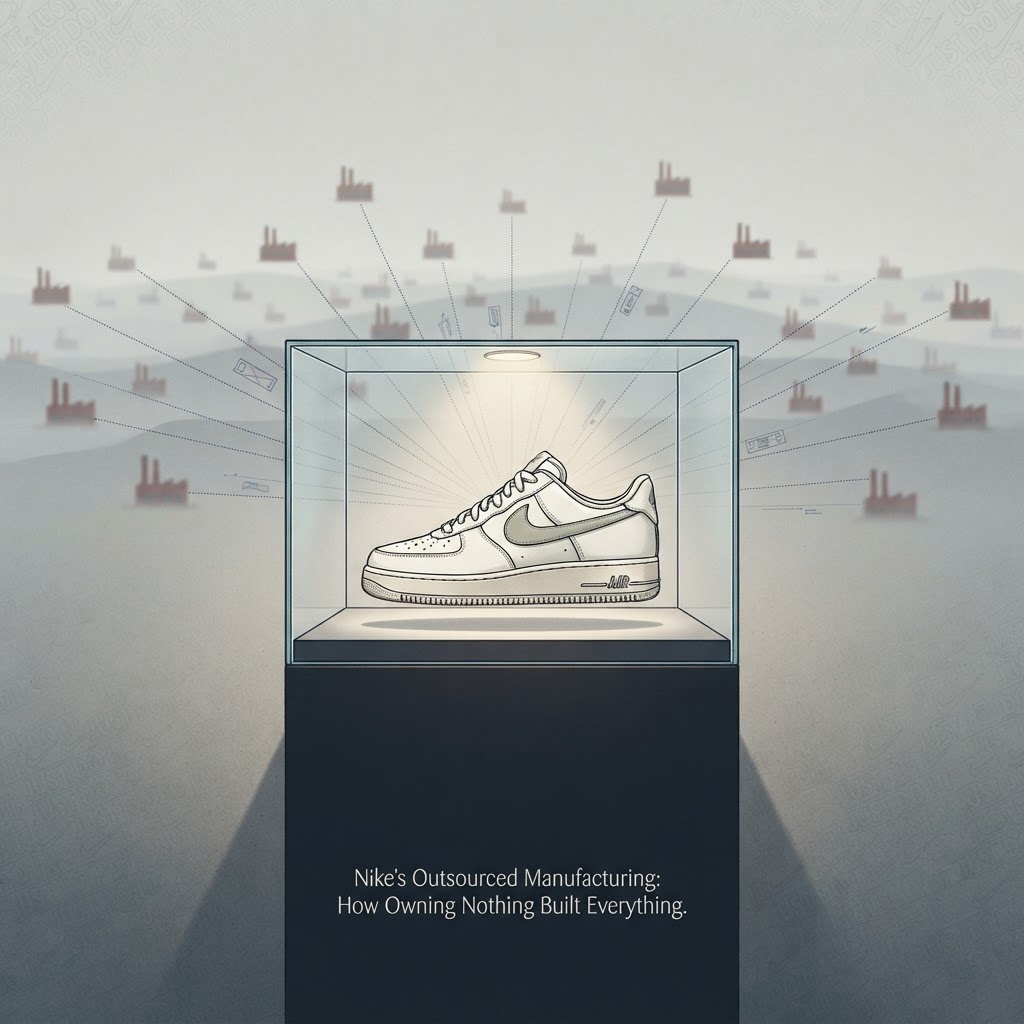
Picture a $51-billion shoe company that has never owned a shoe factory. Not one. The trick isn't where Nike makes its shoes — it's what it decided was worth making at all.
Pairs with the Asset-Light vs Asset-Heavy Comparator — a ready-to-use strategy tool, filled for Nike. Included in the The Asset-Light Bet Casebook →
Nike does not own a single one of the hundreds of factories that make its shoes. Not one. Its own annual report says so in plain language: we do not own or operate any of the footwear or apparel manufacturing facilities behind the world's most recognizable athletic brand.1 And yet, in fiscal 2024, Nike turned $51.4 billion of sales into product at a 44.6% gross margin2 - the kind of number you would expect from a software company, not a maker of physical objects sold in malls. The gap between owning nothing and earning like that is not an accident or a loophole. It is the entire strategy, executed on purpose for sixty years.
The official story is that Nike is a shoe company. The real story is that Nike is a marketing-and-design company that attaches its name to shoes other people's factories make. Once you see that, the swoosh stops looking like a logo on a product and starts looking like the product itself - and everything about how Nike spends its money, defends its turf, and once nearly lost its reputation falls into place.
Own the desire, rent the stitching: the only asset worth keeping is the one nobody else can copy
Every business is a bundle of activities, and the asset-light question is brutally simple: which of them are actually worth owning? Nike's answer, reached early and held without flinching, is that the scarce and defensible work is design, brand, and demand-creation, and the rest is commodity. Stitching a shoe is something hundreds of factories across dozens of countries can do, and do interchangeably; the moment one country gets expensive, the work moves to a cheaper one. Sinking capital into factories would tie Nike to the lowest-margin, most mobile, most replaceable part of the whole enterprise. So Nike refused. The instinct traces straight back to Phil Knight, who started in 1964 by importing high-quality, low-cost Japanese running shoes and selling them from the trunk of his car - competing not on who could manufacture, but on who could understand the runner.3 Nike never stopped being that company. It just scaled the idea until it owned the desire for athletic shoes and rented the means of making them.
| Nike owns | Nike rents | |
|---|---|---|
| The work | Brand, design, R&D, demand-creation | Cutting, stitching, assembly |
| Why | Scarce, defensible, high-margin | Commodity, mobile, replaceable |
| The capital | Marketing and athlete endorsements | Almost none - the factories aren't Nike's |
| Who's exposed | Nike, to taste and reputation | Contractors, to the cost of production |
| What it earns | A ~44% gross margin | A thin manufacturing fee |
The clearest proof of where Nike believes its value lives is where it puts its dollars. In fiscal 2024 the company spent $4.3 billion on what it calls, with unusual honesty, demand creation - the advertising, the endorsement deals, the swoosh on every field of play.2 That is the line item that builds the only thing Nike actually owns. It spends billions manufacturing desire and nothing manufacturing shoes, because it has decided, correctly, that desire is the scarce input and shoes are not.
The bill for renting your conscience: you can outsource the factory, but never the blame for what happens inside it
Here is the part the asset-light celebration usually skips, and it is the part that matters most. When you outsource the making, you also outsource the conditions of the making - but you do not outsource the blame. In the 1990s, the working conditions inside Nike's Asian contract factories became a global scandal: low wages, forced overtime, child labor, abuse. Nike's first instinct was to point out, correctly, that these were not its factories and not its employees. It did not work, and it should not have, because the public had already grasped what Nike's own strategy was built on: the swoosh was the product. If the swoosh was on the shoe, the swoosh owned the shoe - and everything that happened to make it. A company that had spent a fortune teaching the world to feel something about its brand discovered that feeling cut both ways.
“The Nike product has become synonymous with slave wages, forced overtime, and arbitrary abuse.”4
Isn't this just exploitation with a swoosh?: separating the cost arbitrage from the genuine insight underneath it
The honest objection is that 'asset-light' is a flattering name for moving production to wherever labor is cheapest and disclaiming responsibility for the result. Part of that is fair - the cost arbitrage is real, and Nike's early denials were a moral failure. But it mistakes the bill for the strategy. The strategy was the correct identification of where durable value sits: not in the ability to stitch, which anyone can buy, but in the ability to make people want, which almost no one can build. The labor crisis was the price of executing that strategy without owning the conditions it depended on - and, tellingly, it was Nike's own asset-light exposure that forced the fix. Because the brand caught the blame, the brand had to police factories it did not own, inventing the kind of supply-chain monitoring that asset-heavy manufacturers never needed. The model created the problem and then, under pressure, was made to answer for it.
Before you build or buy capacity, sort every activity into two piles: the scarce, defensible, high-margin work that competitors can't easily copy, and the commodity work that's mobile and replaceable. Own the first; rent the second. But add the line most asset-light pitches leave out: price the reputational liability of everything you rent. You own the blame for your supply chain whether or not you own the factories - so monitor what you outsource as if it were yours, because in the eyes of your customers, it is.
Nike makes nothing, and owns the only thing in its industry that's genuinely scarce: the desire. Factories are interchangeable; a billion-dollar feeling about a checkmark is not. That is why the model works, and why it has been copied across consumer goods ever since. But the lesson worth keeping is the one Nike learned the hard way in 1998 - asset-light is light on capital, never on consequences. The day you put your name on someone else's factory, you quietly take ownership of everything that happens inside it. Nike spent the better part of a decade, and a great deal of its hard-won goodwill, learning that the swoosh it had made so powerful could not be switched off when the news got bad.
Asset-Light vs Asset-Heavy Comparator
A side-by-side matrix that pits owning the assets against renting or orchestrating them, dimension by dimension. Blank to weigh your own model choice; filled as the worked example showing why the story's company went capital-light — or planted its money in concrete and steel.
Included, filled and blank, in the The Asset-Light Bet Casebook. See the set → · Preview the blank →
Sources
Where this comes from — the filings, records, and reporting behind it.
- 1Nike states in its Form 10-K that 'we do not own or operate any' of its footwear or apparel manufacturing facilities. In fiscal 2025, virtually all NIKE Brand footwear was made by 15 independent contract manufacturers in 97 factories across 11 countries (Vietnam ~51%, Indonesia ~28%, China ~17%), and apparel by 67 manufacturers across 303 factories in 34 countries.
- 2For fiscal 2024 (ended May 31, 2024) Nike reported $51.4 billion in revenue at a 44.6% gross margin, and spent $4.3 billion on 'demand creation' (advertising, endorsements, and marketing).
- 3Nike's model began with Phil Knight's idea to import low-cost, high-quality Japanese running shoes and compete on design and marketing rather than owning production - the throughline of his memoir 'Shoe Dog.' He started Blue Ribbon Sports in 1964, selling shoes from the trunk of his car.Phil Knight, 'Shoe Dog: A Memoir by the Creator of Nike' (Scribner, 2016), Shoe Dog: A Memoir by the Creator of Nike · ISBN 9781501135910 · 2016
- 4On May 12, 1998, at the National Press Club, Phil Knight acknowledged: 'The Nike product has become synonymous with slave wages, forced overtime, and arbitrary abuse,' and announced reforms - raising the minimum worker age, applying U.S. indoor air-quality standards in factories, and allowing independent monitoring.
More like this — beyond Nike
New Strategically analyses as they publish: the defining moves in business, checked against the record. No noise, and one click to leave.