Pairs with the Vertical-Integration Assessment — a ready-to-use strategy tool, filled for FedEx. Included in the The Vertical Integration Casebook →
On the night of April 17, 1973, fourteen small French-built jets lifted off from Memphis carrying 186 packages bound for 25 cities.1 Strip away the legend and that is what the birth of overnight shipping actually looked like: a fleet of toy planes, fewer parcels than a single modern delivery van carries before lunch, and 389 employees betting that the whole continent could be served by flying everything to one place in the middle of the country and flying it back out again before dawn. The idea was elegant. The economics, that night, were terrible.
The story everyone tells is that a Yale undergrad named Fred Smith wrote a term paper describing the hub-and-spoke network, got a dismissive 'C' for it, and then proved the professor wrong by building it anyway. It is a perfect founding myth, and almost none of it can be verified. Smith himself said he didn't remember the grade; the professor died in 1968; the whole story first surfaces in a 1978 magazine profile.67 The more useful truth is buried under the romance: the idea was never the hard part. The idea was legal four years before it was profitable.
The thesis: FedEx didn't out-think the competition, it out-waited the regulator
Here is the claim a smart skeptic could argue against, and the one worth defending anyway. FedEx's hub-and-spoke overnight network was not a brilliant operation that happened to grow up under bad rules. It was a capital-intensive infrastructure bet that could not work at scale until the rules changed—and the moment they changed, on a single day in 1977, the same idea flipped from cash-burning curiosity to near-uncopyable moat. The genius was real. But the decisive event was regulatory, not operational.
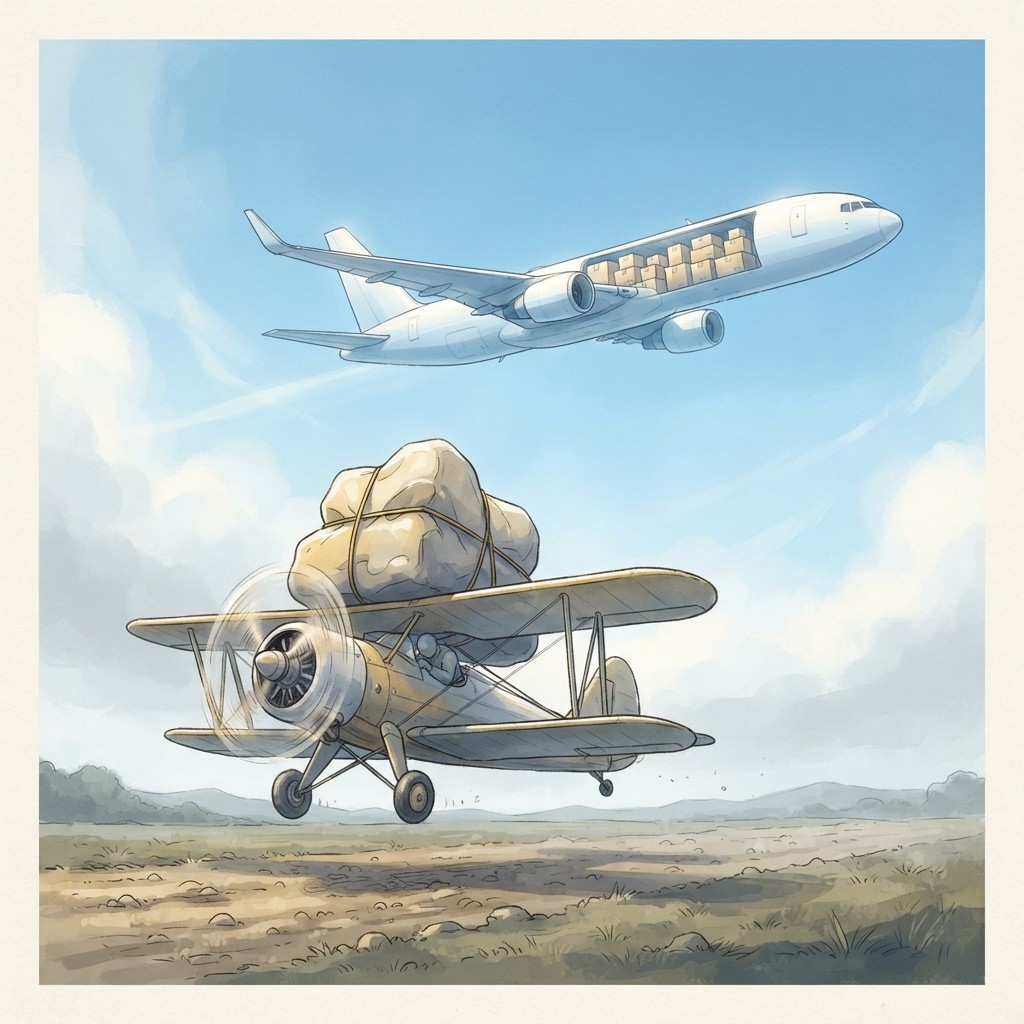
To see why, look at what those 14 jets actually were. They were Dassault Falcon 20s—business jets pressed into freight duty—because federal regulation gave FedEx no choice. Under the Civil Aeronautics Board, FedEx was classified as an 'express' service rather than a cargo carrier, and that classification capped the size of plane it was allowed to fly, even on routes where a larger aircraft was plainly the cheaper way to move the volume.5 A hub-and-spoke network lives or dies on the cost of moving a unit through the hub. FedEx had designed the cathedral and been handed a wheelbarrow to build it with.
| Before Nov 9, 1977 | After Nov 9, 1977 | |
|---|---|---|
| Aircraft allowed | Small jets (Falcon 20) | Large jets (Boeing 727) |
| Regulatory class | 'Express' service, capped | Free cargo carrier, any route |
| Packages per flight | A wheelbarrow's worth | An order of magnitude more |
| Cost per parcel through the hub | Punishing | Falls as volume rises |
| The idea itself | Identical | Identical |
Why one signature in 1977 changed all the math
On November 9, 1977, President Carter signed the Air Cargo Deregulation Act, and FedEx was among its largest beneficiaries—because it could now operate large aircraft, including the Boeing 727, that it had been restricted from flying.4 The company moved fast: it ordered its first seven Boeing 727-100s.8 This is the hinge of the entire story. A hub-and-spoke network has a brutal structural feature—every package flies to the center and back out, so it travels farther than a point-to-point route would. The only thing that redeems that detour is scale: pile enough volume onto big planes and the cost per parcel collapses below what any direct route can match. Deregulation didn't give FedEx the idea. It gave FedEx the airplane the idea required.
Watch what stacked up the instant the constraint lifted. The 727 order came right after the Act. FedEx went public on the NYSE in 1978. And in 1979 it launched COSMOS, becoming the first shipper to run a centralized computer that tracked packages in real time.8 None of that sequence is a coincidence. Big planes made the hub profitable; profitability funded the public listing; the listing funded the information layer that let one building in Memphis route a continent's worth of parcels through the dark and out again by morning. Each piece bolts to the one before it. The flywheel only started spinning once the regulator let go of the propeller.
“I don't know. It was so long ago... I've tried to correct it many times.”7
There is a reason the term-paper myth has more lives than a cat: it tells a flattering story about ideas. A lone visionary sees the future, gets mocked, and is vindicated. But Smith himself spent decades trying to wave the story off, because he knew the harder truth. The idea of an integrated air-to-ground overnight system was the cheap part—FedEx's own obituary for him says he conceived it at Yale and never mentions a grade at all.10 The expensive part was surviving long enough on small planes for Washington to unlock the big ones.
The fair objection: doesn't deregulation help everyone equally?
The honest counter is that the 1977 Act freed every air-cargo carrier, not just FedEx—so why didn't a dozen rivals build identical hubs the moment large planes were legal? If regulation was the moat, the moat should have evaporated the day the regulation did. The answer is that deregulation didn't hand FedEx an advantage; it handed FedEx permission to finish building one nobody else had started. By 1977, FedEx already had four years of hub operations, a working sort at Memphis, the routes, the brand, and the customer base of a network in motion. A late entrant facing the same open rules would have had to spend years and a fortune assembling all of that from zero, against an incumbent already adding 727s and a real-time tracking system. The same regulation that made the network viable for FedEx made starting one from scratch a fool's bet for anyone else. Permission arriving four years early is itself the advantage.
The most durable moats often form in the gap between when an idea is legal and when it becomes profitable. FedEx spent four years running a hub-and-spoke network the regulator had crippled—small planes, punishing unit costs, a cathedral built with a wheelbarrow. That looked like stubbornness. It was positioning. When the Air Cargo Deregulation Act landed in 1977, FedEx already had the routes, the hub, and the customers in place to absorb the big jets instantly, while any rival would be starting from a cold engine. The lesson isn't 'wait for deregulation.' It's that an infrastructure bet placed before the constraint lifts—and survived through it—is far harder to copy than one anyone can now legally start. Just be honest with yourself about which constraint you're waiting on, and whether you can outlast it.
Today the network FedEx pre-built still runs the same way: a primary super-hub in Memphis, a second national hub in Indianapolis, and regional hubs feeding it from Fort Worth, Newark, Oakland, and Greensboro.3 Strip away the term paper, the gentlemanly C, the exact count of that first night, and you are left with the part that actually compounds. FedEx didn't win because one man saw the future more clearly than his professor. It won because it stood, half-built and bleeding cash, in exactly the spot the law would eventually free—and was the only one already there when the runway finally opened. The idea was always feasible. The question was who would still be standing on the night it became cheap.
When the rules, not the idea, decide who wins
Vertical-Integration Assessment
A make-vs-buy assessment for a single stage of the value chain: rate the forces that argue for owning it and the forces that argue for renting it, then read the verdict off the gap. Blank to run on a stage you're deciding now; filled as the worked example showing why the story's company pulled a stage in-house — or pushed it out.
Included, filled and blank, in the The Vertical Integration Casebook. See the set → · Preview the blank →
Sources
Where this comes from — the filings, records, and reporting behind it.
- 1Federal Express Corporation was incorporated on June 18, 1971, in Little Rock, Arkansas; commercial delivery operations began April 17, 1973, from Memphis International Airport with 14 Dassault Falcon jets, 389 employees, and 186 packages delivered to 25 U.S. cities.
- 2FedEx's investor relations financial timeline confirms 186 packages were delivered on the first night of operations in 1973, creating a new industry.
- 3Federal Express's largest sorting facility, located in Memphis, serves as the center of the company's multiple hub-and-spoke system and worldwide air network; a second national air hub is in Indianapolis; regional air hubs operate in Fort Worth, Newark, Oakland, and Greensboro.
- 4On November 9, 1977, President Carter signed the Air Cargo Deregulation Act; a substantial beneficiary was Federal Express, as it allowed the then-young company to operate large aircraft including Boeing 727s, which it had previously been restricted from flying.
- 5The 1977 Air Cargo Deregulation Act allowed carriers such as FedEx to use larger aircraft for overnight shipping over any route; before this, under CAB regulation, FedEx was classified as an express (rather than cargo) service and could only use small planes even when larger ones were the more efficient choice.
- 6Fred Smith's Yale professor for the hub-and-spoke term paper was Challis A. Hall; Smith said in 2002 he did not really remember the grade; the professor died in 1968 and cannot be questioned; the 'C' grade story first appeared in an Esquire profile in August 1978.Snopes, The Origins of FedEx ↗ · 2024-09-10
- 7Smith stated the grade story first appeared in print in Esquire in 1978; in a 2004 interview he said 'I don't know. It was so long ago... I've tried to correct it many times.'
- 8The Air Cargo Deregulation Act (1977) enabled Federal Express to purchase its first large aircraft—seven Boeing 727-100s; FedEx went public on the NYSE in 1978; in 1979 it launched COSMOS, becoming the first shipper to use a centralized computer to manage packages in real time.Wikipedia, FedEx Express ↗ · 2026
- 9FedEx's official 40th-anniversary press release states the company began operations on April 17, 1973, with 186 packages to 25 U.S. cities, confirming 186 as the company's own canonical first-night figure.FedEx Newsroom, FedEx Marks 40th Anniversary ↗ · 2013-04-17
- 10FedEx's official obituary for Fred Smith confirms he conceived 'the idea of an integrated air-to-ground system that would ensure overnight delivery' at Yale and left the Marine Corps in 1970 as a Captain after two tours in Vietnam; no mention is made of the C grade.
More like this — beyond FedEx
New Strategically analyses as they publish: the defining moves in business, checked against the record. No noise, and one click to leave.