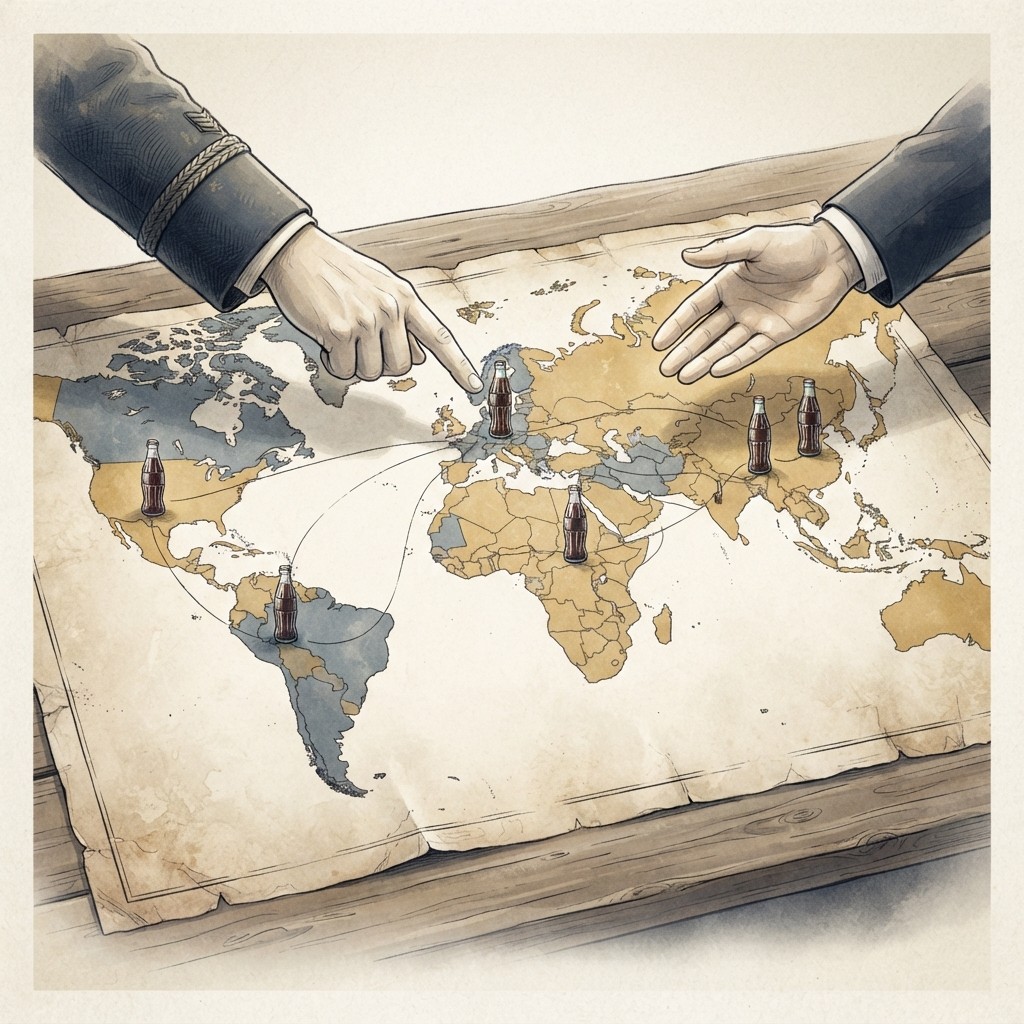
Pairs with the Market-Entry Gambit Canvas — a ready-to-use strategy tool, filled for Coca-Cola. Included in the The Market Entry Gambit Casebook →
On June 29, 1943, a cablegram arrived from General Eisenhower's Allied Headquarters in North Africa. It was not a request for ammunition or fuel. It asked for the materials and equipment to stand up ten bottling plants, three million filled bottles of Coca-Cola, and the supplies to produce that quantity twice a month thereafter.5 Within six months a company engineer had flown to Algiers and opened the first plant - the forerunner of 64 bottling plants shipped abroad during the war, while more than five billion bottles passed through the hands of military personnel.5 A soft-drink company had just been handed the most expensive logistics network on earth, and the bill went mostly to the U.S. government.
The official story is that Coca-Cola conquered the world with the red can, the contour bottle, and a century of brilliant advertising. That story is not wrong about the marketing. It is wrong about the order of events. The advertising filled a global pipe - but the pipe was laid down during a war, on someone else's budget, while the only serious rival was being told to cut production.
Here is the thesis a smart friend can repeat at dinner: Coca-Cola didn't out-market the world. It out-located it - and it did so on the army's dime.
The genius wasn't the syrup. It was who owned the plants.
To see why location was the whole game, you have to understand the machine Coca-Cola built before the war. The company does not, and largely did not, make the drink you buy. It makes concentrate. In 1899 two Chattanooga lawyers secured from Asa Candler the exclusive rights to bottle and sell Coca-Cola across practically the entire United States; the first plant opened in Chattanooga that year, the second in Atlanta the next, and within two decades the count grew from two to more than a thousand - 95% of them locally owned and operated.2 Coca-Cola sold syrup to independent bottlers who supplied their own capital, their own trucks, their own local relationships, and their own risk. That concentrate model is still the structural core of the global system today.8
It is a beautiful arrangement: capital-light at the center, capital-heavy at the edges, and someone else's money funding every truck and every plant. But it has one brutal constraint. A network of independent, locally financed bottlers is slow and expensive to seed in a foreign country. Each plant needs local capital, local permits, local distribution - the very things that take years and a depression-era balance sheet to assemble abroad. The concentrate model scales gorgeously once the plants exist. The problem was always getting the first ones built somewhere far away.
| The Coca-Cola Company | The bottler | |
|---|---|---|
| Supplies | Concentrate, brand, formula | Plant, trucks, capital, labor |
| Bears the capital cost | Almost none | Nearly all of it |
| Owns local distribution | No | Yes |
| The hard part abroad | Trivial - just ship syrup | Funding and building the plant |
The war solved the one problem the model couldn't
Then came the directive that changed everything. Coca-Cola's president, Robert Woodruff, held that every American service man and woman should have a Coke at their disposal, no matter where they were or what it cost the company.4 In peacetime that is a slogan. In wartime it became a procurement order. Where the troops went, the bottling plants followed - except the troops were already being moved, housed, fed, and supplied by the largest logistics operation in human history, and the plants rode along inside it. The company deployed some 248 Technical Observers to build and maintain the facilities, but HistoryNet, citing military records, is blunt about the bill: the 64 wartime plants were 'mostly paid for by the military.'6
Read that against the concentrate model and the arbitrage snaps into focus. The one thing Coca-Cola's beautiful machine could not do cheaply - plant capital-heavy bottling operations on foreign soil - was suddenly done for it, at scale, by the U.S. Army. The government supplied the shipping, the sites, and most of the money; Coca-Cola supplied the syrup and the know-how. When the war ended, the troops went home and the plants stayed. Coke didn't enter dozens of foreign markets. It was already there, with paid-for infrastructure on the ground, before anyone else had finished filling out the permits.
“Every American service man and woman should have a Coke at their disposal, no matter where they were or the cost to the company.”4
Same war, opposite math: what happened to Pepsi
The cleanest proof that this was structural and not just marketing brilliance is the rival who lived through the same years. Pepsi-Cola had no equivalent military access. While Coca-Cola followed the troops abroad on subsidized rails, Pepsi had to sharply cut production at home.6 Two cola companies, one war, opposite outcomes - and the difference was not the taste of the drink or the cleverness of the jingle. It was who got to ride inside the supply lines and who got rationed out of them. HistoryNet's verdict is that it took the massive stimulus of World War II to transform Coca-Cola into a global beverage at all.6 The marketing came later, to a network that was already poured into the ground.
Wasn't it still the brand that won?
The fair objection is that infrastructure is not destiny. Plenty of companies have had a head-start and squandered it; Coca-Cola spent the postwar decades building one of the most valuable brands ever assembled, and that work was real. A network of bottling plants doesn't sell itself - someone has to make people want what's inside, year after year, in 200 different cultures. All true. But it gets the sequence backwards. Distribution is the thing advertising cannot manufacture. You can spend a fortune making people in Manila or Marseille want a Coke, and it does you no good if there is no plant within reach to fill the bottle and no truck to carry it. The war handed Coca-Cola the one asset money struggles to buy quickly - presence everywhere - and turned advertising from a way to create demand into a way to harvest it. The brand was the multiplier. The plants were the thing being multiplied. And it is worth being honest about the legend, too: the famous five-cent-anywhere promise and the tidy 'whole country for a dollar' story are embellishments the record doesn't fully support. The real story is less heroic and more interesting - a logistics accident, seized.
The hardest part of conquering a new market is rarely demand - it's the capital-heavy, slow-to-build physical presence on the ground. Coca-Cola's enduring lesson isn't 'advertise relentlessly.' It's that the company solved its single structural weakness - planting bottling plants on foreign soil - by riding inside the largest logistics operation on earth, on a budget that wasn't its own. Look for the rail already being laid for some other purpose: a government program, a partner's distribution, a platform's reach. The competitor spending peacetime money to build presence one permit at a time can almost never catch the one who arrived inside someone else's supply lines. Presence compounds; advertising only harvests what presence makes possible.
Today Coca-Cola is sold in more than 200 countries and drunk about 2.2 billion times a day, still through the same concentrate-and-bottler machine, only now the bottlers span the planet.1 The advertising is genuinely great, and it gets the credit, because advertising is visible and infrastructure is not. But the moat was poured in concrete during a war, on the army's budget, while the only real rival was rationed out of the race. Coca-Cola didn't win the world by making people thirsty. It won by being the only one already there when they were.
When the real advantage is somewhere you weren't looking
Market-Entry Gambit Canvas
A one-page canvas for staging an entry into a market you don't own yet: the beachhead you take first, the wedge that gets you in cheaply, the sequence that turns a foothold into a position, and the incumbent's likely counter-move. Blank to plan your own entry; filled as the worked example showing how the story's challenger picked its landing spot and walked the rest in.
Included, filled and blank, in the The Market Entry Gambit Casebook. See the set → · Preview the blank →
Sources
Where this comes from — the filings, records, and reporting behind it.
- 1Coca-Cola's branded beverage products are sold in more than 200 countries and territories through a network of independent bottling partners, distributors, wholesalers and retailers, with consumers drinking approximately 2.2 billion servings per day.
- 2Large-scale bottling was made possible in 1899 when Benjamin F. Thomas and Joseph B. Whitehead of Chattanooga, Tennessee, secured from Asa Candler the exclusive rights to bottle and sell Coca-Cola in practically the entire United States; the first bottling plant under the new contract opened in Chattanooga in 1899, the second in Atlanta the following year, and over the next 20 years the number of plants grew from two to more than 1,000 — 95% of them locally owned and operated.
- 3The bottling contract between Thomas, Whitehead, and Candler was signed on July 21, 1899; it excluded Texas, Mississippi, and New England initially (those were later added); Candler sold the rights for $1.00, which he never collected; and the Coca-Cola Bottling Company was chartered in Tennessee on November 30, 1899.
- 4Coca-Cola's global growth expanded during World War II when Coca-Cola President Robert Woodruff believed that every American service man and woman should have a Coke at their disposal, no matter where they were or the cost to the company.
- 5On June 29, 1943, General Eisenhower's Allied Headquarters in North Africa sent an urgent cablegram requesting shipment of materials and equipment for 10 bottling plants and 3 million filled bottles of Coca-Cola (plus supplies to produce the same quantity twice monthly); within six months a Company engineer flew to Algiers and opened the first plant — the forerunner of 64 bottling plants shipped abroad during World War II. More than 5 billion bottles of Coke were consumed by military service personnel during the war.
- 6The 64 wartime bottling facilities were 'mostly paid for by the military,' not solely by Coca-Cola; the company deployed 248 employees (Technical Observers) to build and maintain them; rival Pepsi-Cola had no equivalent military access and had to sharply cut production; it took the massive stimulus of World War II to transform Coca-Cola into a global beverage.HistoryNet, Quench Warfare ↗ · 2020-02-26
- 7In 1916, the bottlers approved the unique contour bottle designed by the Root Glass Company of Terre Haute, Indiana; the shape was granted registration as a trademark by the U.S. Patent Office in 1977.
- 8The Coca-Cola Company's concentrate business model — selling beverage concentrates and syrups to authorized independent bottling partners who then produce, package, and distribute finished beverages — remains the structural core of its global distribution system as of FY2023.
More like this — beyond Coca-Cola
New Strategically analyses as they publish: the defining moves in business, checked against the record. No noise, and one click to leave.