Pairs with the Market-Entry Gambit Canvas — a ready-to-use strategy tool, filled for BASF. Included in the The Market Entry Gambit Casebook →
In March 2026, on a stretch of the Guangdong coast, BASF switched on a city. Not a plant — a Verbund site, the company's own word for a chemical complex wired so tightly that one plant's waste heat and byproducts feed the next, a steam cracker splitting a million tonnes of ethylene a year at its center.13 The headline number everyone repeated was €10 billion. The number BASF actually wrote on the cheque was about €8.7 billion — under budget, and finished while German politicians were still debating how to keep the lights on at home.1
The story told about this site is that BASF made a daring, contrarian China pivot — doubling down on Beijing just as everyone else talked of de-risking. That reading gets the nerve right and the logic backwards. This was not a leap into China. It was the overdue correction of a company that had spent years badly under-weighted in the one market that matters most — and that found, while it was deciding, that the place it was leaving the money had quietly become the dangerous one.
A company half-absent from half the market
Start with the imbalance, because the imbalance is the whole argument. China is roughly half of global chemical demand. BASF's Greater China sales were about €9.4 billion in 2023 — against group sales of €68.9 billion, that is around 13.6% of the company.4 In 2024 the figure slipped to €8.6 billion.4 Sit with that gap: the world's largest chemical company drew roughly a seventh of its revenue from a market that is roughly half the demand on earth. A senior BASF executive called it, plainly, an 'absolute underrepresentation.'8 You do not build an €8.7 billion plant to gamble on China. You build it because you woke up and realized you had been gambling on its absence.
The thesis is this: Zhanjiang is not a bet on China growing. It is a rebalancing toward a market BASF was already losing in by not being there at scale — and the timing was forced not by ambition but by what was happening to costs an ocean away.
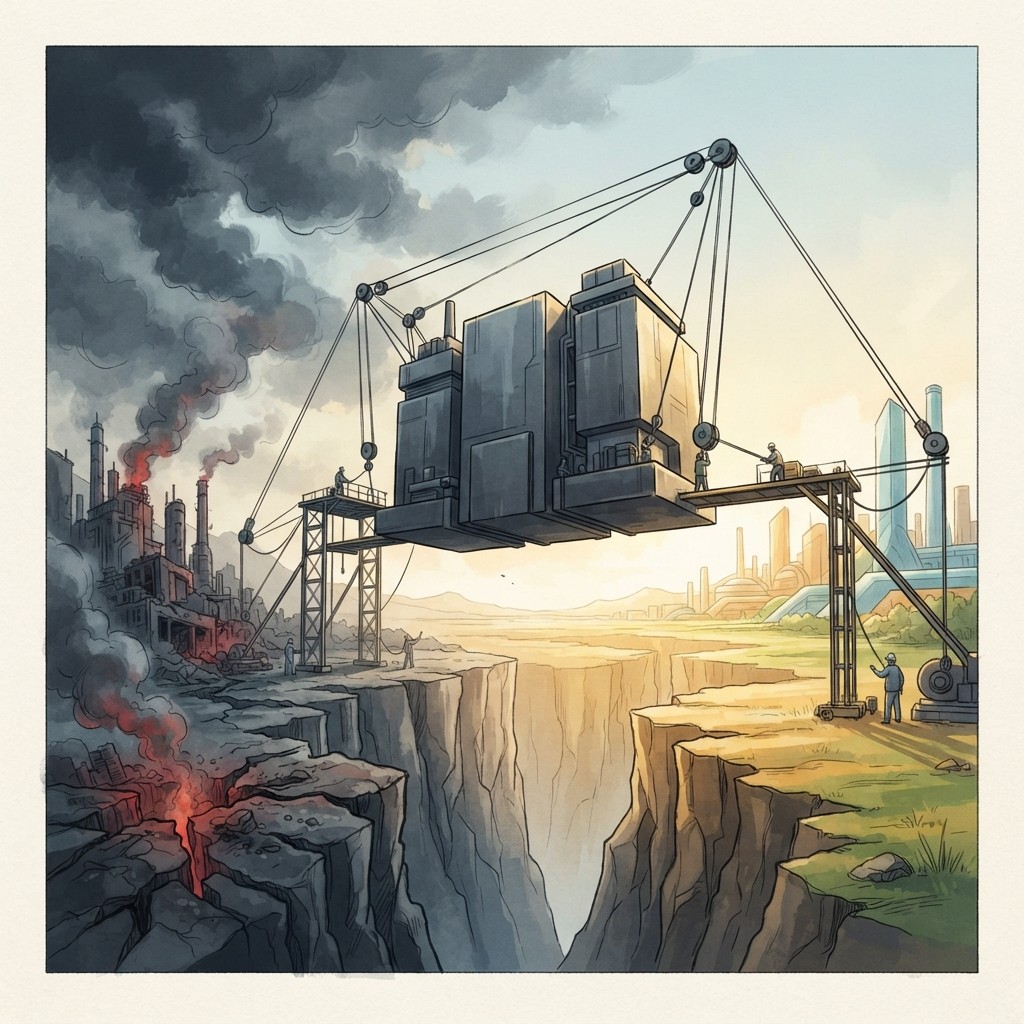
The German plant became the risky asset
Ludwigshafen is BASF's ancestral home — the original Verbund, a chemical site so large it has its own postal codes. For a century its logic was unimpeachable: cheap, abundant energy and a continent of customers next door. Then in 2022 the energy assumption broke. BASF's operational energy costs rose by an additional €3.2 billion across the group that year, with Europe accounting for roughly 84% of the increase and higher natural gas alone driving about 69% of it.5 That bill landed hardest on the most energy-hungry site BASF owns. The cracker is not a side business; it is the furnace the whole Verbund is built around, and Europe had just made the furnace expensive to run.
So the China decision and the German decision were never separate. They were one allocation. While Zhanjiang rose, BASF set a cost-savings program aimed at roughly €1.1 billion in annual savings at Ludwigshafen by the end of 2026, closing plants — adipic acid, cyclododecanon, cyclopentanon — and cutting jobs, after group EBITDA fell about 29% in 2023 to around €7.7 billion.6 One site was being throttled because its energy was suddenly dear; another was being built where energy and demand sat in the same place. Capital does not stay loyal to a postcode. It flows to where the next tonne of ethylene is cheapest to make and closest to who wants it.
| Ludwigshafen (the legacy) | Zhanjiang (the gambit) | |
|---|---|---|
| Energy assumption | Broke in 2022 | Local and competitive |
| Demand next door | A slow-growing Europe | ~50% of global chemical demand |
| BASF's move | ~€1.1B in cost cuts, plant closures | ~€8.7B new Verbund, under budget |
| The 2022–24 verdict | EBITDA down ~29% in 2023 | Cracker live by turn of 2025/26 |
“An absolute underrepresentation.”8
Why the Verbund is the move, not just the location
There is a reason BASF didn't just open sales offices and import. The Verbund is the mechanism — the integrated complex where a cracker's outputs become the next plant's inputs without ever leaving the fence line. That integration is what turns a thin commodity margin into a defensible one, because the cost advantage compounds across the chain rather than living in any single product. Zhanjiang is BASF's seventh Verbund site worldwide and its third largest.1 Building one is enormously hard and slow; BASF signed the first memorandum with Guangdong in 2018, commenced construction in November 2019, took the final investment decision on the main phase in 2022, and inaugurated in 2026.231 That eight-year arc is the point: the asset is difficult to copy precisely because it is difficult to build, and being physically inside the world's biggest market with a fully integrated complex is a position a sales office can never hold.
BASF targets lifting China to ~20% of group sales by 2030, with earnings of €1.0–1.2 billion from the project.8 The capital backing it is real: of a ~€16 billion 2025–2028 capex plan, about €3 billion goes to Zhanjiang, and roughly 28% of capex is pointed at Asia Pacific.7 The subtraction term is the honest one — the executive himself conceded ramp-up will be slower than hoped given oversupply.8
The honest objection: did BASF build into a glut?
The fair counter is sharp, and BASF half-conceded it at its own ceremony. China is not just the biggest market — it is the biggest builder of chemical capacity, and that has produced oversupply that crushes the very margins a new cracker needs. A senior BASF executive acknowledged the production ramp-up would be slower than initially hoped precisely because of these conditions.8 Put bluntly: a beautifully integrated, under-budget Verbund is still a money-loser if it pours a million tonnes of ethylene into a market already drowning in it. The €1.0–1.2 billion earnings target rests on demand catching up to capacity, and capacity has a head start.8 This is the genuine risk, and dressing the project as a cost triumph should not hide it.
Two things still tilt the argument toward BASF. First, integration is the best defense against a glut: when prices are brutal, the lowest-cost, most-integrated producer survives the cycle that bankrupts the marginal one. Second, the alternative was not safety — it was Ludwigshafen, where the energy assumption had already broken and the response was closures. BASF did not choose between a risky bet and a safe one. It chose between a glut it could out-cost and a cost structure it could not fix. Neither was comfortable. Only one had a future on the right side of the world's demand.
The most dangerous bet a company makes is often the one it never recognizes as a bet — the market it is quietly absent from. BASF wasn't 'neutral' on China at 14% of revenue; it was massively short a market that is half of global demand, and pretending that was caution rather than exposure cost it years. The discipline is to read your absences as actively as your presences: where are you under-weight relative to where the demand actually is, and what assumption is propping up the place you've left the money instead? When that assumption breaks — as cheap European energy did — the 'safe' legacy asset becomes the risk, and the 'bold' new market becomes the correction. The lesson isn't 'bet big on China.' It's: find the place your map of risk is upside down.
BASF did not pivot to China. It stopped being absent from it, and it paid for the correction by admitting its old home had become the expensive place to stand. The Verbund came in under budget and on time — a quiet, almost boring competence that the '€10 billion' headline obscures. Whether the bet pays the €1.0–1.2 billion it promises depends on a glut clearing that BASF cannot control. But the deeper move is already settled: a company that read half the world as a footnote finally put its furnace where the demand was. The risk was never China. The risk was the century-old assumption that Germany would always be the cheap place to make things.
Market-Entry Gambit Canvas
A one-page canvas for staging an entry into a market you don't own yet: the beachhead you take first, the wedge that gets you in cheaply, the sequence that turns a foothold into a position, and the incumbent's likely counter-move. Blank to plan your own entry; filled as the worked example showing how the story's challenger picked its landing spot and walked the rest in.
Included, filled and blank, in the The Market Entry Gambit Casebook. See the set → · Preview the blank →
Sources
Where this comes from — the filings, records, and reporting behind it.
- 1BASF's Zhanjiang Verbund site was completed and inaugurated in March 2026 with a final investment of approximately €8.7 billion — under the originally budgeted ceiling of 'up to €10 billion' — and the steam cracker ramped up 'in record time' at the turn of 2025/2026.
- 2BASF signed the first MOU for the Zhanjiang site with the Guangdong Provincial Government in Berlin in July 2018; a Framework Agreement followed in January 2019; construction officially commenced November 2019.
- 3In July 2022, BASF made the final investment decision (FID) for the main construction phase — covering a 1-million-tonne-per-year ethylene steam cracker and downstream plants. The first engineering plastics plant inaugurated September 6, 2022; TPU plant inaugurated January 2024.
- 4BASF's Greater China sales were approximately €9.4 billion in 2023 (out of group sales of €68.9 billion, ~13.6% of the total) and declined slightly to €8.6 billion in 2024. Despite China comprising roughly 50% of global chemical demand, China represented only ~13–14% of BASF group revenue.
- 5BASF's group operational energy costs rose by an additional €3.2 billion globally in 2022, with Europe accounting for ~84% of that increase and Ludwigshafen hardest hit; higher natural gas costs accounted for 69% of the global energy cost increase.
- 6BASF's Europe/Germany cost-savings program targets ~€1.1 billion in annual cost savings by the end of 2026 through restructuring at Ludwigshafen, including plant closures (adipic acid, cyclododecanon, cyclopentanon) and job cuts; EBITDA for 2023 was ~€7.7 billion, down ~29% year-on-year.
- 7BASF's capex plan for 2025–2028 totals ~€16 billion, of which ~€3 billion is allocated to Zhanjiang. Capex peaked at ~€6 billion in 2024 due to Zhanjiang; from 2026 BASF plans to reduce capex to well below depreciation and amortization. For 2025–2028, ~28% of capex is directed to Asia Pacific.
- 8BASF executive Stephan Kothrade told Reuters (March 2025) that China accounted for only ~14% of BASF revenues despite constituting ~50% of global chemicals demand — an 'absolute underrepresentation' — and that the Zhanjiang project is expected to raise China's share to ~20% of group sales by 2030 with earnings targeted at €1.0–1.2 billion. He acknowledged production ramp-up would be slower than initially hoped given oversupply conditions.
More like this — beyond BASF
New Strategically analyses as they publish: the defining moves in business, checked against the record. No noise, and one click to leave.