Pairs with the Adjacency / Synergy Map — a ready-to-use strategy tool, filled for Coca-Cola. Included in the The Adjacency Expansion Casebook →
Walk into any Costa in London and you are drinking a coffee that Coca-Cola paid $4.9 billion for in January 2019.1 It was the headline of the decade for the company: the world's biggest soda maker, finally serious about a world that was drinking less soda. The story wrote itself — water, coffee, the great escape from sugar. Six years later, the same company quietly folded Costa back into one of its geographic regions and switched off the very segment it had built to showcase it.2 The escape was real. But it wasn't where everyone was looking.
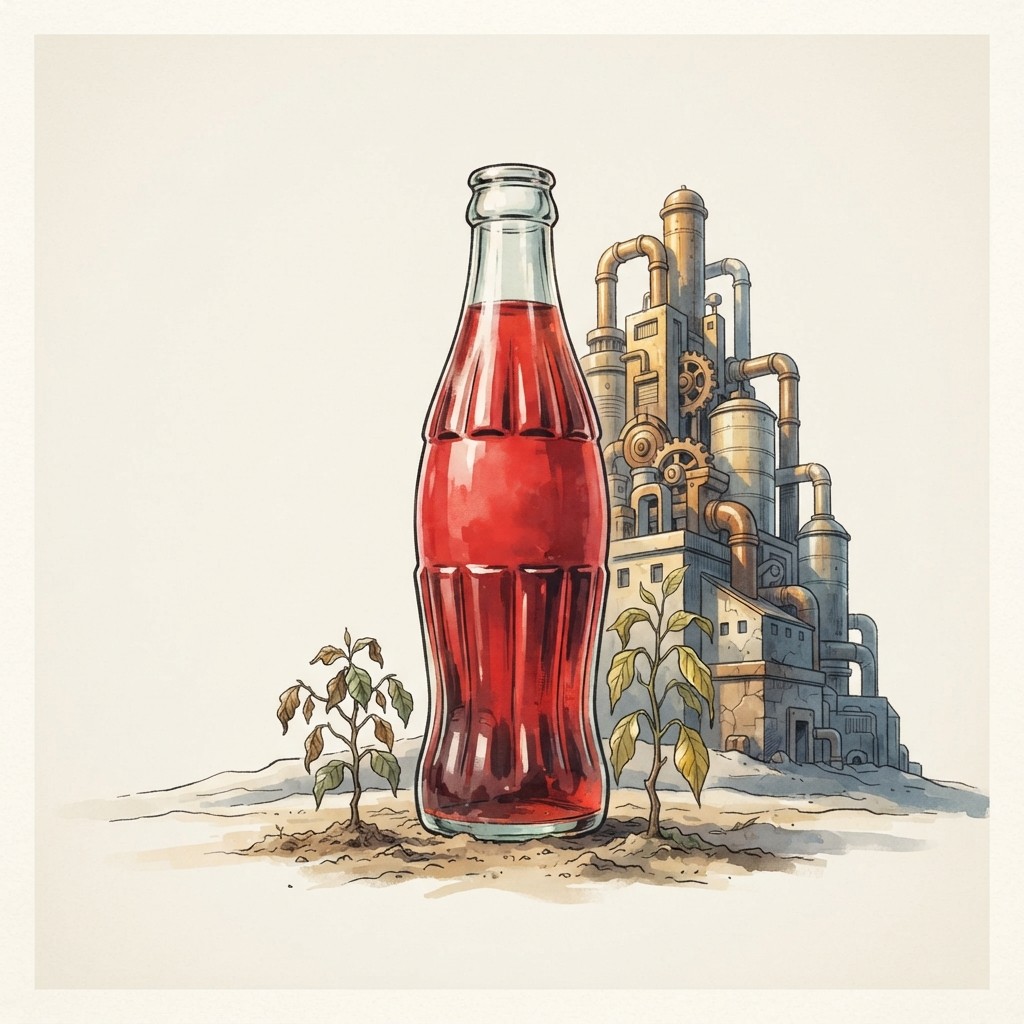
The official story is that Coca-Cola is becoming a 'total beverage company,' diversifying beyond soda through water and coffee. Almost every part of that framing is doing more work than the facts support. The water brand isn't from a spring. The coffee platform is being absorbed, not scaled. And the adjacency that actually moved the needle is one nobody puts in the headline.
Soda never left the throne
Start with the number that the 'beyond soda' narrative would prefer you didn't see. In Coca-Cola's 2024 annual filing, sparkling soft drinks were 69% of worldwide unit case volume — and Trademark Coca-Cola alone, just the red-can family, was 47%.4 After two decades of acquisitions, refreshed labels, and a corporate vocabulary that now calls itself a 'total beverage company' in its own SEC filings,5 roughly seven in ten units the company sells are still carbonated soft drinks. The pivot is not a transformation. It is a fringe — a real, deliberate one, but a fringe — bolted onto a business whose center of gravity has not moved.
This matters because adjacency moves get judged on their press release, not their P&L. 'Coca-Cola buys a coffee chain' is a story about transformation. '69% of volume is still soda' is a story about a very profitable core defending itself. Both are true at once — and the gap between them is the whole point.
The water brand that comes out of a tap
Dasani is sold as proof that Coke can play in water, and the company's own page calls it 'America's No. 1 national water brand.'6 But there is a quiet asymmetry in the bottle. Spring water sells a place — a mountain, a glacier, a source. Dasani has no source in that sense. Launched in 1999, it draws from local municipal water supplies, runs it through reverse osmosis, then re-adds trace minerals: magnesium sulfate, potassium chloride, sodium chloride.6 It is, in plain terms, purified tap water with a recipe and a label. That is a perfectly good product — and a perfectly weak premium narrative. The brand's value rests on manufacturing and distribution, the same machinery that already moves soda, not on owning a scarce natural asset. When you buy Dasani, you are not buying water. You are buying Coca-Cola's logistics, wearing a water costume.
Dasani looks like diversification because the category is different. But strategically it rides the exact same engine as soda — concentrate, bottling, retail shelf placement, brand spend — with municipal water swapped in for syrup. That makes it cheap and fast to launch, and also structurally easy to copy, because the competitor across the aisle owns the same engine. An adjacency that reuses all your existing capabilities is rarely a moat; it's a line extension wearing a category's clothes. The harder, more durable moves are the ones that force you to build something you didn't have.
Costa was the headline. Then it got quietly absorbed.
Costa was supposed to be the dramatic leap — a real platform in hot beverages, a category Coca-Cola had no native presence in. The deal closed in January 2019, $4.9 billion for a chain with operations in more than 30 countries.1 (Costa was founded in London in 1971 and bought by Whitbread in 1995, so Coca-Cola arrived more than two decades into its life — a long-established brand, not a startup bet.8) To house it, the company built a brand-new operating segment, Global Ventures, alongside innocent and doğadan.2 A dedicated segment is how a company signals 'this is a standalone platform we intend to scale.'
Then the signal reversed. In its 2024 filing, Coca-Cola announced it would sunset the Global Ventures segment, folding Costa (ex its ready-to-drink line) back into the EMEA geographic segment effective January 1, 2025.2 Read the structure, not the spin. You build a separate segment to incubate a platform; you dissolve it into a region when the platform is no longer being run as one. This is not failure — the segment's operating margin had swung from roughly negative 6% in 2020 to positive 11% by 20247 — but it is de-emphasis. Costa is being managed as a European business with a coffee brand, not nurtured as the company's coffee future.
| The 'beyond soda' story | What the structure reveals | |
|---|---|---|
| Soda's role | Shrinking, being replaced | Still 69% of volume in 2024 |
| Dasani | Coke's water brand | Purified municipal tap water |
| Costa | Standalone coffee platform | Folded back into EMEA, segment sunset |
| The real bet | Water and coffee | fairlife dairy, projected ~$7.4B |
The adjacency nobody put in the headline
Here is the one that actually worked, and it isn't soda-adjacent at all — it's milk. Coca-Cola completed its full acquisition of fairlife, the filtered, high-protein dairy brand, in January 2020, buying the remaining 57.5% stake for about $980 million.3 That number is the one the popular narrative remembers, and it is wrong by an order of magnitude. The deal carried contingent payments tied to financial milestones running through 2024, and as fairlife's growth blew past them, the total projected cost ballooned to approximately $7.4 billion — making it, per the company's filings, Coca-Cola's largest brand acquisition ever.3 Larger than Costa. Larger than anything. The escape from soda that mattered most ran on contingent earn-outs precisely because fairlife kept hitting the milestones.
Notice the pattern. The adjacency the headlines celebrate — coffee — is being absorbed. The one the headlines garble down to a billion dollars — dairy — is the one Coca-Cola kept paying more for, because it kept performing. The market told the truth in the earn-out: you don't escalate a contingent payment to $7.4 billion on a business that's disappointing you. The needle moved where the milestones were being hit, not where the press conferences happened.
Isn't this exactly what good diversification looks like?
The fair objection: this is precisely how a disciplined company is supposed to behave. Try several adjacencies, let the winners pull ahead, fold the modest performers into the core where they cost less to run, and double down where the milestones get hit. By that reading, sunsetting Global Ventures isn't a retreat — it's housekeeping, and fairlife's escalating price tag is the system working. That's a strong argument, and largely right. The point isn't that Coca-Cola failed; the Costa segment's margin did improve.7 The point is that the public story and the actual story have drifted apart. We narrate the pivot as 'water and coffee' — the categories that sound like the opposite of soda — when the filings say the real diversification was a protein-dairy bet that cost more than everything else combined, and the water brand never left the soda playbook at all. The honest version is less tidy and more useful: Coca-Cola didn't move beyond soda so much as discover, expensively and brand by brand, which non-soda bets were worth keeping outside the core and which belonged inside it.
Coca-Cola's 'beyond soda' decade looks, from the outside, like a bold redirection. From inside the filings, it looks like a company with a near-unbeatable core running a portfolio of side bets — keeping the one that scaled, absorbing the one that didn't, and re-skinning its own logistics as a water brand. The slogan says total beverage company. The volume says soda company that owns some other things. And the most expensive lesson of all is hiding in the line item nobody quotes: the future Coca-Cola actually paid up for wasn't in a coffee cup or a water bottle. It was in a carton of milk.
When the headline move isn't the real move
Adjacency / Synergy Map
A one-page canvas for an adjacency play: the new business next door, the shared assets that justify entering it, the synergies that actually transfer versus the ones that evaporate on contact, and the dis-synergies nobody put on the deck. Blank to test your own expansion; filled as the worked example showing where the story's 'natural adjacency' was real and where it was wishful.
Included, filled and blank, in the The Adjacency Expansion Casebook. See the set → · Preview the blank →
Sources
Where this comes from — the filings, records, and reporting behind it.
- 1Coca-Cola completed the acquisition of Costa Limited from Whitbread PLC on January 3, 2019, for $4.9 billion; the deal was first announced August 31, 2018, and Costa had operations in more than 30 countries.
- 2Effective January 1, 2019, Coca-Cola established a new Global Ventures operating segment to house Costa, innocent, and doğadan; in November 2024, the company announced plans to sunset this segment, with Costa (ex-RTD) moving to the EMEA segment effective January 1, 2025.
- 3Coca-Cola completed full acquisition of fairlife, LLC on January 3, 2020, acquiring the remaining 57.5% stake from Select Milk Producers for approximately $980 million (net of cash acquired), with additional contingent milestone payments through 2024; total projected cost has since ballooned to approximately $7.4 billion, making it Coca-Cola's largest brand acquisition.
- 4Sparkling soft drinks represented 69% of Coca-Cola's worldwide unit case volume in 2024, with Trademark Coca-Cola alone accounting for 47% of worldwide unit case volume, underscoring the continued dominance of soda despite the 'total beverage' pivot.
- 5Coca-Cola self-describes as a 'total beverage company' in its 10-K, grouping brands into: Trademark Coca-Cola; sparkling flavors; water, sports, coffee and tea; juice, value-added dairy and plant-based beverages; and emerging beverages — the 'total beverage' language is a deliberate corporate strategy framing, not just press shorthand.
- 6Dasani was launched in 1999; Coca-Cola draws from local municipal water supplies, filters via reverse osmosis, and adds trace minerals (magnesium sulfate, potassium chloride, sodium chloride). The brand's own company page calls it 'America's No. 1 national water brand.'
- 7The Global Ventures segment's operating margin improved from negative 6.03% in 2020 to positive 11.47% in 2024, confirming Costa/GV dragged results initially but improved — though the segment was still wound down structurally in 2025.
- 8Whitbread acquired Costa in 1995 (not 1996 as implied by the '23 years ago' quote in the 2019 press release); Costa was founded in London in 1971.
More like this — beyond Coca-Cola
New Strategically analyses as they publish: the defining moves in business, checked against the record. No noise, and one click to leave.