Pairs with the Asset-Light vs Asset-Heavy Comparator — a ready-to-use strategy tool. Included in the The Asset-Light Operator Casebook →
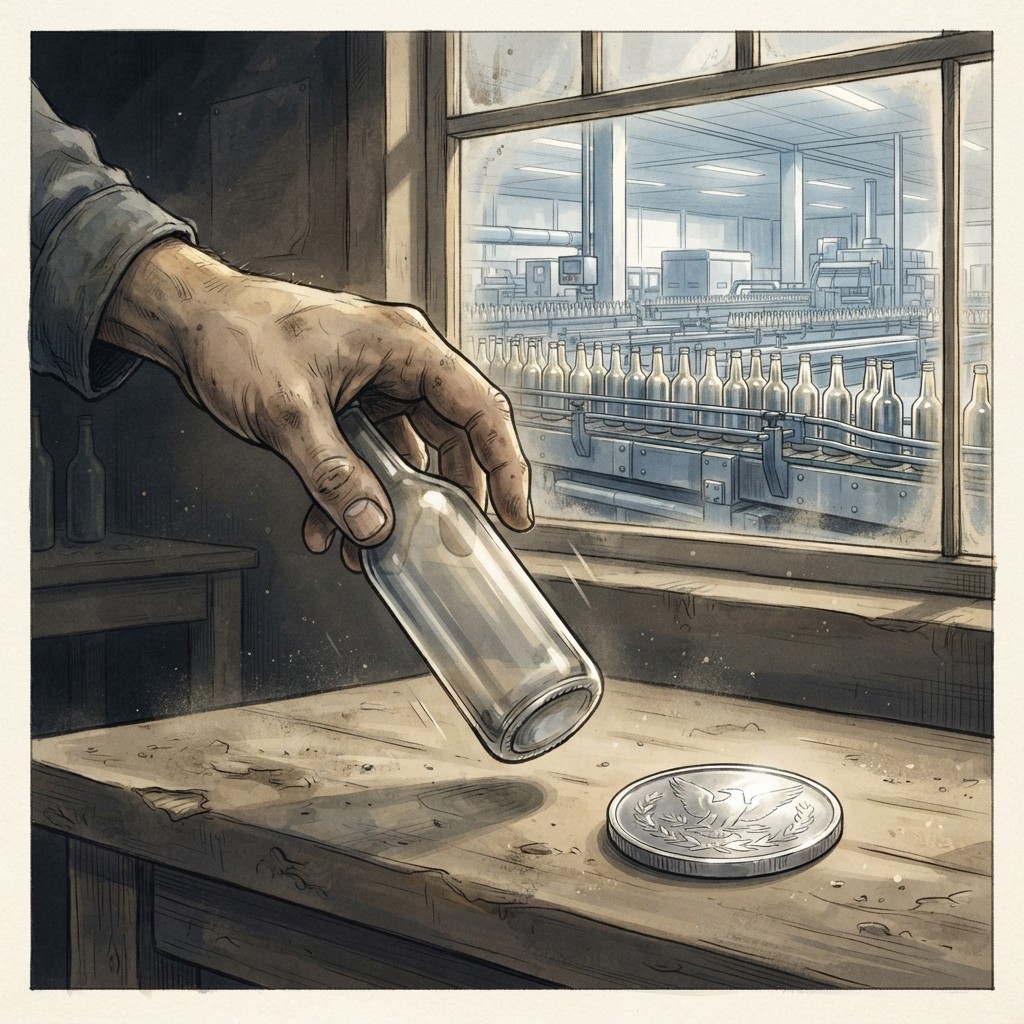
In the summer of 1899, two men from Chattanooga walked into Asa Candler's office and asked for the right to put Coca-Cola in a bottle. Candler gave it to them - for the entire country, in perpetuity, for a nominal sum of one dollar — a price he reportedly never collected.9 He was not being generous. He was being skeptical. He thought bottling soda was a fool's errand, and he signed the contract believing the men in front of him were doomed to fail — telling them, according to one account, 'If you boys fail in this undertaking, don't come back to cry on my shoulder.'910 He gave away the most lucrative half of his own business because he was certain it was worthless.
The official story is that Coca-Cola brilliantly invented the asset-light franchise model - keep the high-margin syrup, let other people own the heavy machinery and the trucks. The real story is the reverse. Coca-Cola backed into the most-copied business structure in consumer goods by accident, then spent the next 125 years engineering its way back into the very margin Candler had thrown away.
“Thomas and Whitehead could not self-fund even a single bottling plant, and Candler signed the contract believing they were doomed to fail.”2
The accident that built a century of structure
Benjamin Thomas and Joseph Whitehead got the rights, but they could not actually use them. They didn't have the money to build even one bottling plant - a single facility ran around $7,500, real capital in 1899 - so they brought in a Chattanooga attorney, John T. Lupton, as the primary financial backer, without whom the whole thing collapses.2 Then the three of them did something quietly ingenious. Rather than build plants themselves, they carved the country into territories and re-licensed the bottling rights to local operators. The 'parent' bottling companies never actually bottled anything; they bought syrup from Atlanta and sold it down to the local franchisees who did the dirty work. The pass-through structure existed from day one - just one layer below The Coca-Cola Company, where the founders couldn't see it.
It scaled with terrifying speed precisely because nobody at the center had to fund it. Capital came from a thousand local entrepreneurs who each wanted a piece of their own town. By 1920, more than 1,200 bottling operations were running on Candler's accidental template.4 The genius nobody intended was this: the network grew on other people's balance sheets. Coca-Cola sold the syrup and let the franchisees buy the trucks.
Why the syrup is the business and the bottle is the burden
Here is the mechanism Candler missed, stated in the flat language of a federal filing a century later. Coca-Cola's own 2024 10-K says concentrate operations generate lower net revenue but higher gross profit margins than finished-product bottling.6 Read that twice, because it is the whole game. Selling concentrate is selling a flavor and a brand - a light, high-margin act. Bottling is buying aluminum, running fill lines, refrigerating warehouses, and driving fleets of trucks to every grocery store in a territory - heavy, low-margin, capital-hungry work. The two halves of the same transaction live in opposite financial universes.
So the model's logic is brutal in its clarity: own the part with the fat margin and almost no assets, push the part with the thin margin and enormous assets onto someone who is thrilled to own a Coke franchise in their own city. In 2024, concentrate operations were 59% of Coca-Cola's net operating revenue and bottling just 41%6 - and concentrate carried the richer margin on top of that. The company that gave bottling away for a dollar now keeps the half that prints money and is busy handing back the half that consumes it.
| Concentrate (the syrup) | Finished product (the bottle) | |
|---|---|---|
| What it sells | Flavor, brand, formula | The physical can on the shelf |
| Capital intensity | Light | Heavy - plants, fleets, warehouses |
| Gross margin | Higher | Lower |
| Share of 2024 net revenue | 59% | 41% |
| Who Coca-Cola wants to own it | Itself | A franchise bottler |
The 10-K is explicit that concentrate earns less revenue but a higher margin than bottling.6 Every territory the company refranchises moves heavy, low-margin assets off its books while it keeps selling the syrup into that same territory. The model's value rises as the assets fall - the more it owns of the can, the worse its blended margin looks.
The hundred-year project to finish what Candler started by accident
If the model were truly clean, the story would end in 1920. It doesn't, because Coca-Cola spent much of the 20th century doing the opposite of asset-light - buying bottlers, consolidating them, taking direct ownership when franchisees stumbled or when control mattered. The U.S. system tells the story in two numbers: 278 domestic bottlers in 1985, collapsing to 79 by 2002, with a single giant, Coca-Cola Enterprises, controlling the large majority of the U.S. Coca-Cola bottling market by the early 2000s.5 Consolidation made the network efficient, but it also pulled all that heavy capital back toward the center. The 2024 10-K still carries a 'Bottling Investments' segment of consolidated bottling operations the company owns outright.6 'Asset-light' was never a finished fact. It was an aspiration the company kept walking away from.
What's new is the discipline of walking back toward it. In recent years Coca-Cola has run a systematic refranchising campaign, selling off the bottling assets it had once gathered up. It refranchised Vietnam in early 2023. In early 2024 it sold its Philippines bottling operations for net cash proceeds of $1.652 billion, handed Bangladesh to a regional partner, and sold certain India territories for $474 million.8 Each deal does the same two things: it converts heavy assets into cash, and it keeps Coca-Cola selling concentrate into the very market it just exited. The company's own words: the franchise model 'has enabled the company to develop a strong global footprint.'8 Candler's accident, finally being run on purpose.
Isn't calling a 125-year accident a 'strategy' just hindsight?
The fair objection is that this reframe is too neat. If the model works so beautifully, why did Coca-Cola spend decades buying bottlers back - and why is it still consolidating bottling on its own balance sheet today? Doesn't that prove the asset-light story is a myth the company tells investors? Partly, yes, and the honest version matters: 'asset-light' describes a direction of travel, not the current state. The Bottling Investments segment is real and still on the books.6 But the deeper point survives the objection. The company keeps returning to the same destination - own the concentrate margin, shed the bottling assets - precisely because the underlying physics never changed. It bought bottlers when it had to (failing franchisees, a fragmented system that needed fixing), then sells them again the moment a capable partner can carry the load. The structure pulls Coca-Cola back toward light the way water finds level. What looks like indecision is actually a company managing the gap between where its capital sits and where it wants it to be.
The most durable seat in a physical-goods business is rarely the one that touches the physical goods. It's the one that owns the formula, the brand, and the demand - and lets someone else own the trucks, the plants, and the working capital. The trap is believing this requires foresight: Coca-Cola got there by accident and spent a century half-undoing it. The lesson is the opposite of 'be visionary.' It's 'watch where the margin lives, and keep moving your capital toward it.' If the high-margin layer is light and the low-margin layer is heavy, the structure will tell you what to keep and what to hand away - whether or not you planned it. The discipline isn't inventing the model. It's having the nerve to keep returning to it.
Asa Candler looked at a bottle and saw a doomed business. He was wrong about the bottle and accidentally right about everything else - that the money was in the syrup, the burden was in the glass, and the smartest thing a company could do was sell the one and give away the other. He just gave it away to strangers instead of structuring it on purpose. The franchise-bottler model wasn't designed; it was discovered, repeatedly, by a company that kept forgetting and re-learning its own best idea. And every refranchising deal it signs now is the same move Candler made in 1899 - only this time, it knows exactly what it's selling, and exactly what it's keeping.
Companies that profit by owning less, not more
Asset-Light vs Asset-Heavy Comparator
A side-by-side matrix that pits owning the assets against renting or orchestrating them, dimension by dimension. Blank to weigh your own model choice; filled as the worked example showing why the story's company went capital-light — or planted its money in concrete and steel.
Included, filled and blank, in the The Asset-Light Operator Casebook. See the set → · Preview the blank →
Sources
Where this comes from — the filings, records, and reporting behind it.
- 1On July 21, 1899, Benjamin F. Thomas and Joseph B. Whitehead signed an agreement with Asa Candler to receive exclusive rights to bottle Coca-Cola throughout most of the United States; the Coca-Cola Bottling Company was chartered in Tennessee on November 30, 1899.
- 2Candler signed the bottling contract believing Thomas and Whitehead were 'doomed to fail'; Thomas and Whitehead could not self-fund even a single $7,500 bottling plant and recruited John T. Lupton as primary financial backer; the three developed a tiered 'parent bottler' system that re-licensed rights to local bottlers without the parent companies doing any actual bottling.
- 3The Coca-Cola Company's own corporate history confirms the contract date of July 21, 1899 between the company and Benjamin Thomas and Joseph Whitehead, initiating bottling franchising.
- 4By 1920, over 1,200 Coca-Cola bottling operations had been established following the geographic franchise contract structure. The Coca-Cola Company's own history of the contour bottle confirms this expansion figure.
- 5In 1985 there were 278 domestic bottlers in the Coca-Cola system; by 2002 that had fallen to 79. The largest domestic bottler, Coca-Cola Enterprises, controlled 77% of the Coca-Cola market by the early 2000s.
- 6The Coca-Cola Company's 2024 10-K (SEC filing) states that concentrate operations generate lower net operating revenues but higher gross profit margins than finished product (bottling) operations, and that the company still operates a 'Bottling Investments' segment of consolidated bottling and distribution operations — confirming the model is not fully asset-light.
- 7In 2024, Coca-Cola's concentrate operations accounted for 59% of total net operating revenues, while finished product (bottling) operations contributed 41%, per the 2024 10-K.
- 8The company's active refranchising program: in January 2023 it refranchised Vietnam operations (net gain $439 million, cash proceeds $823 million received December 2022); in February 2024 it refranchised Philippines operations to CCEP for net cash proceeds of $1,652 million (net gain $595 million) and Bangladesh operations to CCI; in January/February 2024 it refranchised certain India territories for $474 million cash proceeds (net gain $290 million). The company's own press release states 'our franchise business model has enabled the company to develop a strong global footprint.'
- 9In 1899 the Chattanooga entrepreneurs signed a contract with Asa Candler to pay $1 for perpetual bottling rights to Coca-Cola; Candler was skeptical that the fountain drink could be successfully sold in bottles.
- 10Candler thought Thomas and Whitehead were doomed to fail; he was concerned that if they were allowed to bottle the product, they would lose everything and damage the reputation of the Coca-Cola Company.Coca-Cola UNITED, Chattanooga Coca-Cola History ↗ · 2018-04-13
More like this — beyond Coca-Cola
New Strategically analyses as they publish: the defining moves in business, checked against the record. No noise, and one click to leave.