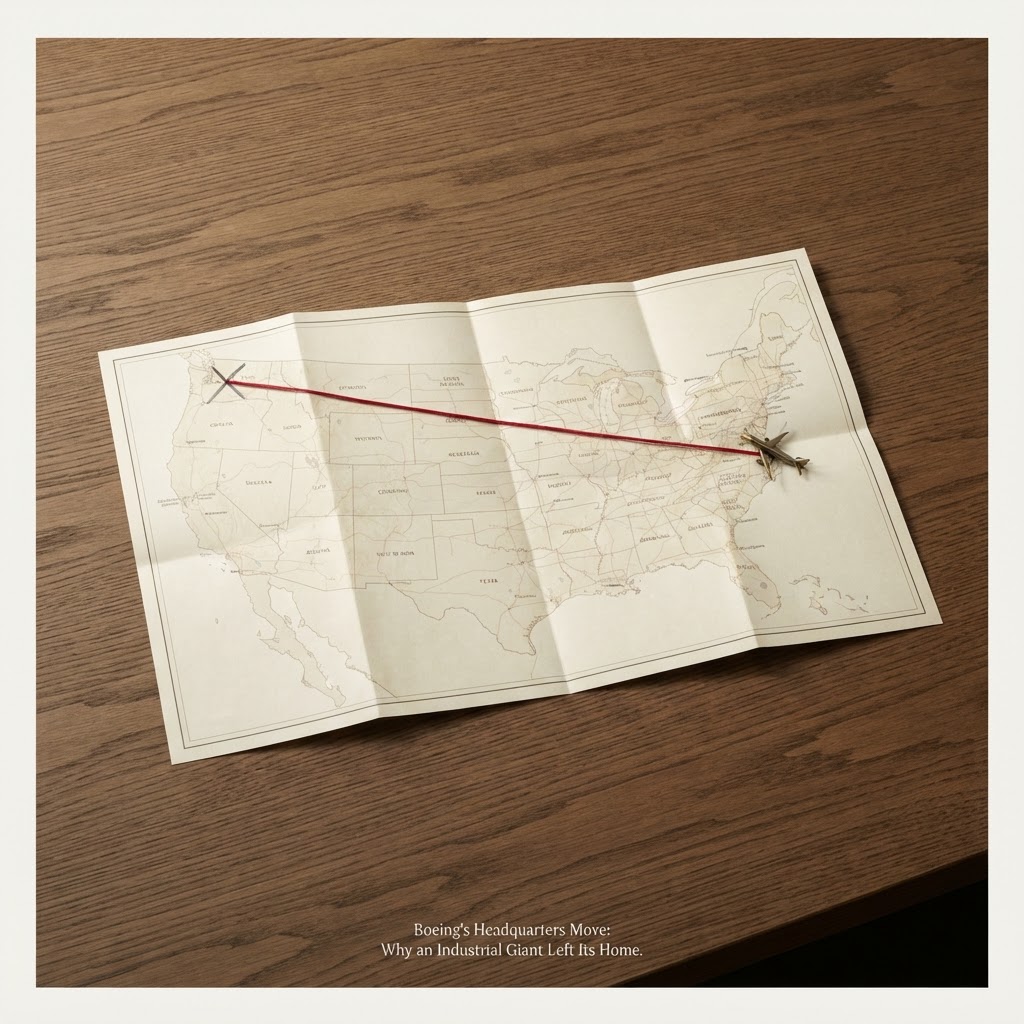
A moving truck doesn't look like a strategy document. But when Boeing pointed one 1,700 miles away from its own engineers, it was answering a question it had spent years refusing to ask aloud.
Pairs with the Fork Decision Tree — a ready-to-use strategy tool, filled for Boeing. Included in the The Fork Casebook →
On March 21, 2001, Boeing's chairman Phil Condit stunned his own company by announcing it would move its headquarters out of the Seattle area — the region where Boeing had built airplanes for 85 years. 1 Three cities had been quietly competing for the prize; the rank and file hadn't been told it was even in play. Within months, a few hundred executives decamped to a tower on the Chicago River, roughly 1,700 miles from the factory floors of Everett and Renton where the actual airplanes came together.
It was sold as a real-estate and tax decision, and on a spreadsheet it penciled out — Chicago reportedly courted Boeing with tens of millions in incentives. 2 But underneath the relocation sat a philosophy. The choice to physically separate the people who allocate capital from the people who bend metal was Boeing answering a question it had spent years avoiding: are we an engineering company that happens to make money, or a financial company that happens to make planes? The honest reading of the move is that, for the first time, the company put its money on the second answer.
The fork hidden inside a relocation: where the stated benefit and the eventual disease turn out to be the same word
Condit's stated rationale was, in hindsight, remarkably candid. The point of a separate headquarters, he argued, was that corporate leadership should not sit on top of any one business. The center needed altitude — distance from the daily gravity of the commercial-airplane unit so it could judge defense, space, and services with a cooler, more dispassionate eye. 3 Read that twice. The stated benefit of the move was the very thing critics would later call the disease: distance. Separation wasn't a side effect to be managed. It was the objective.
This is what makes the move a genuine strategic fork rather than a logistics footnote. A true fork isn't the option that looks bold — it's the one that quietly forecloses an alternative. By relocating leadership away from engineering, Boeing didn't just change a commute. It changed whose questions got asked first in every budget meeting for the next two decades: the engineer's 'will it be safe and excellent?' or the financier's 'what will it return, and how fast?' When those two questions tie, the tie goes to whoever sits closer to power. Boeing had just decided, in steel and glass and a moving-truck invoice, who that would be.
Why the fork existed at all: the merger that came before: the new headquarters wasn't a break from the culture shift — it was that shift finally given an address
You can't understand 2001 without 1997. When Boeing absorbed McDonnell Douglas, a running joke in the industry was that McDonnell Douglas had bought Boeing with Boeing's own money. The acquired company's finance-first, shareholder-value culture — and several of its executives — moved into the cockpit. Harry Stonecipher, the McDonnell Douglas leader who became Boeing's president, was openly contemptuous of the old engineering-led ethos; he wanted Boeing run, in his telling, like a business rather than 'a great engineering firm.' 4 The headquarters move four years later wasn't a break from that shift. It was its physical consummation — the new creed given an address of its own, away from the engineers it was meant to discipline.
Distance changes which problems feel urgent: proximity is attention, and geography can do the suppressing so no one has to
Here is the argument this page exists to make. Org-chart geography is not neutral, because proximity is attention. When leadership shares a parking lot with engineers, a concern about a flight-control system is a hallway conversation — overheard, escalated, hard to ignore. When leadership sits 1,700 miles away, that same concern arrives pre-digested as a line in a deck, where it's far easier to discount, defer, or out-argue with a competing spreadsheet. Nobody has to suppress the engineer's warning. The geography does the suppressing for them, by raising the friction of the warning ever reaching the room where money is decided.
The fair objection is that this is too tidy: surely a memo travels 1,700 miles as easily as 17 feet, and plenty of well-run companies separate HQ from operations. True — and that's why the move alone proves nothing. What it does is tilt the field. It makes the financial frame the default and the engineering frame the exception that has to fight its way upstream. Over twenty years, defaults compound. The decision that most clearly shows the tilt came in 2011, when Boeing chose to re-engine the decades-old 737 rather than design a clean-sheet replacement — the faster, cheaper answer to Airbus, and the one that led to the MCAS compromises at the heart of the MAX disaster. 5 That wasn't a single villain's choice. It was the house style of a company that had relocated its judgment.
| The engineering company | The financial company | |
|---|---|---|
| Core question | Is it the best aircraft we can build? | What is the return on the program? |
| Where power sits | Beside the factory | Beside the capital markets |
| Default answer to a clean-sheet design | Build it right | Re-engine to protect cash and schedule |
| What gets optimized | Safety margin, performance | Cost, time-to-market, share price |
| Whose memo wins a tie | Chief engineer | Chief financial officer |
The second-order consequence: the tilt kept tilting: read as a sequence, each relocation points leadership further from the people who build the product
If the move were merely symbolic, the story would end with the MAX. It doesn't. In 2022 Boeing relocated its headquarters again — this time from Chicago to Arlington, Virginia, a short drive from the Pentagon and the regulators in Washington, and further still from the factory in Washington State. 6 Read as a sequence, the two moves describe a clear trajectory: leadership migrating steadily away from the people who design and build the product and toward the people who fund, buy, and oversee it. The planes are still made near Seattle. The decisions about them are now made wherever the capital and the customers are. That is the fork, twenty years on, still resolving in the same direction.
On the spreadsheet, the 2001 move was a win: incentives in, overhead optimized. The cost that no NPV could capture was cultural — the slow erosion of the engineer's veto. When you evaluate a fork, the decisive consequences are usually the ones that can't be priced: whose concerns get heard first, and whose get to wait. Audit which function wins your ties. That, not your mission statement, is your real strategy.
None of this is an argument that headquarters belongs in a hangar. It's an argument that where you put your decision-makers is itself a decision about what they'll decide. Boeing didn't outsource its engineering. It out-located its judgment — and spent the next two decades discovering what that costs.
Fork Decision Tree
Take the either/or in front of you and draw it out: the question at the fork, the two branches, and what each one triggers two and three moves later. Blank, it forces you to spell out consequences before you commit instead of after. Filled, it replays the story's fork so you can see exactly where each path led — and which downstream node actually decided the outcome.
Included, filled and blank, in the The Fork Casebook. See the set → · Preview the blank →
Sources
Where this comes from — the filings, records, and reporting behind it.
- 1On March 21, 2001, Boeing announced it would move its corporate headquarters out of the Seattle area, its home for ~85 years, ultimately to Chicago (chosen over Denver and Dallas).
- 2Chicago and Illinois offered Boeing a tax-incentive package reported at more than $60 million over ~20 years in exchange for relocating ~500 headquarters jobs.
- 3Boeing (CEO Phil Condit) framed the move as creating a 'neutral' corporate headquarters - an 'honest broker' among its units, deliberately separated from the Seattle operating centers and closer to customers and the financial community.
- 4After the Boeing-McDonnell Douglas merger (completed Aug 1, 1997), a finance-first culture took hold; Harry Stonecipher - the ex-McDonnell Douglas chief who became Boeing's president and CEO (2003-2005) - embodied it, telling the Chicago Tribune in 2004 that he changed Boeing's culture so it would run 'like a business rather than a great engineering firm.'
- 5In 2011 Boeing's board approved (Aug 30, 2011) re-engining the existing 737 - creating the 737 MAX - rather than designing a clean-sheet replacement, a decision driven by the Airbus A320neo and American Airlines' 2011 order; the MAX's MCAS flight-control system was a central factor in two crashes (Lion Air 610, 2018; Ethiopian 302, 2019; 346 deaths total), per official investigations.
- 6In 2022 Boeing relocated its headquarters again, from Chicago to Arlington, Virginia, near the Pentagon and federal regulators.
More like this — beyond Boeing
New Strategically analyses as they publish: the defining moves in business, checked against the record. No noise, and one click to leave.