Pairs with the Market-Entry Gambit Canvas — a ready-to-use strategy tool. Included in the The Market Entry Gambit Casebook →
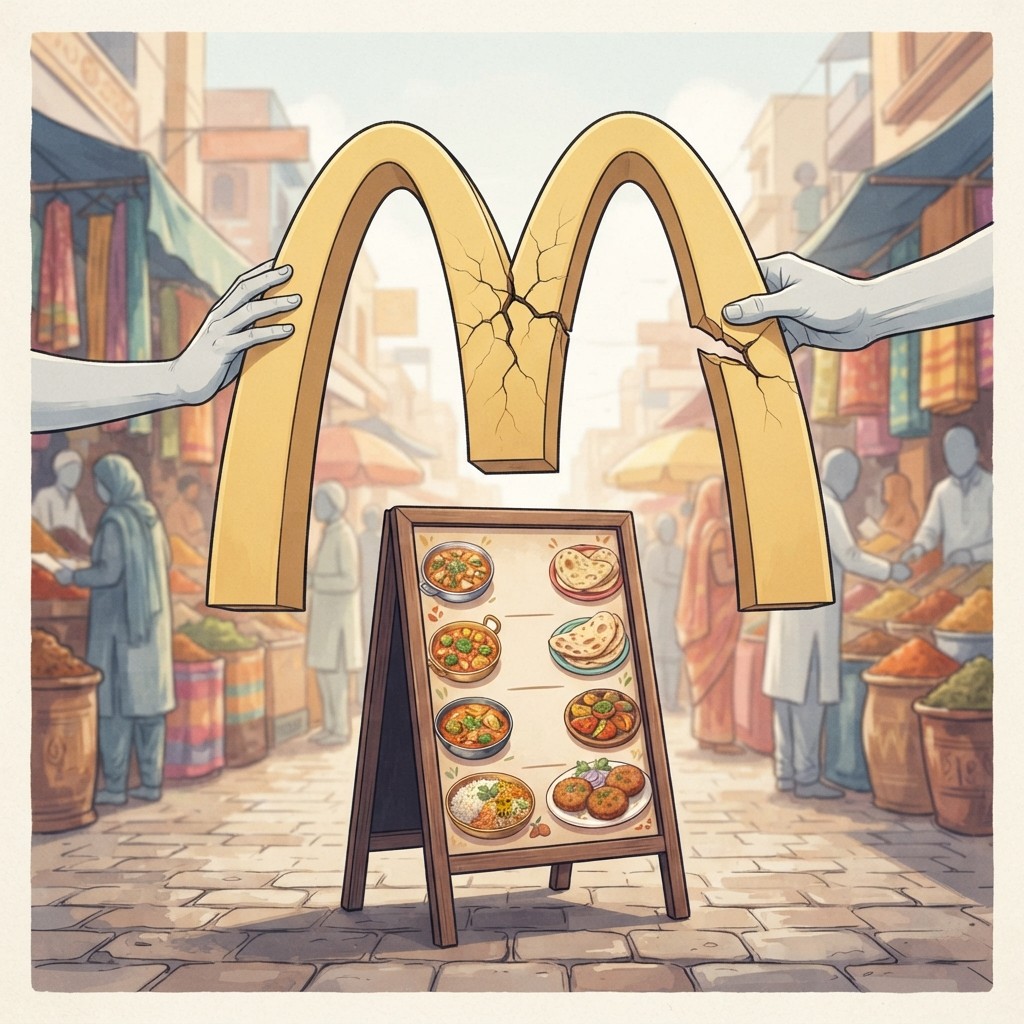
To open its first restaurant in India, McDonald's had to do something it had never done in any country on earth: take the beef off the menu. Not soften it, not offer an alternative — remove it entirely, along with pork, before a single customer walked in. The company that built a planet-spanning empire on a beef patty between two buns arrived in New Delhi on October 13, 1996 selling neither beef nor pork to anyone.2 It had spent more than five years getting to that day.5 This is usually told as the textbook win — the brand that humbly localized and conquered. The more interesting truth is that the same architecture that let McDonald's crack India later dragged it through a courtroom and shut the lights off in most of Delhi.
The popular version says McDonald's entered India in 1996 and Indianized its way to victory. Almost every clause of that needs editing. The corporate entry was 1993; the partnerships came in 1995; only the first restaurant was 1996.32 And it didn't 'franchise' its way in the way the chain did across America. It married two local operators in a structure that would, two decades later, turn into the central villain of the story.
The market was hostile by design, not by accident
Most foreign entrants fail in India because they treat it as a discount version of a Western market — same product, lower price. McDonald's understood the opposite: India is structurally hostile to the exact thing that makes McDonald's McDonald's. The cow is sacred to a Hindu majority; the pig is forbidden to a Muslim minority. A vast share of customers are vegetarian, and many of those who eat meat will not tolerate it touching their food. So the company did the unglamorous, expensive work first. It built the first beef-less and pork-less menu in its history, and it laid down a cold chain across the country before it ever sold a fry — the refrigerated logistics backbone that lets a standardized product exist in a place that had none.5 The kitchen itself was rebuilt: vegetarian and non-vegetarian products kept completely separate, from food processing all the way to the point of service.6 That separation is not a garnish. It is the price of trust in a market where a single cross-contamination rumor can end you.
| Global McDonald's | McDonald's India at entry | |
|---|---|---|
| Hero product | The Big Mac (beef) | The Maharaja Mac (mutton patty) |
| Beef and pork | The core of the menu | Removed entirely — a global first |
| Signature local item | — | McAloo Tikki: potatoes and peas |
| Kitchen | One line | Veg and non-veg fully separated, end to end |
| Menu origin | Mostly exported | More than 70% locally developed |
The reformulation went all the way to the marquee. The Big Mac — McDonald's flagship product and one of the most recognized foods on the planet — was replaced by the Maharaja Mac, originally built around a mutton patty so it would offend neither Hindu nor Muslim diners. Alongside it came the McAloo Tikki, a burger of potatoes and peas invented for the market, not adapted to it. By the company's own academic case record, more than 70% of the India menu was locally developed.6 McDonald's did not bring its product to India. It rebuilt its product as something India would accept, and kept only the logo.
The thesis: the marriage that opened the market also booby-trapped it
Here is the part the success story skips. McDonald's did not enter India as a master franchisor collecting royalties from an operator. It formed two 50:50 joint ventures in 1995 — Connaught Plaza Restaurants with the Delhi realtor Vikram Bakshi for the North and East, and Hardcastle with Mumbai's Amit Jatia for the West and South.37 Fifty-fifty is the crucial detail. A standard franchise has a clear owner and a clear operator; a 50:50 JV has two owners and no tiebreaker. That structure is what gave McDonald's a local partner who could navigate real estate, regulation, supply, and cultural minefields a foreign brand could not — and it is precisely the structure that, when the partnership soured, gave the local partner equal standing to fight back. The JV terms even priced in patience: profits weren't expected to flow until the final ten years of a twenty-five-year agreement.7 McDonald's bought local muscle for the entry by giving away half the company. The bill arrived later.
In 2013 McDonald's ousted Bakshi as managing director of the northern joint venture. He took the fight to the National Company Law Tribunal, alleging oppression — and in July 2017 the tribunal ruled the steps taken to remove him unlawful, and put him back.4 McDonald's then terminated the franchise agreement covering 169 restaurants across North and East India.4 The breakthrough partnership had become a hostage situation, and the customers paid: a large share of Delhi's outlets went dark. The same equal-standing structure that let a Delhi realtor open doors for a foreign giant let him slam them shut when the giant tried to push him out.
“The first McDonald's restaurant in India opened on October 13, 1996 at Basant Lok, Vasant Vihar, New Delhi — the first McDonald's restaurant globally not to serve any beef or pork products[[cite:s10]][[cite:s11]].”2
Wasn't the localization the real genius, and the lawsuit just bad luck?
The fair objection is that the menu was the masterstroke and the legal mess was an unrelated misfortune — a partner who turned difficult, the kind of thing that can happen anywhere. There's truth in it: McDonald's genuinely innovated, and the rest of its system is enviably clean, with roughly 95% of its 41,822 restaurants franchised across more than 100 countries and global franchise sales of nearly $120 billion in 2023.18 But the menu and the lawsuit were not separable. The beef-less reinvention required deep local knowledge — supply, sourcing, the cold chain, the cultural reading — and the fastest way to buy that knowledge in 1995 was to hand half the equity to someone who already had it. The localization didn't happen despite the joint venture; it happened because of it. You cannot praise the entry and disown the structure that made the entry possible. The honest reading is that McDonald's accepted a governance fragility as the cost of cracking a closed market, and then discovered, twenty years later, what that cost actually was.
When a market is genuinely hard to enter — regulatory thickets, cultural landmines, no supply chain — the local partner who can get you in is, by definition, someone with leverage you don't have. A 50:50 joint venture converts that leverage into permanent equal standing. That's a feature on the way in and a defect on the way out. So price the divorce when you write the marriage: decide who breaks a tie, what triggers a buyout, and what a clean exit costs, while everyone is still friendly. The mechanism that opens the door is rarely the mechanism you want guarding it a decade later — and the time to fix that is before you've built 169 restaurants on top of it.
McDonald's did crack a market that breaks others. It deleted its own best-selling product, rebuilt its kitchen around a faith line, invented burgers that exist nowhere else, and laid cold-chain track across a country that had none — a feat of localization so complete that India became the first place on earth where a McDonald's served no beef.25 All of it real, all of it earned. But the gambit had a clause buried in it. The half-share that bought the local genius also handed away the tiebreaker, and when the partnership failed, the very leverage that opened India was used to keep it open against the company's will. The lesson isn't 'localize.' Everyone says localize. The lesson is harder: the deal that gets you in is almost never the deal you want to be stuck with — and a market entry is only as durable as the exit you never bothered to design.
Market-Entry Gambit Canvas
A one-page canvas for staging an entry into a market you don't own yet: the beachhead you take first, the wedge that gets you in cheaply, the sequence that turns a foothold into a position, and the incumbent's likely counter-move. Blank to plan your own entry; filled as the worked example showing how the story's challenger picked its landing spot and walked the rest in.
Included, filled and blank, in the The Market Entry Gambit Casebook. See the set → · Preview the blank →
Sources
Where this comes from — the filings, records, and reporting behind it.
- 1Of the 41,822 McDonald's restaurants at year-end 2023, approximately 95% were franchised; the company operates in more than 100 countries.
- 2The first McDonald's restaurant in India opened on October 13, 1996 at Basant Lok, Vasant Vihar, New Delhi — and it was the first McDonald's restaurant globally not to serve any beef or pork products[[cite:s10]][[cite:s11]]. Three days later, Hardcastle opened the Mumbai outlet in Bandra.
- 3McDonald's entered India in 1993 (incorporation of McDonald's India Private Limited) and formed two 50:50 joint ventures in 1995 — one with Vikram Bakshi (Connaught Plaza Restaurants Ltd, covering North and East India) and one with Amit Jatia (Hardcastle Restaurants, covering West and South India).
- 4In 2013, McDonald's ousted Bakshi as managing director of CPRL. Bakshi challenged his removal before the National Company Law Tribunal alleging oppression. The NCLT ruled in July 2017 that steps taken to non-elect Bakshi were unlawful and reinstated him. McDonald's subsequently terminated CPRL's franchise agreement for 169 restaurants in North and East India.
- 5McDonald's spent more than 5 years (from 1990 onwards) developing the first beef-less and pork-less menu in McDonald's history, and pioneered the establishment of a cold chain across India prior to its 1996 opening.
- 6McDonald's India replaced its core product the Big Mac with the Maharaja Mac (served with a mutton patty rather than beef to avoid offending Hindu and Muslim dietary restrictions) and introduced the McAloo Tikki burger made from potatoes and peas as a locally developed product. More than 70% of the menu in India was locally developed, with complete separation of vegetarian and non-vegetarian products from food processing to point of service.
- 7McDonald's India forayed into India in 1995 by forging partnerships with Bakshi, then a Delhi-based realtor, and Mumbai-based Jatia. The CPRL joint venture was a 50:50 split; the JVA specified that profits would only begin flowing in the last 10 years of the 25-year JV period, signaling a structurally long-horizon commitment.
- 8McDonald's global franchise sales reached $119.75 billion in 2023, up from $109.47 billion the prior year, based on data sourced from McDonald's corporate filings.
- 943 of McDonald's 55 Delhi outlets were closed since June due to expiry of eating house licences, with 18 of those 43 later reopening on 19 September after health licences were received.
- 10The first McDonald's restaurant in India, which opened on October 13 1996, was the first in the then-19,400-strong McDonald's chain not to offer beef and pork derivatives on its menu.
- 11The world's first McDonald's restaurant without beef burgers opened on October 13 1996 in New Delhi; the Maharaja Mac featured two all-mutton patties.
More like this — beyond McDonald's
New Strategically analyses as they publish: the defining moves in business, checked against the record. No noise, and one click to leave.