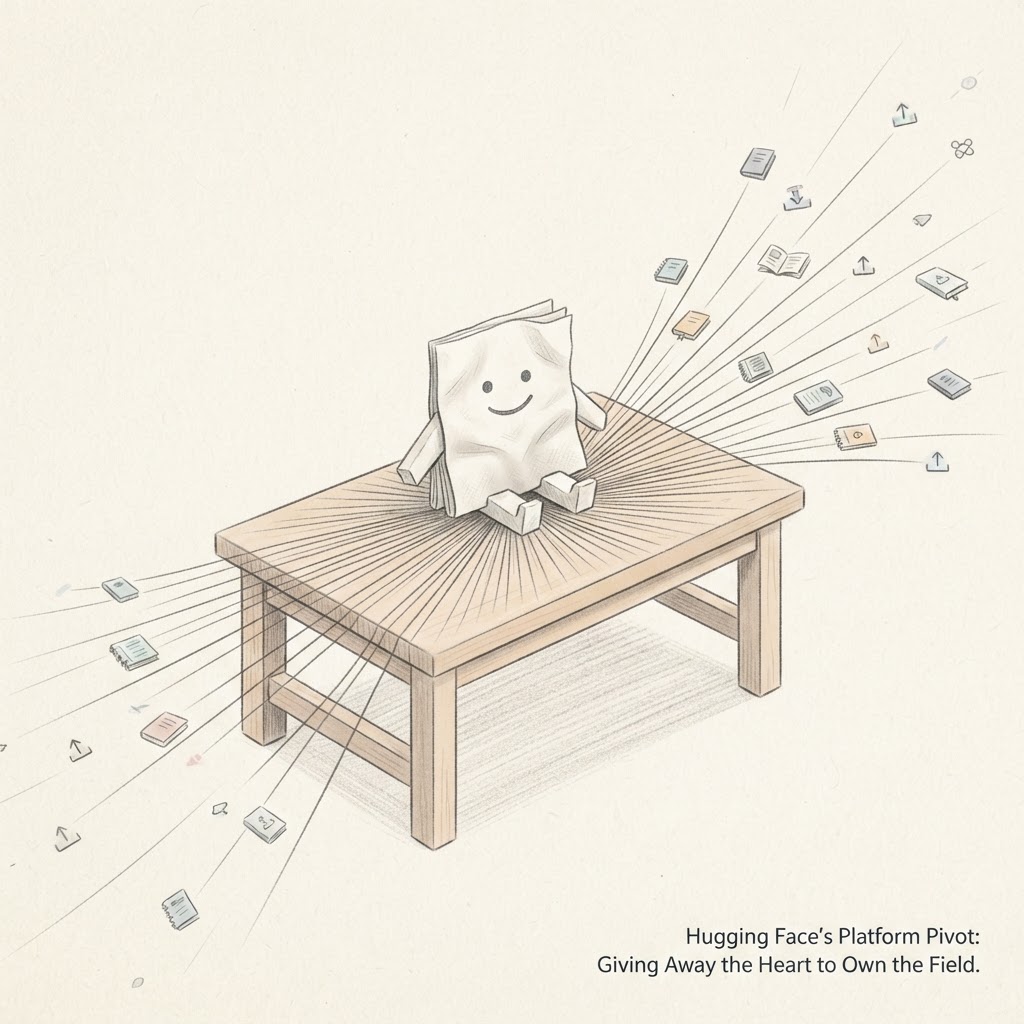
A chatbot for teenagers gave away its best code to its own rivals — and became the front door to all of AI. The pivot wasn't luck. It was the nerve to stop competing and start owning the ground everyone else fights on.
Pairs with the Fork Decision Tree — a ready-to-use strategy tool, filled for Hugging Face. Included in the Fork Casebook →
“What did the decision you did not take actually cost?”
Hugging Face started as a joke you could talk to. Founded in 2016 in New York by three French engineers — Clément Delangue, Julien Chaumond, and Thomas Wolf — and named after the 🤗 emoji, the product was a chatbot app aimed at teenagers: a friendly AI you texted when you were bored.1 And it worked. By 2017 it had around 100,000 daily users sending it more than a million messages a day.2 For a consumer app, that's not failure. That's traction most startups would kill for. They walked away from it anyway.
The story everyone tells is tidy: a cute consumer app flopped, and the team got lucky when a side project — an open-source machine-learning library — happened to blow up. That version is wrong in the part that matters. The library didn't rescue a dying company. The founders looked at a working product and a free side project and made a deliberate choice: the free thing they were giving away was the more valuable business. The interesting question was never 'why did the chatbot fail?' It's why a team would kill a live product to go maintain software they hand to their own rivals for free — and the answer is a lesson in what a platform actually is.
The week the side project became the company: a piece of plumbing that thousands of people needed and nobody wanted to build twice
Here's the mechanical trigger. In late 2018, Google released BERT — a language model that reset the state of the art in natural-language processing overnight. Every AI team on earth wanted to use it, but Google shipped it in TensorFlow, and much of the research world lived in PyTorch. Within days, the Hugging Face team ported BERT to PyTorch and open-sourced it.2 It was a small act of engineering plumbing. It became the most-used code they ever wrote.
Because it turned out thousands of researchers had the exact same problem, and no one wanted to solve it twice. The port — which grew into the Transformers library — became the default way to load a state-of-the-art model in one line. That's the moment the company changed shape. Not because the library was brilliant (plenty of people could port BERT), but because the founders saw what it was: not a tool, but a position. Every team that pulled a model through Transformers was standing on Hugging Face's ground. So in 2019 they made the fork. They stopped building a product and started building the place other people build their products. The chatbot — the thing with real users — was retired. The free library became the company.
Why giving it away was the strategy, not the sacrifice: price the ground at zero and let the network do the compounding
This is the move that looks insane until you see the mechanism. Hugging Face's most valuable assets — the library, and later the Hub that hosts the models, datasets, and demos — are free and open. They hand the crown jewels to Google, Meta, Amazon, and every AI startup, no charge. A normal reading calls that leaving money on the table. It's the opposite: the free layer is the moat.
Watch the flywheel. Every model someone uploads makes the Hub more valuable to download from. Every download makes it more valuable to upload to — because that's where the users are. Two sides, each pulling the other, and the whole thing spins faster the more open it is. A model behind a paywall never enters the flywheel. So Hugging Face priced the ground at zero and let the network do the compounding. The Hub grew to host well over a million models and became what people started calling the GitHub of machine learning — the default place the entire field publishes and pulls its work. But the deeper reason the flywheel spun for Hugging Face and not for the giants is the thing they gave up: they refused to compete with their own users.
The moat isn't the code — it's the neutrality: in a field where every serious player is also a rival, the one that competes with no one wins the middle
Google, Meta, and OpenAI all host models too. But every one of them also wants to own the end product — the assistant, the cloud, the ad engine that the models feed. A startup that publishes its model on a Google-owned platform is handing distribution to a company that would happily replace it. That tension is permanent, and it caps how much anyone will trust the platform. Hugging Face has no such tension, because it deliberately kept none. It doesn't sell the winning chatbot. It doesn't run the dominant cloud. It doesn't compete with the labs whose models it hosts or the startups who build on it. It is Switzerland — and in a field where every serious player is also everyone else's rival, the one place that competes with no one becomes the one place everyone can safely stand. Killing the chatbot wasn't just retiring a product. It was resigning from the war so it could sell tickets to it.
| Chatbot era (2016–18) | Platform era (2019–) | |
|---|---|---|
| What Hugging Face sells | A finished product (the chatbot) | The ground others build products on |
| Relationship to AI teams | A rival for the same users | The neutral place they all publish |
| The crown jewels | Kept, to power the app | Given away free, to spin the flywheel |
| Where value compounds | One app's user growth | Every upload and download, network-wide |
| The moat | Being a better chatbot | Being the default — and competing with no one |
The honest objections: the two a sharp reader raises first
'They just got lucky. BERT dropped, they happened to port it first.' Luck was real — the timing was a gift. But dozens of teams could have ported BERT, and some did. Only one decided the port, not its own live product, was the company, and then killed a chatbot with 100,000 daily users to prove it meant it.2 Luck handed everyone the same week. The strategy was seeing that being the distribution layer beat being a product, and having the nerve to act before the evidence was comfortable.
'It's all free — where's the business?' The same place a cloud provider's is: you don't monetize the free layer, you monetize the gravity it creates. Once you're the default place every enterprise's ML team already works, you sell them the things they'll pay for around it — private model hosting, managed inference, an enterprise-grade Hub, compute. Revenue was still small and early (roughly $15 million in 2022), which is exactly why the skeptic isn't wrong to ask. But the market answered the strategic question in 2023: Hugging Face raised $235 million at a $4.5 billion valuation, in a round that included the very giants it gives its software to — Google, Amazon, Nvidia, Salesforce, IBM, Intel, AMD, and Qualcomm.3 They didn't invest in a chatbot, or in a library. They invested in the toll booth — and several of them were paying the toll.
When a company gives away its best asset for free, don't call it charity or a mistake — look for the flywheel the free layer feeds. Value moves from the product to the position. And notice what the winners refuse to do: a platform earns trust by not competing with the people who build on it. Hugging Face killed a working product to become the neutral ground of its industry, because a rival can't be a Switzerland. If you want to own the middle of a market, you often have to resign from the fight for its ends.
Hugging Face's pivot is usually filed as a plucky-startup comeback. It's something colder and more useful than that. The founders had a working consumer product and gave it up, on purpose, to occupy a position instead: the neutral distribution layer of an entire industry. They gave away the models — which depreciate the moment a better one ships — to own the shelf they sit on, which only gets more valuable as the shelf fills. The lesson isn't 'open source wins.' It's sharper. In a field where everyone is racing to own the product, the most defensible place to stand is often the one spot no one else can occupy — the ground between the competitors, held by the one company willing not to be one of them. Hugging Face stopped trying to win the game. That's how it ended up owning the field.
Fork Decision Tree
Take the either/or in front of you and draw it out: the question at the fork, the two branches, and what each one triggers two and three moves later. Blank, it forces you to spell out consequences before you commit instead of after. Filled, it replays the story's fork so you can see exactly where each path led — and which downstream node actually decided the outcome.
Included, filled and blank, in the Fork Casebook. See the set → · Preview the blank →
Sources
Where this comes from — the filings, records, and reporting behind it.
- 1Hugging Face was founded in 2016 in New York City by Clément Delangue, Julien Chaumond, and Thomas Wolf, originally as a chatbot app aimed at teenagers, named after the 🤗 emoji; it later pivoted to a machine-learning platform after open-sourcing its model.Wikipedia, Hugging Face ↗ · 2026-07
- 2The consumer chatbot launched publicly in March 2017 and reached roughly 100,000 daily active users processing over one million messages per day; after Google released BERT in late 2018, the team open-sourced a PyTorch implementation within days, which grew into the Transformers library and prompted the 2019 pivot to open-source ML infrastructure.
- 3In August 2023 Hugging Face raised $235 million in a Series D round at a $4.5 billion valuation, led by Salesforce Ventures with participation from Google, Amazon, Nvidia, Intel, AMD, Qualcomm, and IBM — roughly double its ~$2 billion valuation from May 2022.
Weighing outside help with a decision like this? Hiring a corporate strategy consultant
More like this — beyond Hugging Face
New Strategically analyses as they publish: the defining moves in business, checked against the record. No noise, and one click to leave.