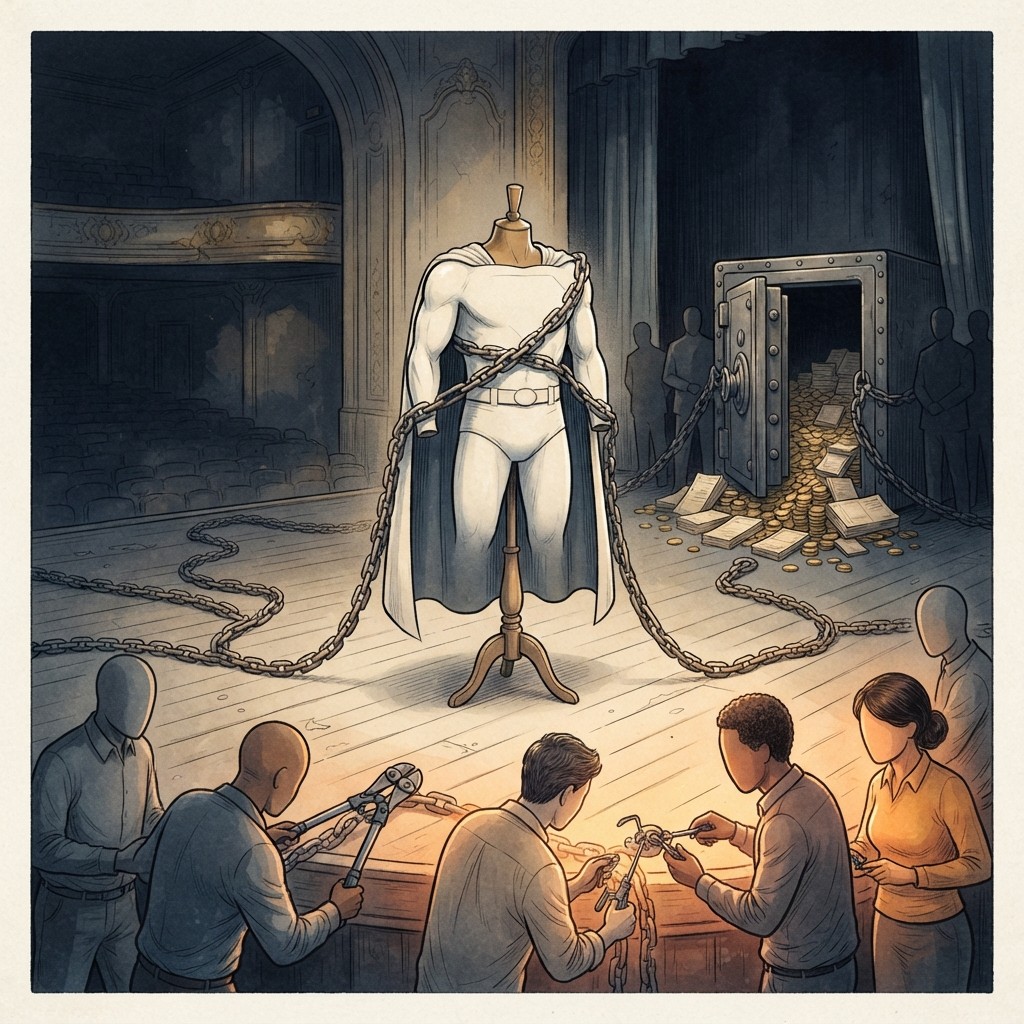
Pairs with the Founder Doctrine Canvas — a ready-to-use strategy tool. Included in the Founder Doctrine Casebook →
“What does holding control cost you, and what must it be worth?”
In 1989, a corporate raider bought Spider-Man, the X-Men, and the entire Marvel universe for $82.5 million1 — a fraction of what studios would routinely spend on a single superhero movie a generation later. Ronald Perelman did not buy Marvel to make comic books. He bought it the way he bought everything: as an asset to be borrowed against. Within five years he had pledged roughly 80% of Marvel's stock as collateral for bonds with a face value of $894 million.2 The characters were never the product. The collateral was.
The official story is that Marvel nearly died from bad comics and bad luck. The real story is quieter and stranger: Marvel kept changing hands not because the characters lost value, but because the people who held them kept treating them as something to leverage rather than something to believe in. The whole modern arc — bankruptcy, raider, raider, operators, Disney — is a single mechanism running over and over. Control slips from the people who make the thing to the people who finance it, and the thing suffers until someone who actually believes in it gets the keys back.
The pledge that handed the keys to a stranger
Here is the part everyone glosses over. Owning 80% of a company normally makes you untouchable. But Perelman had pledged that stock as security for the bonds he issued in 1993 and 1994.2 Pledged collateral is not really yours anymore — it is a hostage you've handed to your lenders, retrievable only if you keep paying. When Marvel filed for Chapter 11 on December 27, 1996,3 the lenders could simply claim what had been promised to them. Perelman's controlling stake evaporated not because he was outvoted but because he had already signed it away in exchange for cash years earlier. The 80% was never armor. It was bait, sitting in escrow, waiting for someone with the patience to wait for a default.
That someone was Carl Icahn, who bought Marvel's distressed bonds at a fraction of their value and turned the pledge against the man who made it.3 But notice what Icahn won, and how little time he kept it. In 1997 he gained court approval to vote the pledged stock and replace Marvel's board, Perelman included. By December 1997 the bankruptcy court appointed a trustee and pushed Icahn out.3 Two financiers fought a brutal war over Marvel, and both lost — the court took the company away from each of them in turn. The men who treated Marvel as a position to trade could not hold it.
The men who were already inside
The recovery did not arrive as a rescue from outside. ToyBiz — the toy company that licensed and sold figures of Marvel's characters — and Marvel were merged into a new entity, Marvel Enterprises, in June 1998, with ToyBiz folded in as a division.4 This is the detail that gets flattened in the retellings: nobody simply 'bought' Marvel out of bankruptcy. Both Perelman and Icahn were ousted, and the people who took control — Isaac Perlmutter and Avi Arad — had been on Marvel's board since 1993.4 They were not raiders parachuting in. They were operators who already had skin in the actual business of making and selling things people wanted, and who had watched two financiers nearly destroy a company by treating it as a balance-sheet entry.
| The financiers (Perelman, Icahn) | The operators (Perlmutter, Arad) | |
|---|---|---|
| What Marvel was to them | Collateral and a trading position | A working business they ran |
| How they made money | Leverage, distressed debt, the deal | Products, licensing, films |
| Relationship to the IP | Something to borrow against | Something to build with |
| How long they held control | Years, then six months | A decade, into the Disney era |
The cleanest evidence of the operators' instinct is what they did next. Rather than license the remaining characters out for quick fees, they decided to finance their own films — and the structure they chose tells you everything about how carefully they now guarded ownership. In September 2005 Marvel closed a $525 million non-recourse credit facility arranged by Merrill Lynch, with the borrowing done by a bankruptcy-remote subsidiary, MVL Film Finance LLC.6 The crucial word is non-recourse: the debt was explicitly not recourse to Marvel Enterprises itself.6 A man who had just watched a pledge devour a company built a firewall so that, if the films flopped, the lenders could take the movie rights inside the box — and nothing else.
And look at what was actually in the box. The collateral was the film rights to ten characters: Ant-Man, the Avengers, Black Panther, Captain America, Cloak & Dagger, Doctor Strange, Hawkeye, Nick Fury, Power Pack, and Shang-Chi.7 Not Spider-Man. Not the X-Men. Not the Fantastic Four — those rights had already been licensed away to other studios.7 The popular telling is that Marvel 'bet its best characters.' It did the opposite: it pledged the leftovers, the B-team, the ones nobody else wanted, and built a cinematic universe out of them. The genius wasn't the financing. It was that the operators saw value where the financiers had only seen something to sell off.
When you pledge an asset, you are telling the world you value the cash today more than the thing itself tomorrow. Perelman pledged his controlling stake and lost the company. Marvel's operators pledged only the second-tier film rights — and ring-fenced them so a failure couldn't reach the parent. The test of whether a founder believes in their IP is not what they say about it; it's what they refuse to put on the table. The characters you will not borrow against are the ones you actually intend to keep.
The mini-Disney line everyone misremembers
There is a famous quote that Perelman called Marvel a 'mini-Disney,' usually offered as proof he had a grand vision all along. He didn't. The line came in a 1995 magazine interview, and he said it in response to the interviewer's own prompt — he was agreeing with a leading question, not unveiling a blueprint.5 It matters because the myth credits the financier with foresight he never had. The man who likened Marvel to Disney didn't build the path to Disney; he built the path to bankruptcy court. The people who turned the comparison into reality were the operators who took over after he was gone.
“It is a mini-Disney in terms of intellectual property... But at Marvel we are now in the business of the creation and marketing of characters.”5
Wasn't selling to Disney just the operators cashing out?
The fair objection is that the operators' story ends the same way the financiers' did: with control leaving the building. On August 31, 2009, Disney announced it would acquire Marvel at a transaction value of approximately $4 billion, paying shareholders $30 per share in cash plus 0.745 Disney shares each; the stockholders approved it on December 31, 2009.89 If conviction was the whole lesson, why sell the thing you believed in? Because conviction and ownership are not the same axis. The operators proved that only someone who treats the IP as a business — not as collateral — can sustain it. But sustaining it is expensive, and a global film universe needs a parent with theme parks, distribution, and a balance sheet the size of Disney's. The sale wasn't a betrayal of the doctrine; it was its logical end. Control moved one layer up, to an owner that, whatever else it is, genuinely makes things from its characters rather than borrowing against them.
So the arc completes itself with a twist. Perelman called Marvel a mini-Disney as a throwaway line; two decades later it became part of the actual Disney, at a transaction value of approximately $4 billion9 — roughly fifty times what he'd paid. But the company that got there was the one the financiers couldn't hold. Control of great IP behaves like the pledged stock at the center of this whole story: it flows, inexorably, toward whoever is willing to keep paying for it — not in interest, but in belief. Perelman pledged Marvel and lost it. The operators refused to pledge what mattered, and kept it long enough to make it worth selling to someone who would actually build with it. The lesson isn't that Marvel was saved. It's that the only owner who can hold extraordinary IP is the one who would never have put it up as collateral in the first place.
Founder Doctrine Canvas
A one-page canvas for the operating system inside a founder's head: the principles they hold, the formative experiences that forged them, and the specific strategic moves each principle produces. Blank to make your own decision rules legible to the people who execute them; filled as the worked example showing why the story's company keeps making the bets it makes — because the founder can't make any others.
Included, filled and blank, in the Founder Doctrine Casebook. See the set → · Preview the blank →
Sources
Where this comes from — the filings, records, and reporting behind it.
- 1Ronald Perelman's MacAndrews & Forbes Holdings bought Marvel from New World Entertainment for $82.5 million on January 6, 1989.
- 2At the time of the Chapter 11 filing, Ronald O. Perelman controlled Marvel through the Holding Companies, which owned 80% of Marvel's common stock; Perelman had pledged that stock as security for bonds issued in 1993 and 1994 in a face amount of $894 million. Marvel also owed secured lenders including Chase Manhattan Bank approximately $625 million.
- 3The Marvel group of companies filed for Chapter 11 bankruptcy protection on December 27, 1996. Carl Icahn began buying Marvel's bonds at 20% of their value; in February 1997 Icahn won court approval to take control of the company's stock, and in June 1997 won the right to replace Marvel's board including Perelman. In December 1997, the bankruptcy court appointed a trustee in place of Icahn.Variety, Perelman Takes Marvel to Bankruptcy Court ↗ · 1996-12-30
- 4ToyBiz and Marvel were merged into Marvel Enterprises to bring the company out of bankruptcy in June 1998, with ToyBiz becoming a division of the new company. Both Perelman and Icahn were ousted in the process; Isaac Perlmutter and Avi Arad, who had been on Marvel's board since 1993, assumed control.
- 5Perelman's 'mini-Disney' quote — 'It is a mini-Disney in terms of intellectual property. Disney's got much more highly recognized characters and softer characters, whereas our characters are termed action heroes. But at Marvel we are now in the business of the creation and marketing of characters' — was made in response to an interviewer's prompt in a 1995 Cigar Aficionado interview, not as an unprompted founding vision.
- 6On September 6, 2005, Marvel Enterprises announced completion of a $525 million non-recourse credit facility arranged by Merrill Lynch, Pierce, Fenner & Smith Inc., consisting of $465 million in revolving senior bank debt and $60 million in mezzanine debt. The borrower was MVL Film Finance LLC, a special purpose bankruptcy-remote subsidiary, which pledged the theatrical film rights to ten characters as collateral. The borrowings were non-recourse to Marvel Enterprises, Inc.
- 7The ten characters pledged as collateral for the Merrill Lynch facility were Ant-Man, the Avengers, Black Panther, Captain America, Cloak & Dagger, Doctor Strange, Hawkeye, Nick Fury, Power Pack, and Shang-Chi — not Spider-Man, X-Men, or Fantastic Four, whose film rights had already been licensed to other studios.
- 8The Walt Disney Company announced the acquisition of Marvel Entertainment on August 31, 2009; Marvel stockholders voted to approve the Disney merger on December 31, 2009. Under the deal, Marvel shareholders received $30 per share in cash plus 0.745 Disney shares for every Marvel share.
- 9Based on the closing price of Disney stock on August 28, 2009, the transaction value was $50 per Marvel share or approximately $4 billion.
More like this — beyond Marvel
New Strategically analyses as they publish: the defining moves in business, checked against the record. No noise, and one click to leave.