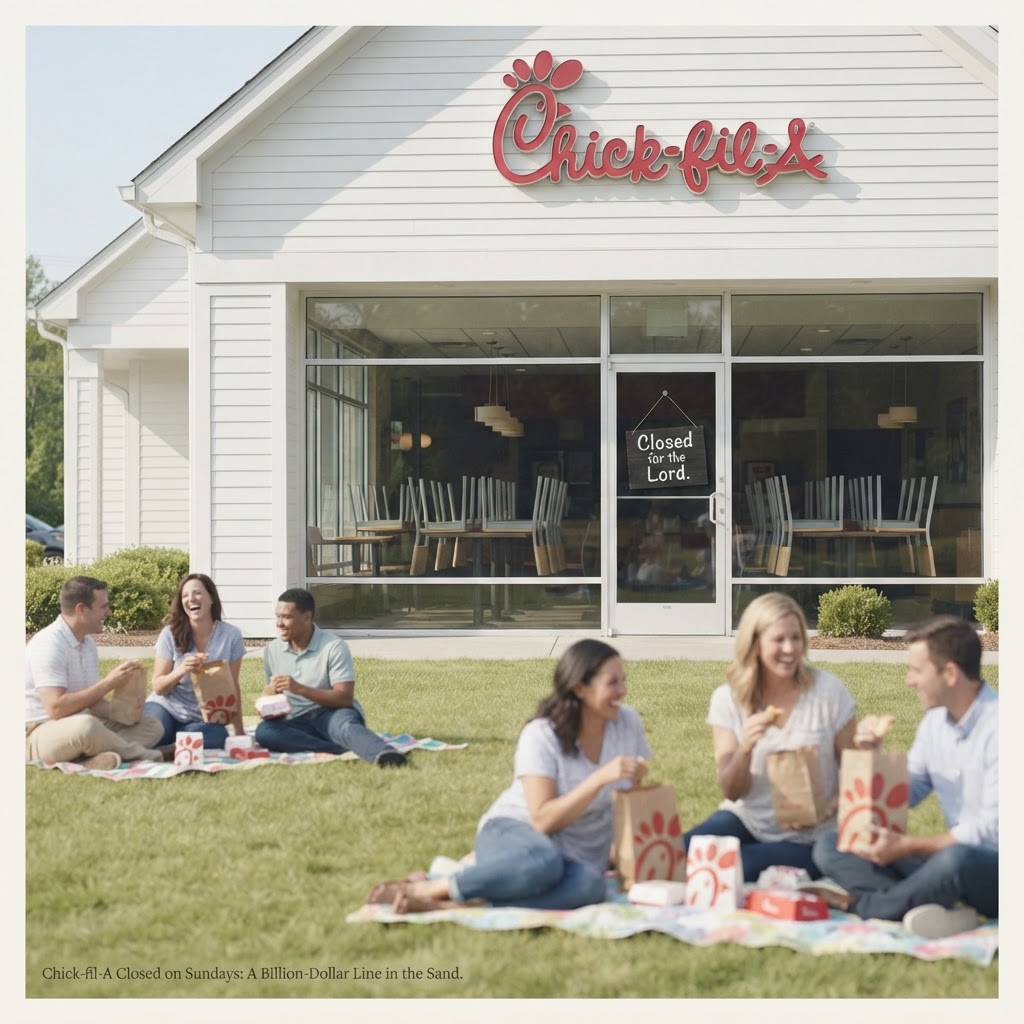
It throws away one day of sales every week. That missing day is the reason it out-earns every competitor on the other six.
Pairs with the Culture Doctrine Canvas — a ready-to-use strategy tool, filled for Chick-fil-A. Included in the Culture Doctrine Casebook →
Here is a fact that ought to be impossible. Chick-fil-A voluntarily closes every one of its restaurants one day a week - surrendering, on its face, roughly a seventh of its potential sales - and still earns more money per restaurant than any major chain in the United States. Its stand-alone locations average somewhere around $9.4 million in annual sales, more than double McDonald's, the most efficient large operator on earth.1 A few years ago the gap was even more striking: the average Chick-fil-A made more per store than a McDonald's, a Starbucks, and a Subway combined - while shut every Sunday.2 The closed-Sunday rule is usually filed under 'religious quirk.' That filing is a mistake. It is the visible keystone of a culture doctrine, and the doctrine is the reason for the numbers.
Why a costly rule is the whole point: a principle only proves itself when a company keeps paying for it
A culture doctrine is a non-negotiable principle a company holds even when it appears to cost money, because the principle shapes everything else about how the organization behaves. The closed-Sunday rule, dating to founder Truett Cathy's first restaurant, is the doctrine made concrete and unmistakable.3 And the crucial insight is that the apparent cost is the source of the value, because a doctrine only works if it's expensive enough to be credible. A 'value' a company abandons the moment it's inconvenient isn't a value; it's a slogan. By holding a rule that visibly costs it a day of revenue, Chick-fil-A proves - to its operators, its employees, and its customers - that its stated principles are real. That proof is not sentimental. It is an economic asset, and it pays out through three channels that together explain the unit economics.
How a day off becomes a profit engine: recruiting, brand, and scarcity all flow from the same closed door
The first channel is operator and employee quality. Chick-fil-A is famously selective about who runs its restaurants, accepting a tiny fraction of applicants, and the culture - guaranteed Sundays off, a hospitality ethos, a sense of mission - is a powerful recruiting and retention tool in an industry defined by punishing hours and brutal turnover. Better-run restaurants with lower turnover are simply more productive, and productivity per location is exactly what the AUV measures. The second channel is the brand. The closed-Sunday rule is the single most recognizable thing about the company; it signals a coherent set of values that a large segment of customers actively want to support, turning a religious observance into a durable brand differentiator no competitor can copy without looking derivative. The third channel is scarcity. A restaurant people can't visit on Sunday becomes a restaurant people plan around the other six days - the unavailability manufactures intent, concentrating demand into the open days rather than spreading it thin across seven. Add the three together and the math inverts: the day Chick-fil-A is closed is a meaningful contributor to how much it earns on the days it's open.
| Typical fast-food chain | Chick-fil-A | |
|---|---|---|
| Days open per week | 7 | 6 (closed Sundays) |
| Avg sales per restaurant | ~$2-4M (McDonald's ~$4M) | ~$9.4M (stand-alone) |
| Operator selection | Broad | Highly selective |
| Employee proposition | Hours, turnover | Guaranteed Sundays off, mission |
| Role of the 'costly' rule | — | Recruiting, brand, and scarcity engine |
Correlation, culture, and the limits of the lesson: the rule compounds because it's part of a coherent whole, not a lever to bolt on
The honest objection is that closing on Sundays does not, by itself, cause $9 million restaurants - and that's correct. Chick-fil-A also has a focused menu, an obsessively engineered drive-thru, deliberately limited unit growth that protects each restaurant's volume, and a customer base skewing higher-income than the fast-food average. The Sunday rule is not a magic lever you could bolt onto any chain to double its sales; a struggling competitor that simply closed on Sundays would just sell less. So the lesson isn't 'close on Sundays.' It's subtler and more transferable: a credible culture doctrine - a principle you visibly pay for - can become a compounding advantage in recruiting, brand, and loyalty that shows up, eventually, in the only number that matters. The doctrine works because it's part of a coherent whole, and because the company never treats it as negotiable. The moment Chick-fil-A opened on Sundays to chase the extra revenue, it wouldn't just gain a day - it would forfeit the very thing that makes the other six days so productive.
A culture doctrine is only worth anything if it costs something. The question to ask of any company's stated values is: what does this principle cost them, and do they pay it even when it hurts? If the answer is 'nothing' or 'they drop it when money's on the line,' it's branding, not culture, and it buys no loyalty. Chick-fil-A's closed Sunday is expensive, public, and unwavering - which is precisely why it generates returns a cheaper, more flexible 'value' never could. The expensive rule isn't despite the strategy. It is the strategy.
The deepest irony is that the discipline of giving something up is what created the abundance. A company optimizing purely for revenue would never close on Sundays; it would chase every available dollar and, in doing so, hollow out the culture, brand, and scarcity that make its restaurants extraordinary. Chick-fil-A did the opposite - it drew a line it refused to cross for money - and ended up with the most profitable storefronts in American fast food. The empty parking lot on Sunday isn't a sacrifice the business survives despite. It's part of why the lot is full the other six days.
The culture & control set
Culture Doctrine Canvas
A one-page canvas for the unwritten rules that actually run a company: the core beliefs, the behaviors they reward and punish, the lines it won't cross, and the moments that prove the doctrine is real. Blank to articulate your own operating culture before it drifts; filled as the worked example that decodes why the story's company behaves the way it does — even when it costs them.
Included, filled and blank, in the Culture Doctrine Casebook. See the set → · Preview the blank →
Sources
Where this comes from — the filings, records, and reporting behind it.
- 1Chick-fil-A's non-mall (stand-alone) restaurants generated average unit volumes of roughly $9.3-9.4 million (FY2023-2024) - more than double McDonald's (~$4 million) - despite being closed on Sundays.
- 2In 2017, the average Chick-fil-A unit (~$4.09M) made more per restaurant than a McDonald's, Starbucks, and Subway combined - while closed on Sundays.
- 3Chick-fil-A traces to S. Truett Cathy's Dwarf Grill, opened May 23, 1946 in Hapeville, Georgia (later The Dwarf House). The first Chick-fil-A opened in 1967 in Atlanta's Greenbriar Mall. The closed-on-Sundays policy dates to the 1946 grill and has applied brand-wide since 1967.
More like this — beyond Chick-fil-A
New Strategically analyses as they publish: the defining moves in business, checked against the record. No noise, and one click to leave.