Pairs with the Culture Doctrine Canvas — a ready-to-use strategy tool, filled for Abercrombie & Fitch. Included in the The Culture Doctrine Casebook →
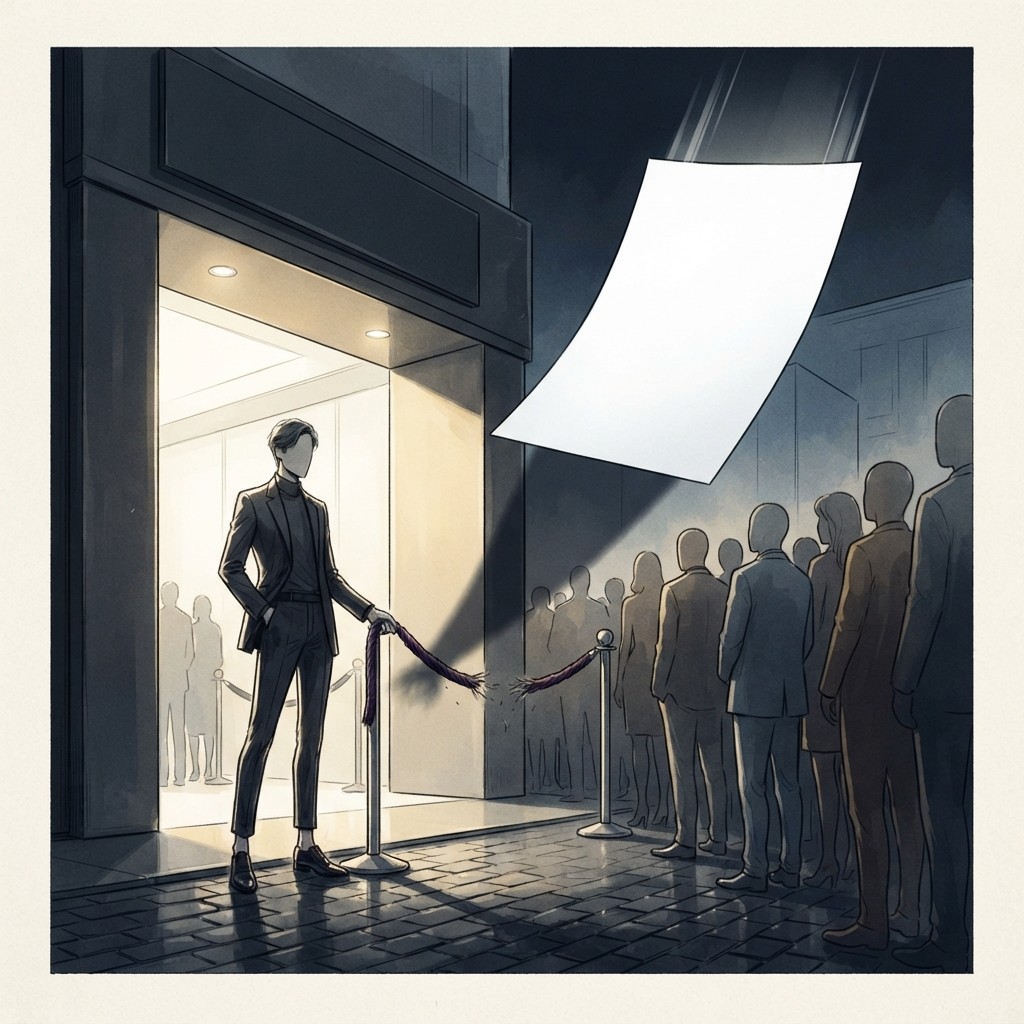
Walk past an Abercrombie & Fitch in the mid-2000s and you'd feel the doctrine before you saw a single shirt: the music too loud, the lights too dim, cologne pumped through the vents, and a shirtless model at the door who was hired the way a casting director hires extras. None of that was decoration. It was the strategy made physical. The store wasn't selling clothes so much as selling a verdict about whether you belonged - and for about a decade, that verdict printed money.
The official story is that Abercrombie was a teen apparel retailer that ran into bad luck and bad press. The real story is sharper and more damning: it ran a culture doctrine that built exclusion directly into who it hired, and it kept running it long after the courts had told it - in plain language, with money attached - that the doctrine was illegal. The brand didn't trip. It walked into a wall it had been warned about for years.
The doctrine said the quiet part on the record
Most companies guard the line they'd never want on a billboard. Abercrombie's CEO offered it to a magazine. 'Candidly, we go after the cool kids,' Mike Jeffries told Salon in 2006. 'Are we exclusionary? Absolutely.'6 That wasn't a gaffe. It was the thesis. The whole business model assumed that desire is manufactured by exclusion - that a garment becomes valuable in proportion to who is made to feel they can't have it. Price the feeling, not the fabric.
“In every school there are the cool and popular kids, and then there are the not-so-cool kids. Candidly, we go after the cool kids … Are we exclusionary? Absolutely.”6
The trouble with a culture doctrine is that it can't live only in marketing. To make the store feel exclusive, the people in it had to look a certain way - and so the doctrine reached down into the hiring process and the famous 'Look Policy.' That is the precise moment a brand attitude becomes an employment practice, and an employment practice is something a court can examine. Abercrombie had quietly converted a marketing idea into a legal liability, and it would spend the next decade paying the conversion fee.
The courts kept sending the invoice
The first big bill came due in 2004. Out of a race-and-sex discrimination case - the class action Gonzalez v. Abercrombie & Fitch had been filed in 2003 in federal court in California2 - the company agreed to a consent decree that cost $50 million in total to resolve the EEOC suit and two private class actions, roughly $40 million of it going into a fund for class members.1 The company admitted no liability, but it accepted a court-supervised decree on its hiring that stayed in force for years.2 That should have been the warning. Instead it was treated as a cost of doing business.
The deeper problem surfaced in the hijab cases, where Abercrombie tried to defend the Look Policy as a genuine business necessity - the legal argument that accommodating a head scarf would impose 'undue hardship' on its brand. In April 2013 a federal judge dismissed that defense, citing a 'dearth of proof' linking store performance or brand image to Look Policy compliance; that September the company paid $71,000 to settle two such suits and agreed to change its policies.5 Read that finding twice. A court looked at the doctrine's central commercial claim - that the look drives the sales - and found no evidence for it. The mythology had no numbers behind it.
Then the doctrine reached the Supreme Court. Samantha Elauf had been denied a job at a Tulsa store because her hijab clashed with the Look Policy, and in June 2015 the Court ruled, in EEOC v. Abercrombie & Fitch, that an employer can't refuse to hire someone to avoid accommodating a religious practice - even if the applicant never explicitly asked.3 The damages were almost trivial: $25,670 to Elauf, plus $18,983 in court costs.4 But the precedent was not trivial. The doctrine had now generated case law that constrains every employer in the country. Abercrombie's culture had become a Supreme Court citation.
| The pitch inside the company | What the record shows | |
|---|---|---|
| The Look Policy | A brand necessity that drives sales | A court found 'dearth of proof' it affected performance |
| Exclusivity | The engine of desire and pricing power | The engine of serial discrimination litigation |
| The CEO's candor | Confidence in a winning strategy | A 2006 quote that detonated in 2013 |
| Outcome | A durable cultural moat | 18 straight quarters of declining revenue |
Why the collapse waited seven years
Here is the part that everyone gets backwards. The cool-kids quote didn't blow up when Jeffries said it in 2006. It blew up in May 2013, when a Business Insider article resurfaced the old interview and 'touched off a firestorm of protest online' - seven years later.6 Jeffries dismissed it as a 'seven-year-old, resurrected quote,' and on the facts he was right. So what changed between 2006 and 2013? Not the words. The distribution. In 2006 the doctrine could be said out loud to a niche magazine and stay in its lane. By 2013, social platforms could take any sentence and detonate it in front of the exact people it insulted, instantly, at no cost. The doctrine's commercial logic depended on exclusion being a private feeling. Once it became a public broadcast, the same exclusivity that drew people in pushed them away - same words, opposite math.
And worth correcting while we're here: the line everyone remembers - that Jeffries 'doesn't want larger people in his store, he wants thin and beautiful people' - was never his quote. It came from retail author Robin Lewis, characterising Jeffries' philosophy to Business Insider in May 2013.7 That the most-shared version of the scandal was an interpretation, not a transcript, hardly mattered. By then the brand had primed everyone to believe the worst, and the documented quotes were ugly enough on their own.6
The damage was not abstract. Revenue declined for 18 consecutive quarters starting in the first quarter of 2013 - the same window the quote went viral. Jeffries was out by December 2014, and the slide didn't reverse into growth until the third quarter of 2017, after Fran Horowitz was named CEO.8 The doctrine took a decade to build and four years to bury the brand that built it.
But didn't the doctrine work for a decade?
The honest objection is that this read is too tidy - that for years the exclusivity doctrine genuinely worked, drove the growth, and that blaming the strategy ignores how much money it made before the fall. That's fair, and it's the most important point against the thesis. A culture-led strategy is not the problem; plenty of great brands are built on a strong, specific identity that not everyone is invited to share. Exclusivity, on its own, is a legitimate and powerful engine.
But notice what's distinctive here. Abercrombie didn't build its exclusivity on price, scarcity, or taste - levers a company controls and can defend. It built it on who you are, enforced through hiring, in ways federal courts repeatedly found unlawful. That's the difference between a moat and a time-bomb. A doctrine that excludes by taste is durable. A doctrine that excludes by race, body, or religion is a liability accruing on a delay - it works right up until a court or a viral thread presents the bill, and then it doesn't merely stop working, it inverts. The decade of growth wasn't the strategy succeeding. It was the fuse burning.
A culture built on exclusion can be a real competitive engine - but pressure-test it on two axes before you bet the company on it. First, the legal axis: the moment your brand attitude reaches into hiring, promotion, or who you serve, it stops being marketing and becomes a practice a court can examine - and 'it's good for the brand' is not a legal defense, as Abercrombie learned when a judge found no proof its Look Policy even drove sales. Second, the daylight axis: assume every internal sentence, every CEO interview, every casting rule will one day be read aloud to the exact people it excludes, instantly and for free. If the doctrine only works while it stays private, it was never a strategy - it was a secret, and secrets have a half-life that social media keeps cutting shorter.
Abercrombie spent a decade convincing the world that belonging to its tribe was worth paying for, and it built that feeling out of the one material guaranteed to come back around: telling other people they didn't belong. For years the exclusion stayed quiet enough to read as allure. Then the same words went public, the courts kept their receipts, and the doctrine that made the brand turned around and ate it. The lesson isn't that culture can't lead a strategy. It's that a culture built on legally indefensible exclusion is always one ruling - or one resurfaced quote - away from becoming the most expensive thing the company owns.
When the brand and the business model collide
Culture Doctrine Canvas
A one-page canvas for the unwritten rules that actually run a company: the core beliefs, the behaviors they reward and punish, the lines it won't cross, and the moments that prove the doctrine is real. Blank to articulate your own operating culture before it drifts; filled as the worked example that decodes why the story's company behaves the way it does — even when it costs them.
Included, filled and blank, in the The Culture Doctrine Casebook. See the set → · Preview the blank →
Sources
Where this comes from — the filings, records, and reporting behind it.
- 1In November 2004, Abercrombie & Fitch agreed to a consent decree paying $50 million total (combining the EEOC lawsuit and two private class actions — Gonzalez et al. and West v. A&F) to resolve race and sex discrimination claims; the class member fund portion was approximately $40 million, with ~$10 million for monitoring and attorneys' fees. The company did not admit liability.
- 2The class-action race discrimination lawsuit Gonzalez v. Abercrombie & Fitch, No. 3:03-cv-02817, was filed June 16, 2003 in U.S. District Court for the Northern District of California; the consent decree received final court approval in April 2005 and remained in effect until at least June 2011.
- 3The U.S. Supreme Court ruled on June 1, 2015 (EEOC v. Abercrombie & Fitch Stores, Inc., 575 U.S. 768) that an employer may not refuse to hire an applicant if motivated by avoiding the need to accommodate a religious practice, even without explicit verbal notice from the applicant; the case arose from Samantha Elauf being denied hire at a Tulsa, Oklahoma A&F store for wearing a hijab that violated the Look Policy.
- 4Following the Supreme Court ruling, Abercrombie paid $25,670 in damages to Elauf and $18,983 in court costs to resolve the case; Abercrombie's request to dismiss its own appeal was granted as the final step.
- 5In September 2013 the EEOC announced Abercrombie would pay $71,000 and change its policies to settle two separate religious discrimination lawsuits on behalf of Muslim teens wearing hijabs; U.S. District Judge Edward J. Davila had dismissed Abercrombie's undue-hardship defense in April 2013, citing 'dearth of proof' linking store performance or brand image to Look Policy compliance.
- 6Mike Jeffries stated in a 2006 Salon interview: 'In every school there are the cool and popular kids, and then there are the not-so-cool kids. Candidly, we go after the cool kids … Are we exclusionary? Absolutely.' These quotes were resurfaced by a May 3, 2013 Business Insider article, triggering the viral backlash — seven years after the original interview.
- 7The characterisation that Jeffries 'doesn't want larger people shopping in his store, he wants thin and beautiful people' originated from Robin Lewis, co-author of 'The New Rules of Retail,' speaking to Business Insider in May 2013 — it is Lewis's interpretive attribution, not a verbatim Jeffries quote.
- 8Abercrombie & Fitch's revenue declined for 18 consecutive quarters beginning in Q1 2013; Mike Jeffries was ousted in December 2014; Fran Horowitz was formally named CEO on February 1, 2017 per an SEC Form 8-K; the sales decline turned to growth for the first time in Q3 2017.
More like this — beyond Abercrombie & Fitch
New Strategically analyses as they publish: the defining moves in business, checked against the record. No noise, and one click to leave.