Pairs with the Founder Doctrine Canvas — a ready-to-use strategy tool, filled for Marvel. Included in the The Founder Doctrine Casebook →
In September 2005, a newly created company with no employees and no office signed for $525 million. It was called MVL Film Finance LLC, it was a wholly-owned, bankruptcy-remote subsidiary of Marvel, and its entire job was to borrow money against cartoon characters and hand it back to the parent so Marvel could make its own movies for the first time.13 The legend that grew up around it is irresistible: a comic-book company, fresh out of bankruptcy, betting its soul on Iron Man. The truth is colder and far more interesting. Marvel didn't bet the company. It bought an option on independence — and the option was nearly free.
The story everyone repeats is that Marvel mortgaged its crown jewels — Spider-Man, the Hulk, the X-Men — to fund the films that became the MCU. Almost every word of that is wrong. By 2005 those characters were already licensed away to other studios. What Marvel pledged were the leftovers: ten characters nobody else wanted yet.
The crown jewels were already pawned
To understand the deal you have to understand what Marvel no longer owned. The marquee names — the ones that would have made 'mortgaging the characters' a genuinely terrifying sentence — had been licensed out years earlier to studios with the cash to make blockbusters. So when Marvel went looking for collateral, it reached for the only film rights still sitting in its own vault: Ant-Man, the Avengers, Black Panther, Captain America, Cloak & Dagger, Doctor Strange, Hawkeye, Nick Fury, Power Pack, and Shang-Chi.2 Read that list with 2005 eyes, not 2019 eyes. David Maisel, the man who built Marvel Studios and structured the deal, described them as ranging 'from Captain America and something vaguely called the Avengers at the high end, dwindling to Shang-Chi and Power Pack.'8 These were the bench, not the starting lineup. The popular framing borrows the fame these characters earned later and pretends Marvel risked it then.
| The legend | The 8-K | |
|---|---|---|
| The characters | Spider-Man, X-Men, Hulk | Avengers, Captain America, Black Panther, Doctor Strange, and six others |
| Their 2005 value | Proven box-office gold | B- and C-tier residuals |
| The instrument | A bet-the-company mortgage | A non-recourse loan to a shell subsidiary |
| Recourse to Marvel | The whole company | None |
The deal nobody reads the fine print on
Here is the thesis, plainly: Marvel's 2005 deal was not a gamble that risked the firm — it was a near-zero-opportunity-cost option on owning its own films. The structure does the work. The $525 million facility — $465 million in senior bank debt, $60 million in mezzanine — was borrowed by MVL Film Finance LLC, the shell, and was explicitly non-recourse to Marvel Enterprises.13 If the films lost money, the lenders could come after the pledged characters. They could not come after Marvel. The parent company's other assets, its licensing income, its balance sheet — all walled off behind a bankruptcy-remote subsidiary.
And the trigger to seize even those characters was extraordinarily generous. According to Maisel, the collateral could only be enforced if Marvel lost money on the first four films — four consecutive failures, not one.5 Marvel retained every non-theatrical right regardless of what happened: the toys, the comics, the merchandise, the television, the licensing machine that was already the company's actual cash engine. And the punchline that dissolves the whole 'losing the characters' fear: even if a lender seized a character and made a film with it, Marvel would still collect the same license fee it would have earned by passively licensing that character to any other studio.5 The worst case looked almost exactly like the status quo of doing nothing.
“The collateral could only be enforced if Marvel lost money on the first four films — and even if the bank made a film with one of the characters, Marvel would still collect the same license fee. The opportunity cost was virtually zero.”5
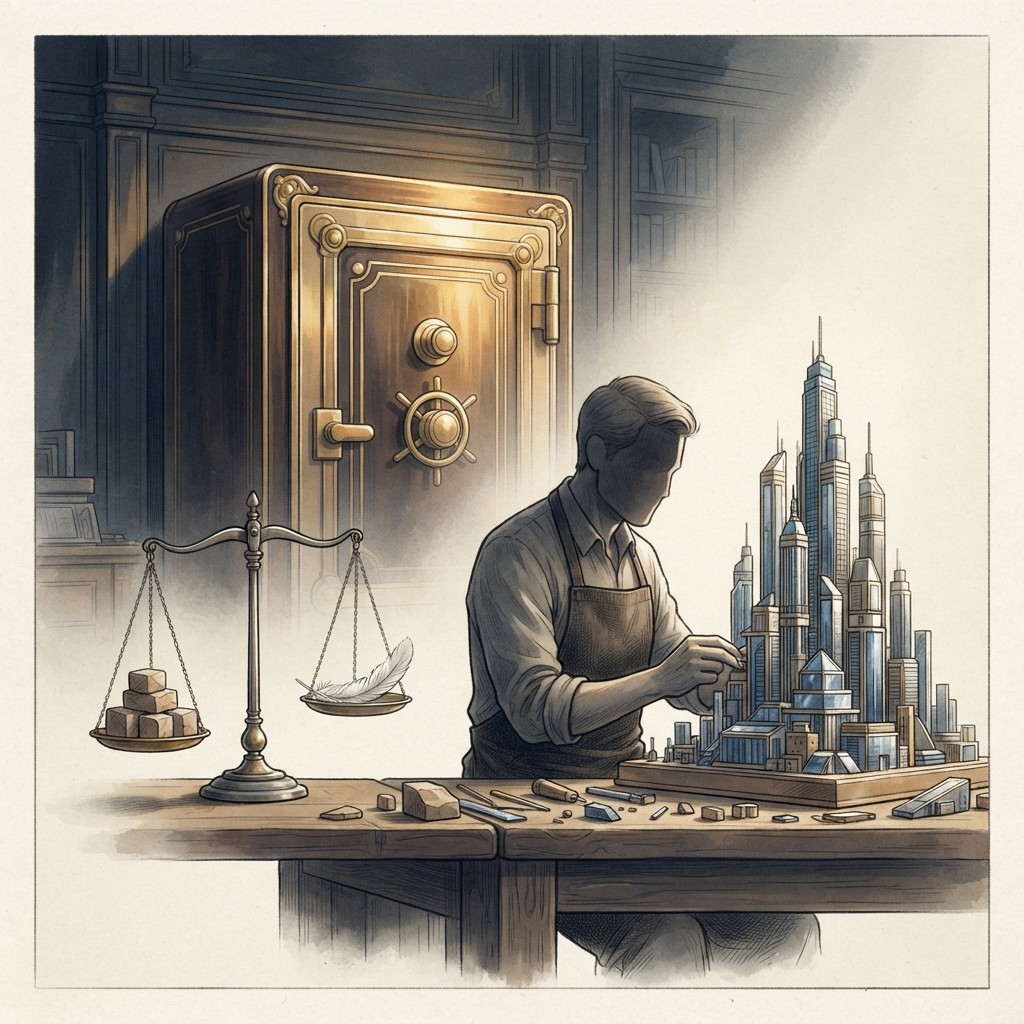
A bet has symmetric stakes: you can win big, you can lose big. An option does not. You pay a small, capped premium for the right to a large upside, while your downside stays pinned near zero. Maisel didn't structure a bet — he structured an option. The 'premium' was the residual film rights to characters Marvel couldn't monetize at full value anyway. The downside, if the films flopped, was a license fee Marvel would have collected from passive licensing regardless. The upside was the entire Marvel Cinematic Universe. When the worst case is your existing baseline, you are not being brave. You are being precise.
The legend assumes the worst case was 'lose your best characters,' a catastrophic loss against a baseline of keeping them. But the actual worst case — a lender makes films with the pledged characters — still pays Marvel its standard license fee, the same money passive licensing would have produced.5 Subtract the baseline and the real downside collapses toward zero, while the upside was the right to produce and own its own films outright. That asymmetry, not nerve, is what made the deal smart.
Why this wasn't a survival move
Part of why the deal is misremembered is that people fold it into Marvel's bankruptcy era. They picture a company on its knees, desperate enough to pawn its characters to stay alive. The timeline says otherwise. Ronald Perelman's holding company had bought Marvel back in January 1989 for $82.5 million, with the stated goal of licensing and character monetization — not making films.6 Marvel filed for Chapter 11 in December 1996, and the reorganized Marvel Enterprises emerged from that wreckage in 1998.6 By the time the Merrill Lynch facility closed on September 1, 2005, the bankruptcy was seven years in the rear-view mirror. This was not a survival instrument. It was a growth-phase company choosing to stop renting out its characters and start producing for itself.
But Kevin Feige called it make-or-break
The honest counter comes from inside the building. Kevin Feige told Variety the film rights to those characters were 'on the line,' and that 'if the movies hadn't worked, something would have happened and it wouldn't have been good.'7 That is real, and it deserves an answer, not a dismissal. Two things were true at once. The corporate downside was structurally near-zero — the non-recourse wall and the guaranteed license fee saw to that. But the strategic downside was not. If the early films had flopped, Marvel's dream of running its own studio would have died, the characters might have ended up made by someone else, and the company would have slunk back to passive licensing forever. The deal protected the balance sheet brilliantly; it could not protect the ambition. Feige is describing the stakes of the mission. Maisel is describing the stakes of the money. Both are right, and confusing the two is exactly how the 'bet the company' myth survives.
The genius of the 2005 deal was never courage. Courage is what you need when the downside is real and you accept it anyway. Maisel did something harder and quieter: he engineered the downside away, then let the upside run. He took the characters no studio would pay full price for, walled the company off behind a shell that could borrow half a billion dollars in Marvel's name without putting Marvel at risk, and structured the seizure trigger so far out of reach that 'losing the characters' meant collecting the same checks Marvel was already collecting. The legend remembers a gambler pushing in his chips. The 8-K records something rarer — a company that found a way to want everything and risk almost nothing, and got to keep the whole upside when the bet it never really made came in.
When the real move is hidden in the structure
Founder Doctrine Canvas
A one-page canvas for the operating system inside a founder's head: the principles they hold, the formative experiences that forged them, and the specific strategic moves each principle produces. Blank to make your own decision rules legible to the people who execute them; filled as the worked example showing why the story's company keeps making the bets it makes — because the founder can't make any others.
Included, filled and blank, in the The Founder Doctrine Casebook. See the set → · Preview the blank →
Sources
Where this comes from — the filings, records, and reporting behind it.
- 1On September 1, 2005, MVL Film Finance LLC closed a $525 million, seven-year non-recourse financing facility arranged by Merrill Lynch Commercial Finance Corp., comprising $465M in revolving senior bank debt and $60M in mezzanine debt; the borrower pledged theatrical film rights to ten Marvel characters as collateral; borrowings were non-recourse to Marvel Enterprises, Inc.
- 2The ten characters whose theatrical film rights were pledged as collateral were: Ant-Man, the Avengers, Black Panther, Captain America, Cloak & Dagger, Doctor Strange, Hawkeye, Nick Fury, Power Pack, and Shang-Chi.
- 3As of September 1, 2005, MVL Film Finance LLC — a newly formed, special-purpose, bankruptcy-remote, wholly-owned consolidated Marvel subsidiary — closed the $525 million financing facility to produce Marvel's own slate of feature films. The film facility consisted of $465M revolving senior bank debt and $60M mezzanine debt.
- 4Marvel Enterprises sold Fleer/SkyBox International for $26 million in cash (not $30 million as widely reported) to a newly formed private company founded by Alex Grass and his son Roger Grass, per a January 29, 1999 announcement.
- 5David Maisel, founding chairman of Marvel Studios, stated on the record that the collateral could only be enforced if Marvel lost money on the first four films, that Marvel retained all non-film rights even in a default scenario, and that even if the bank made a film with a seized character Marvel would still collect the same license fee — making the opportunity cost of the deal 'virtually zero.'
- 6On January 6, 1989, Ronald Perelman's MacAndrews & Forbes Holdings bought Marvel Entertainment Group from New World for $82.5 million. Marvel made an IPO of 40% of stock on July 15, 1991. Marvel filed for Chapter 11 bankruptcy on December 27, 1996. ToyBiz and Marvel Entertainment Group were merged into Marvel Enterprises on June 2, 1998.
- 7Kevin Feige confirmed to Variety that Marvel's film rights to those characters were 'on the line' in the Merrill Lynch deal: 'It was make-or-break. If the movies hadn't worked, something would have happened and it wouldn't have been good.'
- 8David Maisel described the ten characters as ranging from 'Captain America and something vaguely called the Avengers at the high end, dwindling to Shang-Chi and Power Pack,' and the original plan was to make four movies (not ten).
More like this — beyond Marvel
New Strategically analyses as they publish: the defining moves in business, checked against the record. No noise, and one click to leave.