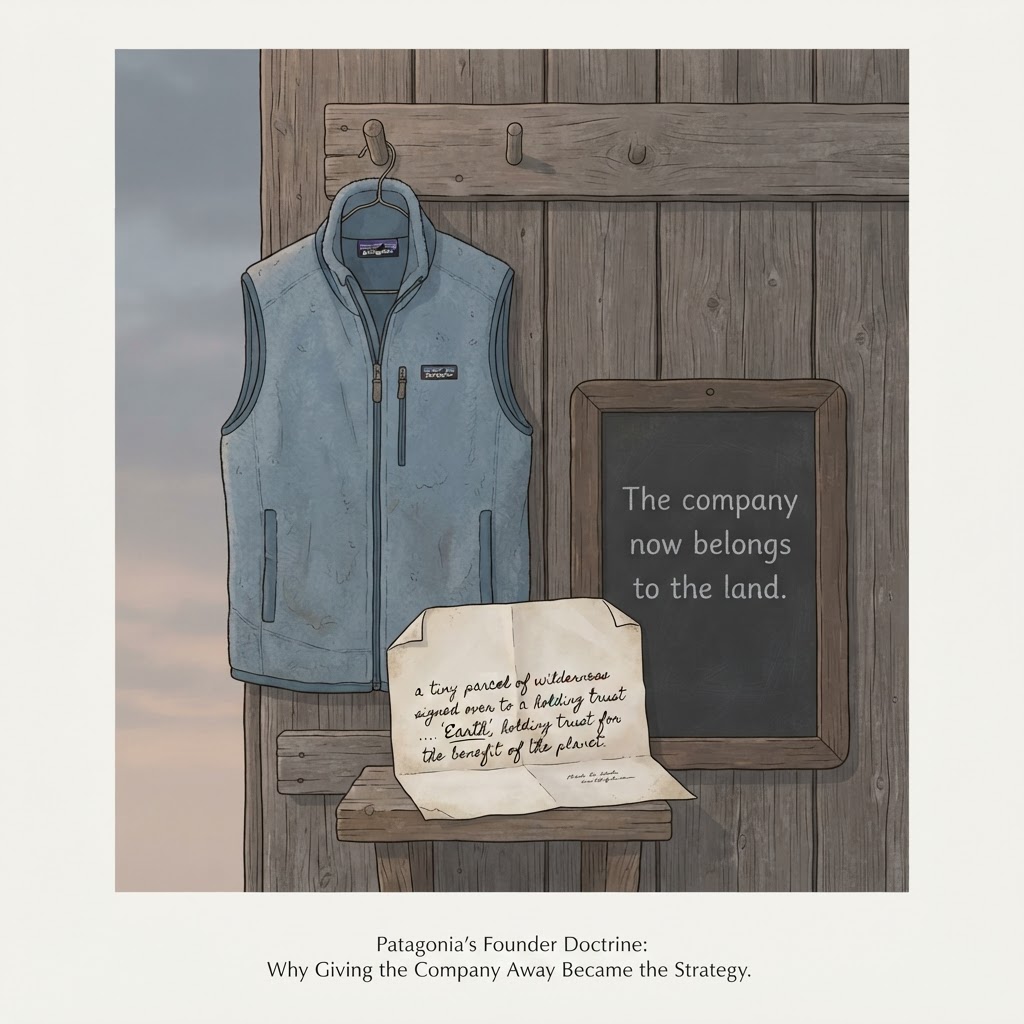
Most founders protect their legacy by picking the right heir and praying the culture holds. One climber-turned-CEO decided prayer was a single point of failure - so he engineered it out.
Pairs with the Founder Doctrine Canvas — a ready-to-use strategy tool, filled for Patagonia. Included in the Founder Doctrine Casebook →
In September 2022, the founder of a roughly $3 billion company gave the entire thing away - and in doing so executed the most radical founder doctrine in modern business.2 Yvon Chouinard, the climber who built Patagonia, did not sell it, did not take it public, and did not simply leave it to his children. He and his family transferred all of it into two new entities engineered for a single purpose: to make Patagonia's environmental mission permanent and impossible for anyone - future owner, heir, or executive - to ever undo.1 'Earth is now our only shareholder,' Chouinard wrote. The line reads like a slogan. It is, in fact, a precise description of a legal structure, and that structure is the point. Patagonia is the clearest case study of a founder doctrine enforced not by culture or charisma, but by the cap table itself.
“Earth is now our only shareholder.”1
Why a founder's values rarely outlive the founder: because culture is a soft constraint and whoever holds the shares holds the soul
A founder doctrine is the set of values and priorities a founder builds a company around - the soul of the place, the reason it does things the way it does. The chronic tragedy of founder doctrines is that they rarely outlive the founder. The moment a values-driven founder sells, dies, or hands over control, the doctrine is at the mercy of whoever holds the shares: public-market investors who demand growth over principle, private-equity owners who optimize for resale, or heirs who don't share the conviction. History is littered with mission-driven companies that lost their souls the instant ownership changed hands, because culture is a soft constraint and ownership is a hard one. Chouinard understood this with unusual clarity, and his solution was to refuse to leave the doctrine vulnerable. Instead of trusting future people to honor his values, he would change the ownership structure so they had no choice.
Separating control from cash flow: the quiet engineering trick that puts the mission beyond anyone's reach to buy or redirect
The structure is elegant, and understanding it is understanding the whole strategy. The Chouinard family split the company into two kinds of stock and gave each away to a different entity. The voting stock - about 2% of the shares, but 100% of the control - went to the Patagonia Purpose Trust, whose sole function is to ensure the company never deviates from the founder's values. The non-voting stock - 98% of the economic value - went to the Holdfast Collective, a nonprofit that receives all of Patagonia's profits, expected to be around $100 million a year, and spends them fighting the environmental crisis.1 This separation of control from cash flow is the brilliant move. By putting control in a purpose trust and the money in a mission-bound nonprofit, Chouinard removed the two levers anyone could ever pull to corrupt the company: you cannot buy control, because the controlling stock isn't for sale and exists only to enforce the mission; and you cannot redirect the profits, because they flow by design to the planet. The doctrine is no longer a hope about how future stewards will behave. It's a constraint baked into who owns what.
| Conventional company | Patagonia (post-2022) | |
|---|---|---|
| Who the shareholders are | Investors seeking returns | A purpose trust and a nonprofit |
| What shareholders want | Profit / share price | Mission permanence and the planet |
| Where profits go | Dividends / buybacks | ~$100M/yr to environmental causes |
| Can the mission be sold off? | Yes - new owners decide | No - control is locked to values |
| What protects the culture | Goodwill of current owners | The ownership structure itself |
The price of permanence - and the counter-argument: what irreversibility costs, and why a lock that can't be picked also can't be corrected
It's essential to see what this cost, because the cost is what makes it a genuine doctrine rather than a publicity move. Because the receiving nonprofit is a 501(c)(4), the family got no charitable tax deduction, and by giving the company away rather than selling it, they walked away from a personal fortune and an estimated ~$700 million in tax that a sale would have triggered - choosing mission permanence over billions in the bank.2 That is the price of making values irreversible, and most founders, faced with it, blink. But the honest counter-argument deserves a hearing too. Critics noted that a 501(c)(4) can fund political activity in ways a traditional charity cannot, giving the family-guided structure real influence; and one can fairly ask whether concentrating that power in a founder-guided trust is its own kind of control, simply pointed at causes the founder favors. The structure makes the mission un-undoable - which is wonderful if you trust the mission and the people guiding the trust, and a harder question if you imagine a future where you don't. Permanence is a double-edged tool: it protects good values from erosion and bad ones from correction alike.
If your company's values matter to you, culture won't protect them - ownership will. Mission statements, B Corp certifications, and founder speeches are soft constraints that the next owner can ignore. The hard question Chouinard answered is: when you're gone, who holds the shares, and what are they obligated to do with them? A founder doctrine survives only if it's wired into the ownership structure, because in the end a company does what its owners want - so the surest way to protect what you built is to make sure its owners can want only one thing.
Most founders try to protect their legacy by choosing the right successor and hoping the culture holds. Chouinard didn't trust hope. He treated his values the way an engineer treats a critical system - by removing the single points of failure, in this case every future human who might one day decide the mission was negotiable. Whatever you make of the politics or the permanence, the strategic achievement is undeniable: he turned a founder doctrine, the most fragile thing in business, into the one thing about Patagonia that can never be sold.
Founder Doctrine Canvas
A one-page canvas for the operating system inside a founder's head: the principles they hold, the formative experiences that forged them, and the specific strategic moves each principle produces. Blank to make your own decision rules legible to the people who execute them; filled as the worked example showing why the story's company keeps making the bets it makes — because the founder can't make any others.
Included, filled and blank, in the Founder Doctrine Casebook. See the set → · Preview the blank →
Sources
Where this comes from — the filings, records, and reporting behind it.
- 1On September 14, 2022, Yvon Chouinard and family transferred all Patagonia ownership to two entities: the Patagonia Purpose Trust (2% voting stock, control of values) and the Holdfast Collective, a 501(c)(4) nonprofit (98% non-voting stock, receiving all profits); 'Earth is now our only shareholder.'
- 2Patagonia was valued around $3 billion and expects to distribute roughly $100 million per year in profits to environmental causes; because the nonprofit is a 501(c)(4), the family received no tax benefit and forwent an estimated ~$700M tax bill a sale would have triggered.
- 3Yvon Chouinard founded Patagonia in 1973; it is a Certified B Corporation (B Lab, Dec 2011) and was the first California benefit corporation (Jan 2012); since 1985 it has pledged 1% of sales (not profits) to environmental groups; its mission, adopted 2018, is 'We're in business to save our home planet.' In 2022 the Chouinard family transferred ownership to the Patagonia Purpose Trust and Holdfast Collective; Patagonia remains a B Corp.
More like this — beyond Patagonia
New Strategically analyses as they publish: the defining moves in business, checked against the record. No noise, and one click to leave.