Pairs with the Founder Doctrine Canvas — a ready-to-use strategy tool. Included in the The Founder Doctrine Casebook →
In April 2018, the founder of one of the most valuable private companies on earth sat down and wrote a confession. Not about a defective product or a data leak. About his app's recommendation engine. Chinese regulators had just ordered ByteDance to shut down Neihan Duanzi, a joke-sharing app, for 'vulgar' content — and Zhang Yiming posted a public apology admitting his algorithms had shown 'weak implementation of Xi Jinping Thought' and had put commercial interests above social responsibility.7 Read that sentence again. A machine-learning system was scolded for insufficient ideological devotion, and the CEO accepted the charge on its behalf.
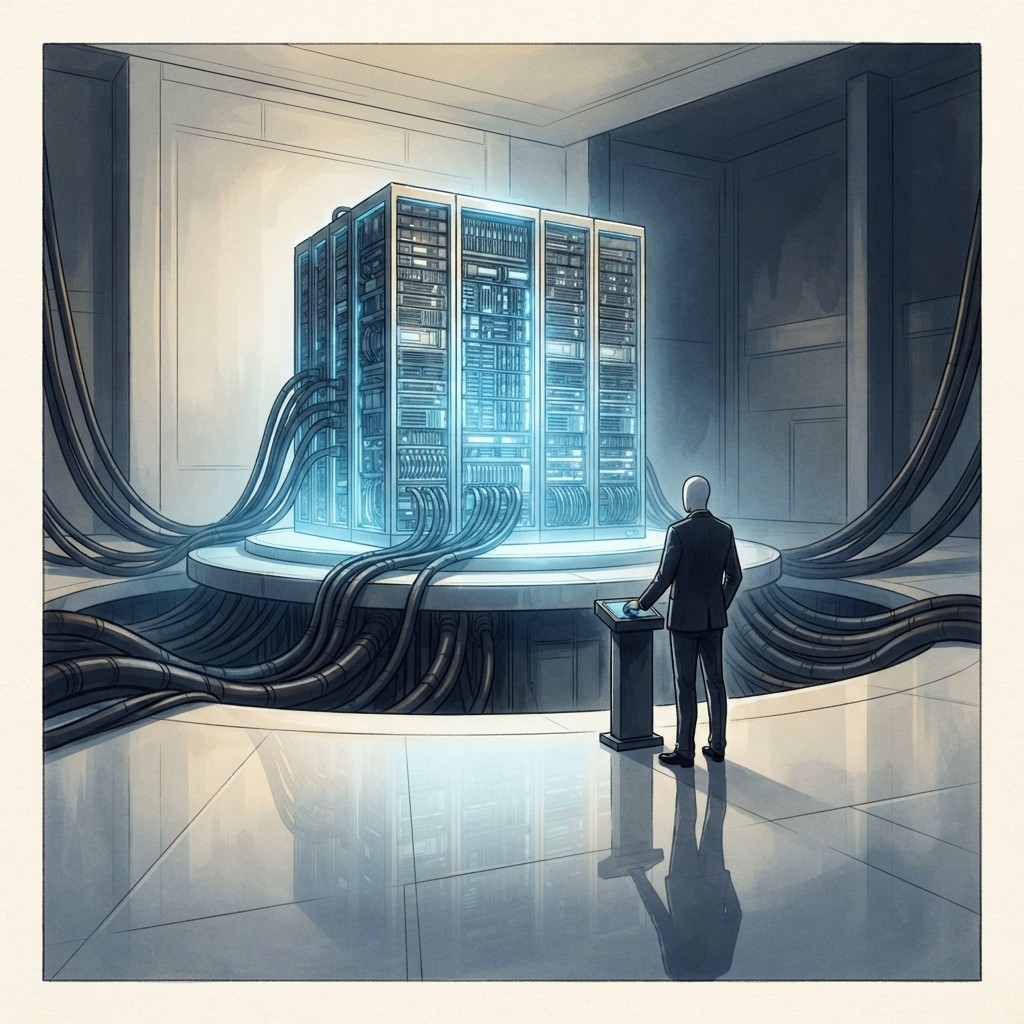
The official story of ByteDance is that Zhang built a product company around a single radical idea: let the algorithm decide. Not editors, not taste, not human gatekeepers — data. It is told as pure engineering elegance. It was also something quieter and more useful: a hedge. An algorithm makes a perfect shield. It can be blamed for nothing, because it has no opinions. And it can be made to obey anyone, because it has no conscience to overrule.
A doctrine built before there was a video to watch
ByteDance was founded in early 2012 — by Zhang Yiming and his co-founder Liang Rubo, a detail the lone-genius retellings tend to drop. Its first product, Toutiao, launched that August out of a Beijing apartment as an AI-driven news aggregator.6 The bet was unusual for the time. Most news products of 2012 still ran on human curation: an editor picked the front page. Toutiao threw that out. It built a feed that watched what you tapped, how long you lingered, what you skipped — and assembled your news from your behavior, not someone else's judgment. The doctrine arrived years before the dancing teenagers did. The video came later. The machine came first.
This is the part that makes ByteDance a founder-doctrine story rather than a viral-app story. The recommendation engine wasn't a feature bolted onto a media company. It was the company's theory of itself, applied to news, then short video, then everything. When ByteDance bought the lip-sync app Musical.ly in November 2017 — for a price never officially disclosed, reported somewhere between $800 million and $1 billion3 — it wasn't buying a product. It was buying a Western audience to feed into a machine it already trusted more than any editor.
| The traditional media company | ByteDance's doctrine | |
|---|---|---|
| Who picks the feed | Human editors with names | A recommendation engine |
| Who is accountable for bias | The editor, on the record | No one — 'it's the algorithm' |
| How to change what surfaces | Argue with a person | Adjust a model nobody sees |
| What a regulator can demand | An editorial line | A re-weighting, applied silently |
The shield cuts both ways
Here is the mechanism, worked down to the bottom. Outsourcing editorial judgment to a machine does two opposite-seeming things at once, and ByteDance got both. First, it removes a target. When there is no editor, there is no editor to accuse of bias. The feed simply 'reflects what users want' — a defense that is both convenient and partly true. Second, and this is the part the elegance narrative omits, it removes a defender. A human editor with a byline can refuse an order, resign in protest, leak the memo. An algorithm cannot. It is a dial. When the state arrives demanding different content surface — or vanish — there is no conscience between the demand and the compliance. You just turn the dial.
The Neihan Duanzi apology is the doctrine caught in the act. Zhang did not argue that the algorithm was neutral and therefore innocent. He apologized for the algorithm, promised to embed 'correct values' into it, and complied.7 In a single move he conceded what the West would later spend years trying to prove: an algorithm-run platform is not ungovernable. It is governable by whoever holds the dial. The same structure that lets ByteDance say 'we don't make editorial decisions' also lets a regulator make them instead — quietly, at the level of model weights, where no leak and no resignation will ever surface.
“Our product took the wrong path, and content appeared that was incommensurate with socialist core values... [it] exhibited weak implementation of Xi Jinping Thought.”7
An algorithm feels neutral because no person signs its decisions — but neutrality is about who can override it, not who authored it. The same 'we just show what users want' that deflects an accusation of bias also dissolves any structural resistance to a state that wants the feed changed. A platform with no editor to fire is a platform with no one positioned to say no. Founders who build on automated judgment to escape accountability should notice they've also escaped the ability to refuse. The shield that protects you from blame protects no one from you.
Why the West can't take 'trust the algorithm' for an answer
When Musical.ly and TikTok formally merged in August 2018 — accounts and data folded together, despite ByteDance's earlier line that Musical.ly would run independently5 — a Chinese-governed recommendation engine inherited a vast Western teenage audience overnight. And the trust problem TikTok still cannot solve is downstream of the doctrine itself, not of any single proven incident. The argument 'TikTok is just an algorithm serving what you like' is the company's strongest defense. It is also, given Neihan Duanzi, its weakest. Because the same structure that makes the bias-accusation hard to prove makes the compliance-capability easy to demonstrate. ByteDance has already shown, in public, in its founder's own words, that when the state asks, the dial turns.
That is why no audit, no Texas data center, no 'transparency center' fully closes the question. You cannot inspect your way to certainty about a system whose entire design is that humans don't visibly decide. The reassurance and the risk are the same architecture seen from two angles. Same engine. Opposite fear.
The fair objection: maybe it was only ever good product
The honest counter is that this reads too much intent into engineering. The algorithm-first doctrine works as pure product strategy — it built a $156 billion revenue business8 precisely because machine recommendation genuinely beats human curation at scale and at speed. Maybe Zhang chose it for retention metrics, not political cover, and the Neihan Duanzi episode was just the ordinary cost of operating in China, the same toll every domestic platform pays. That is a real objection, and it has weight: the doctrine would have been the right call commercially even if every regulator on earth vanished.
But intent is not the claim. Structure is. You do not need Zhang to have schemed for a political hedge; you only need the architecture to deliver one, and it does. A doctrine can be sincere product philosophy and a censorship-compatible design at the same time — that is exactly why it's dangerous, because it never has to choose. When Zhang resigned as CEO in May 2021, his letter spoke of focusing on long-term strategy and admitted he lacked 'some of the skills that make an ideal manager.'1 He stepped down as chairman that November.2 The framing was strategic. The timing — amid a sweeping crackdown on Chinese tech leadership — was political. With ByteDance, the two are never cleanly separable, and the algorithm is the reason. It was built to make them inseparable.
Zhang Yiming's genius was not a feed that knew what you wanted. It was a company designed so that no human ever has to admit choosing what you see — which means no human can be held to it, and no human can refuse on your behalf. That is a magnificent way to build a media empire and an impossible way to earn trust across a border where the state holds the dial. ByteDance didn't fail to solve TikTok's trust problem. It engineered the problem into the foundation, on purpose or not, and called it neutrality. The machine decides. That was always the point. And it is exactly why nobody on the other side of the wall can ever be sure who the machine is really deciding for.
When the founder's idea becomes the company's fate
Founder Doctrine Canvas
A one-page canvas for the operating system inside a founder's head: the principles they hold, the formative experiences that forged them, and the specific strategic moves each principle produces. Blank to make your own decision rules legible to the people who execute them; filled as the worked example showing why the story's company keeps making the bets it makes — because the founder can't make any others.
Included, filled and blank, in the The Founder Doctrine Casebook. See the set → · Preview the blank →
Sources
Where this comes from — the filings, records, and reporting behind it.
- 1Zhang Yiming announced his resignation as ByteDance CEO in May 2021 via an internal letter to employees, citing a desire to focus on long-term strategy and admitting he 'lack[s] some of the skills that make an ideal manager'; Liang Rubo took over as CEO after a six-month transition.
- 2Zhang Yiming also stepped down as ByteDance chairman in November 2021, with Liang Rubo assuming both CEO and chairman roles; Zhang retained some advisory capacity focused on long-term strategy.
- 3ByteDance acquired Musical.ly in November 2017 for a price reported by multiple outlets as between $800 million and $1 billion; the deal price was never officially disclosed by either company.
- 4Bloomberg's contemporaneous reporting placed the Musical.ly acquisition price at approximately $800 million; the Wall Street Journal reported up to $1 billion — the two figures are irreconcilable, confirming the deal was undisclosed.
- 5Musical.ly and TikTok formally merged on August 2, 2018, with existing Musical.ly accounts and data consolidated into TikTok; ByteDance had originally stated Musical.ly would operate independently post-acquisition.
- 6ByteDance was founded in early 2012 by Zhang Yiming and co-founder Liang Rubo; Toutiao, its first major product, launched in August 2012 as an AI-driven news aggregator operating from a Beijing apartment.
- 7In April 2018, following the Chinese regulator-ordered shutdown of ByteDance's Neihan Duanzi app for 'vulgar' content, Zhang Yiming issued a public apology on WeChat admitting the platform's algorithms 'exhibited weak implementation of Xi Jinping Thought' and prioritized commercial interests over social responsibility.
- 8ByteDance reported 2024 revenues of approximately $156 billion (a 29% year-over-year increase), per Snowball Finance data aggregated by Statista; the company is private and does not publish audited financials.
More like this — beyond ByteDance
New Strategically analyses as they publish: the defining moves in business, checked against the record. No noise, and one click to leave.