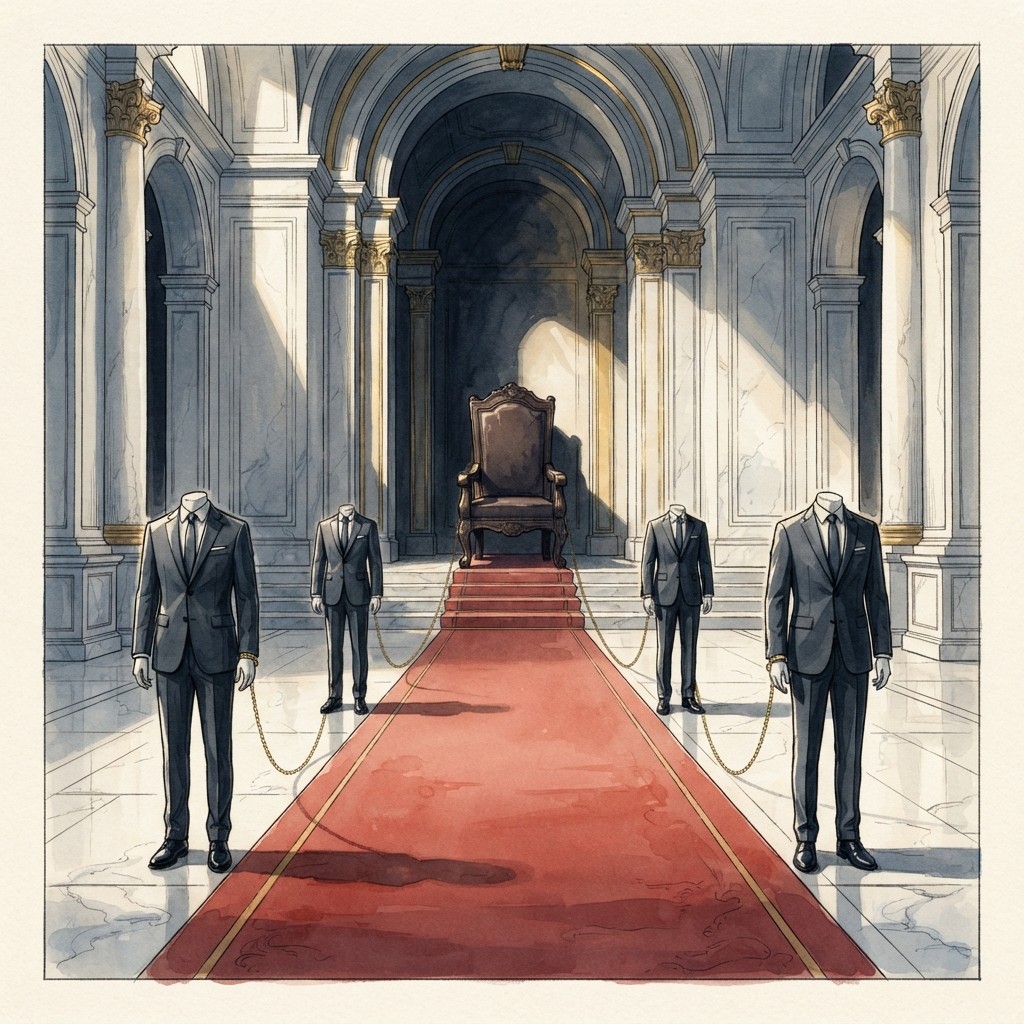
Pairs with the Founder Doctrine Canvas — a ready-to-use strategy tool. Included in the The Founder Doctrine Casebook →
He owns less than half of it, yet no decision of consequence happens without him. At the end of 2024 the Arnault family held 49% of LVMH's share capital but 64.8% of its votes - and by February 2026, a quiet run of market purchases nudged the family's equity stake past 50% to 50.01%.1 That gap, between the money owned and the power held, is not an accident. It is the whole architecture. Bernard Arnault spent four decades building a machine that converts a minority of the capital into a near-total grip on the votes, and then he built a second machine on top of it to make sure that grip outlives him by thirty years. The remarkable part is what he left out: a name for who actually runs the place when he's gone.
The official story is that Arnault, the founder of LVMH, is gracefully arranging his succession by grooming five children for the throne. Almost every word of that is off. He did not found LVMH - the group was assembled in 1987 and he took it over in 1989.2 And the 'succession' he has arranged settles everything about ownership and almost nothing about leadership. He has answered the easy question - who will own this - with a vault. He has left the hard one - who will run it - deliberately open.
“...became the leading shareholder and Chairman and Chief Executive Officer in 1989.”2
Two questions, and he answered the wrong one on purpose
Every founder hands over two things, and they are not the same thing. One is ownership - the shares, the votes, the legal title to the empire. The other is leadership - the hands on the controls, the person who decides which brand to buy and which CEO to fire. Most founders blur the two and get neither right. Arnault did the opposite. In July 2022 he converted his family holding company into Agache SCA, a société en commandite par actions, and created a small entity called Agache Commandité SAS in which each of his five children holds exactly 20%.3 Those shares are locked - legally inalienable for thirty years, and after that period only direct descendants of Bernard Arnault, or entities wholly owned by them, may hold them.3 This is not a family lock. It is a bloodline lock. No son-in-law, no investor, no creditor can ever pry a single share loose. The ownership question is now answered with the finality of concrete.
But notice what the same structure does for leadership. A commandite is a peculiar French vehicle in which the managing partner - the gérant commandité - holds power wildly out of proportion to the capital. Arnault is that managing partner of Agache SCA, and only when he leaves the role does Agache Commandité SAS succeed him.4 A legal expert reviewing the design called it 'a very significant padlock,' precisely because it lets a holder of a relatively small stake exercise outsized sway over the whole.8 In plain terms: while Arnault is alive and in the seat, the children's equal 20% slices buy them ownership but not command. The lock protects the dynasty from outsiders. It does nothing to dilute the founder.
| Ownership succession | Leadership succession | |
|---|---|---|
| Status | Settled for 30 years | Deliberately open |
| Mechanism | Agache SCA + bloodline lock | Unnamed; rotating family chair |
| Who is bound | All five children, equally | No one |
| What it does for Arnault | Protects his legacy | Preserves his leverage |
The beauty contest is the leash
Watch what the children actually got. At the April 2024 AGM, shareholders approved Alexandre and Frédéric joining the LVMH board, bringing the count to four of five children on the board; only the youngest, Jean, sits off it while working inside the group.6 Inside the family holding, the chairmanship of Agache Commandité rotates every two years, starting with Delphine, with a five-member board engineered to balance power among the siblings.8 This is the structure widely read as a 'beauty contest' - a tournament in which the most capable heir earns the crown. But look at the incentives it actually creates. Five children, each with an equal slice, each circling a single prize that only the father can award. After he departs, they decide by a majority of three7 - which means none of them can act without persuading at least two siblings, and all of them must keep the patriarch happy while he can still tip the outcome.
That is not a transition mechanism. It is a control device. An unresolved succession keeps every heir in audition mode indefinitely, and the auditioner-in-chief is the one judge. It is the same move Arnault has run before. He entered LVMH not as a builder but as an invited investor who read the seams in a divided power structure and took the whole thing.2 He knows exactly what ambiguity does in a house with more than one claimant: it concentrates power in whoever controls the clock. By naming no successor, he has made himself the indispensable arbiter of a contest with no scheduled end - and given himself every reason never to schedule one.
And he keeps reinforcing the deck. Between February and mid-September 2025, Arnault spent roughly €1.4 billion buying LVMH shares through his holding companies, at an average price near €566.5 The family didn't need the votes - it already had 64.8% of them. What it bought was margin: a thicker cushion under a position that is already unassailable, and another decade in which no one - not an activist, not a rival, not an impatient child - can change the subject.
Isn't an open contest exactly how you find the best leader?
The fair objection is that this reading is too cynical - that a competition among capable heirs is genuinely the smartest way to surface the best one, and that refusing to anoint a favorite avoids the classic dynastic trap of crowning the wrong child too early. There is real merit here. Naming a successor a decade out can hollow out the contenders who lost and the one who won alike, and Arnault's approach keeps all five engaged, tested, and accountable to results. A bloodline lock that protects the company from outsiders while leaving leadership to merit is, on paper, a thoughtful design.8
But the market isn't buying the benign version, and its reasons are the tell. When Arnault moved to extend his own age limit, investors including Baillie Gifford and Allianz Global Investors opposed or abstained, citing the lack of succession disclosure7 - and in early 2026, large holders went further and demanded clarity on the plan outright.7 If the open contest were really about meritocratic discovery, it would come with a process, a timeline, a way to know when it ends. It comes with none of those. A contest designed to find a successor eventually produces one; a contest designed to hold power simply keeps running. The age limit extension is what settles it: each time the clock approaches, the clock gets moved. That is not the behavior of a man clearing the stage. It is the behavior of a man who has discovered that the surest way to keep the throne is to never let anyone be sure they'll get it.
Founder-led firms hand over two distinct things: ownership and command. The cleanest succession architectures settle ownership early (so the company can't be raided or split) while resolving leadership on a real timeline (so the firm isn't hostage to one mortality). Arnault did the first with surgical finality and left the second deliberately unresolved - which tells you what the structure is actually for. When you evaluate a dynasty, don't ask whether control is locked down; that's the easy part and it's usually airtight. Ask whether there's a named successor, a process, and a date. If ownership is settled to the year 2052 but leadership has no answer at all, the 'succession plan' is doing a different job: it isn't transferring power, it's preserving it.
Arnault has built the most secure ownership cage in luxury - thirty years, five children, one bloodline, no exits.3 He has surrounded himself with capable heirs and given each of them a seat, a stake, and a reason to keep proving themselves to him.6 What he has not done, and shows no sign of doing, is the one thing a succession is supposed to do: hand over the controls. The cage protects the empire from everyone except the man who built it. He didn't found LVMH - he found the opening in someone else's divided house and walked through it. Then he spent forty years making sure no one could ever do the same to his. The succession isn't unfinished. It's working exactly as designed: the heir-apparent who never quite arrives is the perfect insurance policy for the founder who never quite leaves.
Founder Doctrine Canvas
A one-page canvas for the operating system inside a founder's head: the principles they hold, the formative experiences that forged them, and the specific strategic moves each principle produces. Blank to make your own decision rules legible to the people who execute them; filled as the worked example showing why the story's company keeps making the bets it makes — because the founder can't make any others.
Included, filled and blank, in the The Founder Doctrine Casebook. See the set → · Preview the blank →
Sources
Where this comes from — the filings, records, and reporting behind it.
- 1At end of 2024, the Arnault family held 49% of LVMH share capital and 64.8% of voting rights; by February 2026, market purchases took the equity stake from 49.77% to 50.01%.
- 2LVMH's 2023 Universal Registration Document (primary company filing) states Bernard Arnault 'became the leading shareholder and Chairman and Chief Executive Officer in 1989,' corroborating that he did not found the group (formed 1987).
- 3In July 2022, France's AMF published a regulatory notice confirming Agache's conversion to Agache SCA (société en commandite par actions), the creation of Agache Commandité SAS with each of five children holding 20%, and a 30-year inalienability on those shares; only direct Arnault descendants or entities wholly owned by them may hold shares after that period.
- 4The 2022 AMF notice states Arnault will be the managing general partner (gérant commandité) of Agache SCA; Agache Commandité SAS will succeed him as gérant, with the five children's capital held equally.
- 5Between February and mid-September 2025, Arnault spent roughly €1.4 billion on LVMH share purchases through holding companies, per Paris stock market filings; average price ~€566/share.
- 6At the April 2024 AGM, shareholders approved Alexandre and Frédéric Arnault joining the LVMH board, putting four of five children on the board; only Jean (youngest) remains without a board seat but is employed at the group.
- 7After Arnault's departure, his five heirs make decisions by a majority of three (per corporate filings); Agache Commandite SAS heads Agache SCA as soon as Arnault leaves the role. Investors including Baillie Gifford and Allianz GI opposed or abstained on Arnault's age-limit extension citing lack of succession disclosure.
- 8Bloomberg's succession deep-dive (2023) reports the Agache SCA structure allows a shareholder with a relatively small holding to have outsized sway—a structure one legal expert called 'a very significant padlock'—and that Agache Commandite has a rotating two-year chairmanship starting with Delphine, with a five-member board to balance power among the children.
- 9LVMH shareholders voted at the April 17, 2025 AGM to raise the maximum age for its chairman and CEO from 80 to 85, passing with 99.18% of the vote.
More like this — beyond LVMH
New Strategically analyses as they publish: the defining moves in business, checked against the record. No noise, and one click to leave.