Pairs with the Adjacency / Synergy Map — a ready-to-use strategy tool, filled for Marvel. Included in the The Adjacency Expansion Casebook →
In 2008 a company that had declared bankruptcy a decade earlier released a film about its fifth-favorite superhero - a character it had to buy back from another studio after it had already signed the loan - and accidentally launched the most lucrative franchise in the history of moving pictures. Iron Man opened on May 2, 2008, produced by Marvel Studios and distributed by Paramount.6 By the time Deadpool & Wolverine arrived in 2024, the Marvel Cinematic Universe had become the first film franchise to cross $30 billion at the global box office.8 The flywheel is real. The masterplan is mostly a story told afterward.
The official version is a tale of strategic vision: Marvel saw the value of a connected universe, bet on itself, and built the flywheel on purpose. The record underneath says something less heroic and far more interesting. Marvel didn't bet on its best characters. It pledged its leftovers - because the good ones were already gone.
A bankruptcy that was really a buyout gone wrong
The convenient story is that Marvel went broke because comic books stopped selling in the 1990s. That's a footnote, not the cause. When Marvel Entertainment Group filed for Chapter 11 on December 27, 1996, the proximate problem was leverage: Ronald Perelman controlled the company through holding companies that owned 80% of its stock, and that stock had been pledged as security for $894 million in bonds issued in 1993 and 1994. On top of that, Marvel owed secured lenders roughly $625 million.3 This is the wreckage of a leveraged buyout, not an operating collapse. The comics downturn made it worse; the debt structure made it fatal. After a brutal fight, ToyBiz and Marvel were merged into Marvel Enterprises on June 2, 1998, Perelman and Carl Icahn were both ousted, and Isaac Perlmutter and Avi Arad emerged in control of what was left.4
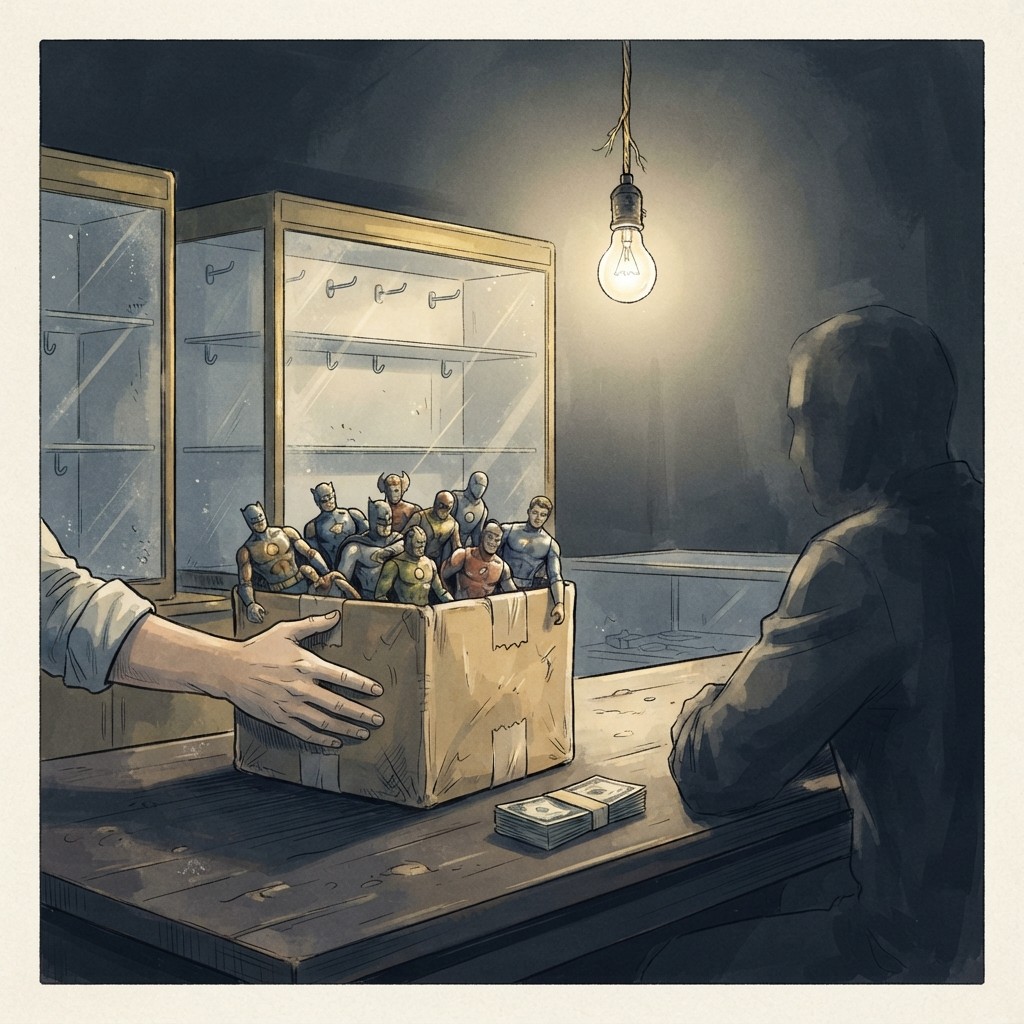
What was left was a name, a vault of characters, and almost no cash. So Marvel did what a cash-poor IP house does: it rented out its characters. Spider-Man went to Sony. The X-Men went to Fox. The Hulk went to Universal. Iron Man went to New Line. Marvel collected a fee and watched other people keep the profits on its own creations - the licensing model that funds the landlord and enriches the tenant.
The loan against the characters nobody else wanted
On September 1, 2005, Marvel closed a $525 million non-recourse film financing - $465 million in senior bank debt and $60 million in mezzanine, arranged by Merrill Lynch and distributed by Paramount.1 The point of the deal was to stop renting and start owning: Marvel would finance up to ten of its own films, keep complete creative control, and capture far more profit than licensing ever gave it.2 This is the moment the flywheel could begin to spin - because for the first time, a Marvel hit would pay for the next Marvel film instead of someone else's quarter.
But look at what Marvel actually put up as collateral. The SEC filing and Marvel's own press release name the characters: Captain America, Nick Fury, and The Avengers.2 Not Iron Man. Marvel couldn't pledge Iron Man, because at the moment it signed, Iron Man's film rights still belonged to New Line. They only came back in November 2005 - after the loan closed.5 The first and most important MCU film, in other words, starred a character Marvel didn't even control when it secured the money to make movies. The Hulk followed home from Universal in February 2006; Thor was announced as a Marvel Studios production in April 2006.5 The 'planned shared universe' was assembled out of whatever rights happened to wander back through the door.
| The masterplan story | What the record shows | |
|---|---|---|
| The bet | Marvel backed its best characters | Best characters were licensed to rivals; B-list was the collateral |
| The collateral | Iron Man, Thor, Captain America | Captain America, Nick Fury, The Avengers - not Iron Man[[cite:s2]] |
| Iron Man's rights | Held all along | Returned from New Line in Nov 2005, after the loan closed[[cite:s5]] |
| The motive | Creative vision of a universe | Desperate financial engineering by a post-bankruptcy IP house[[cite:s3]] |
Why the flywheel only spins when you own the wheel
Here is the mechanism that turned desperation into a money machine. A licensed film is a one-time fee: the studio that makes it keeps the box office, the sequels, the merchandising upside, and crucially the audience relationship. Every dollar of goodwill a hit creates accrues to the tenant, not the landlord. A self-financed film inverts all of that. When Marvel owned the film, the profit funded the next film, the audience built loyalty to Marvel's universe rather than a single studio's franchise, and each character a hit introduced became a free marketing asset for every other character in the slate. Nick Fury walks into a post-credits scene in one film and pre-sells the next four. That cross-pollination is the entire reason the structure compounds - and it is mechanically impossible when your characters live on other studios' balance sheets. You cannot build a connected universe out of rented rooms. The non-recourse loan wasn't just money; it was the act of reclaiming the wheel so it could finally turn.
Marvel held world-famous IP for years and stayed broke, because licensing converts a compounding asset into a flat fee. The flywheel only appears when one hit can finance the next AND build an audience that belongs to you - which requires owning the production, the slate, and the customer relationship, not just the characters. The lesson generalizes past Hollywood: an asset you rent out earns you rent; an asset you operate earns you the loop. The most valuable thing Marvel reclaimed in 2005 wasn't a character. It was the ability to let its own success pay for its own future.
“...Marvel would retain complete creative control and greater profit potential than from licensed films.”2
Wasn't it visionary anyway?
The fair objection is that calling this 'desperation, not vision' is too cute. Plenty of bankrupt companies pledge assets for loans; none of them produced a $32.4 billion franchise across 37 films, the highest-grossing film series ever and miles ahead of Sony's Spider-Man, Star Wars, and Harry Potter.8 Surely the genius is real. It is - but it lived in execution, not in the origin myth. The structure was a contingent improvisation: a B-list collateral package, a marquee character that wandered back after the deal closed, rights reassembled film by film. What Marvel did brilliantly was recognize, once the wheel was in its hands, exactly how to turn it - the post-credits hooks, the patient slate, the discipline of letting each hit fund and pre-sell the next. The honest version isn't that there was no genius. It's that the genius was the operator's, not the prophet's. Marvel didn't foresee the universe. It built one out of the only pieces it could afford, and then ran the flywheel better than anyone had before.
The proof of how well it worked arrived on August 31, 2009, when Disney agreed to buy Marvel Entertainment for roughly $4 billion - a deal that closed at $4.24 billion on the last day of that year.7 A company that had pledged its second-string heroes against a half-billion-dollar loan four years earlier was now worth more than eight times that loan to the most disciplined buyer of franchises on earth. The flywheel was real, and Disney paid full price for the wheel. But the founding move wasn't a bet on greatness. It was a cornered company borrowing against the characters nobody else had bothered to license - and discovering, almost by accident, that the most valuable thing it owned was not Iron Man. It was the right to keep the profits when Iron Man finally came home.
When the origin story doesn't match the filing
Adjacency / Synergy Map
A one-page canvas for an adjacency play: the new business next door, the shared assets that justify entering it, the synergies that actually transfer versus the ones that evaporate on contact, and the dis-synergies nobody put on the deck. Blank to test your own expansion; filled as the worked example showing where the story's 'natural adjacency' was real and where it was wishful.
Included, filled and blank, in the The Adjacency Expansion Casebook. See the set → · Preview the blank →
Sources
Where this comes from — the filings, records, and reporting behind it.
- 1On September 1, 2005, Marvel Enterprises closed a non-recourse $525,000,000 financing to produce its own slate of films, arranged by Merrill Lynch Commercial Finance Corp., consisting of $465 million in revolving senior bank debt and $60 million in mezzanine debt, distributed by Paramount Pictures.
- 2The $525 million facility would finance up to ten films based on Marvel characters including Captain America, Nick Fury, and The Avengers; Marvel would retain complete creative control and greater profit potential than from licensed films.
- 3Marvel Entertainment Group filed for Chapter 11 bankruptcy on December 27, 1996. At the time of filing, Ronald Perelman controlled Marvel through holding companies owning 80% of Marvel's common stock, which had been pledged as security for $894 million in bonds issued in 1993–1994. Marvel separately owed secured lenders approximately $625 million.
- 4ToyBiz and Marvel Entertainment Group were merged into Marvel Enterprises to bring Marvel out of bankruptcy on June 2, 1998, with Perelman and Icahn both ousted and Isaac Perlmutter and Avi Arad emerging in control.
- 5Marvel gained the film rights to Iron Man from New Line Cinema in November 2005 — after, not before, the Merrill Lynch financing closed on September 1, 2005. In February 2006, Marvel regained Hulk rights from Universal. In April 2006, Thor was announced as a Marvel Studios production.
- 6Iron Man (2008) was produced by Marvel Studios, distributed by Paramount Pictures, directed by Jon Favreau, and is the first film in the Marvel Cinematic Universe. It was released in the United States on May 2, 2008.
- 7On August 31, 2009, Disney announced it had agreed to acquire Marvel Entertainment in a stock and cash transaction valued at approximately $4 billion ($50 per Marvel share) based on Disney's closing price on August 28, 2009. The transaction closed at $4.24 billion on December 31, 2009.
- 8With Deadpool & Wolverine (2024), the MCU became the first film franchise to cross $30 billion at the global box office. As of mid-2026, the MCU has grossed over $32.4 billion across 37 films and is the highest-grossing film franchise of all time, well ahead of Sony's Spider-Man ($10.6B), Star Wars ($10.3B), and Harry Potter ($9.6B).
More like this — beyond Marvel
New Strategically analyses as they publish: the defining moves in business, checked against the record. No noise, and one click to leave.