Pairs with the Founder Doctrine Canvas — a ready-to-use strategy tool. Included in the The Founder Doctrine Casebook →
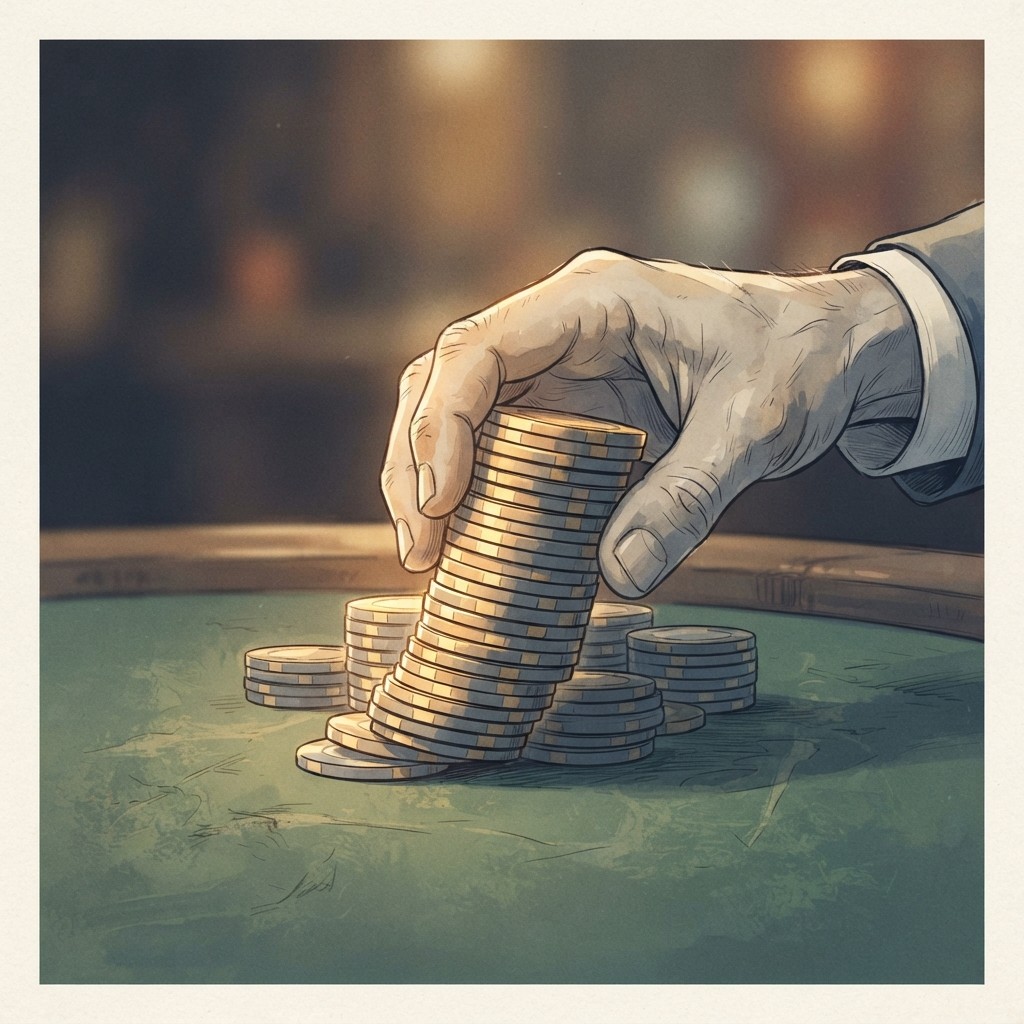
On the evening of October 23, 2009, Warren Buffett put a number on the table: $100 a share for the part of a railroad he didn't already own. Ten days later, on November 2, the BNSF board approved it.6 Then came the line that made the deal famous. It was, Buffett said, 'an all-in wager on the economic future of the United States. I love these bets.'3 The recession was still in the air, the markets were still shaky, and here was the most patient investor alive sounding like a man pushing his chips to the center of the table. It is a great story. It is also, in one important way, the wrong one.
The official story is that Buffett went all-in on America in a moment of crisis nerve. The truer story is quieter: he had been buying the railroad for three years, already owned almost a quarter of it, and the 'wager' was the last move in a long, deliberate position — not the first.
“Most important of all, however, it's an all-in wager on the economic future of the United States. I love these bets.”3
The bet had a three-year head start
Here is the fact the headline buries. By the time the merger agreement was signed in November 2009, Berkshire already owned about 22.6% of BNSF's common stock, accumulated through ordinary open-market purchases that began back in 2006.4 Not 2007, as several retellings have it,9 and not in the panic of the financial crisis — Berkshire started buying in August 2006, when the economy was still expanding and railroads were not a contrarian idea.7 So the 'all-in wager' was not a man walking into a casino with empty pockets. It was a man who had quietly been buying into the game for years, finally deciding to own the whole table. The acquisition completed the position. It did not open it.
This matters because it inverts the lesson people draw. The popular reading is about courage — the nerve to make a giant, decisive bet when others are frozen. The real reading is about patience compounding into optionality. Owning nearly a quarter of BNSF for years gave Buffett something a cold buyer never has: a deep, lived understanding of the asset, a stake that already moved with it, and the standing to act fast when the moment came. The speed of the final negotiation — roughly eleven days from first contact to signed agreement6 — wasn't impulse. It was a thesis that had been resolved long before, executed the instant the price made sense.
| The 'all-in bet' legend | What the record shows | |
|---|---|---|
| When it started | November 2009, in the crisis | August 2006, mid-expansion |
| Berkshire's prior stake | Roughly zero — a leap | About 22.6% already owned |
| The decision | A bold gamble under pressure | Completing a years-long position |
| What it cost | Often cited as $34B | ~$44B enterprise value, incl. ~$10B debt |
What was actually being wagered — and on what
Be precise about the money, because the loose number flatters the legend. The transaction was valued at roughly $44 billion, and that includes about $10 billion of BNSF debt that Berkshire took onto its balance sheet — making it the largest acquisition in Berkshire's history at the time.2 The price for the remaining 77.4% of shares Berkshire did not already own was set at $100 each.1 That was a premium of about 33% over the last close before the deal, and roughly 37% over the prior year's average price.8 Buffett, famous for hating to overpay, paid up. The 'I love these bets' bravado was partly cover for the fact that this was an expensive thing he wanted badly.
And what he wanted was not a stock trade. It was a piece of physical infrastructure that cannot be replicated — thousands of miles of track laid across a continent, a route network no competitor can simply build alongside. The 'wager on the economic future of the United States' was sincere, but it was a wager on a very specific thing: that goods would keep needing to move across America by the cheapest land route there is, and that the company owning the rails would collect a toll on every ton of it, recession or not. That is not a gambler's instinct. That is an infrastructure thesis, dressed in a gambler's grin.
But Buffett called it a wager himself — wasn't it one?
The honest objection is that the 'all-in wager' language is not a journalist's exaggeration — it is Buffett's own. He said it in 2009, and he said it again, unprompted, in his 2013 shareholder letter, recalling 'the gloom of the Great Recession' and the largest purchase in Berkshire's history.5 If the man who made the bet calls it a bet, who are we to demote it? Fair. But notice what the framing does and doesn't claim. Buffett never said he came to BNSF in a flash of crisis courage; the 'wager' was a statement about the macro view — a long bet that the American economy would grow — not a description of an impulsive, from-scratch move. The discipline and the drama are not in conflict. The wager language sells the conviction. The 2006 purchases reveal the method. A patient operator can hold a strong view for years and still describe its final, irreversible execution as a wager, because committing the last ~$26.5 billion in cash and stock7 genuinely was one. The error isn't in the word. It's in reading the word as a substitute for the homework underneath it.
When a great operator makes a dramatic, decisive bet, look backward before you admire the nerve. The decisiveness you're seeing is almost always the visible tip of a position built quietly over years — the stake accumulated, the asset studied, the thesis resolved long before the headline. Buffett didn't out-gamble the market on BNSF; he out-prepared it, then moved fast when the price arrived. The lesson isn't 'be bold in a crisis.' It's 'do the work in the calm, so that when the moment comes, the bold move is just the obvious one finally executed.' Beware drawing courage lessons from outcomes that were really patience lessons in disguise.
Buffett got the best of both worlds: the dignity of a long, disciplined position and the romance of a single brave plunge. The 'all-in wager' line is true and it is theater. Strip the theater away and what's left is more impressive than the legend, not less — a man who started buying a railroad in 2006 because he understood it could not be rebuilt, held a quarter of it through a crash, and finished the job when the rest of the market was too scared to bid. The wager on America was real. It just wasn't a leap. It was the last step of a walk he'd been taking for three years.
When the legend and the ledger disagree
Founder Doctrine Canvas
A one-page canvas for the operating system inside a founder's head: the principles they hold, the formative experiences that forged them, and the specific strategic moves each principle produces. Blank to make your own decision rules legible to the people who execute them; filled as the worked example showing why the story's company keeps making the bets it makes — because the founder can't make any others.
Included, filled and blank, in the The Founder Doctrine Casebook. See the set → · Preview the blank →
Sources
Where this comes from — the filings, records, and reporting behind it.
- 1Berkshire Hathaway and BNSF signed a merger agreement on November 2, 2009, for Berkshire to acquire the remaining 77.4% of outstanding BNI shares not already owned at $100 per share in cash and stock.
- 2The transaction was valued at approximately $44 billion, including $10 billion of outstanding BNSF debt, making it the largest acquisition in Berkshire Hathaway history at that time.
- 3Buffett's exact quote from the announcement: 'Most important of all, however, it's an all-in wager on the economic future of the United States. I love these bets.' This language appeared in the original November 3, 2009 press release filed with the SEC.
- 4At the time of the merger agreement, Berkshire already owned approximately 22.6% of BNSF's outstanding common stock, acquired through prior open-market purchases. Berkshire first acquired BNSF shares in 2006.
- 5Buffett retrospectively confirmed the 'all-in wager' language in his 2013 shareholder letter, writing: 'Late in 2009, amidst the gloom of the Great Recession, we agreed to buy BNSF, the largest purchase in Berkshire's history. At the time, I called the transaction an all-in wager on the economic future of the United States.'
- 6The deal negotiations moved from first contact (October 22-23, 2009) to a signed merger agreement in approximately 11 days. Buffett proposed $100/share on the evening of October 23, 2009, and the BNSF board unanimously approved the merger agreement on November 2, 2009 in Detroit.
- 7Berkshire began accumulating BNSF shares in August 2006, long before the financial crisis, and owned 22.5% of the railroad by early 2009. The acquisition was finalized on February 12, 2010, with Berkshire paying $15.9 billion in cash and issuing stock with market value of $10.6 billion to acquire the remainder.
- 8The premium paid was approximately 33% over the closing price on October 30, 2009 (the last trading day before the merger agreement), and 37% over the average closing price for the 12 months ending October 30, 2009.
- 9Berkshire began investing in BNSF in 2007 — a secondary retelling placing the start of Buffett's position in 2007 rather than 2006.
- 10The BNSF purchase is valued at $34 billion — a widely cited figure representing Berkshire's offer for the 77.4% it did not own, before adding assumed debt.
More like this — beyond Buffett-BNSF
New Strategically analyses as they publish: the defining moves in business, checked against the record. No noise, and one click to leave.