Pairs with the Founder Doctrine Canvas — a ready-to-use strategy tool. Included in the Founder Doctrine Casebook →
“What does holding control cost you, and what must it be worth?”
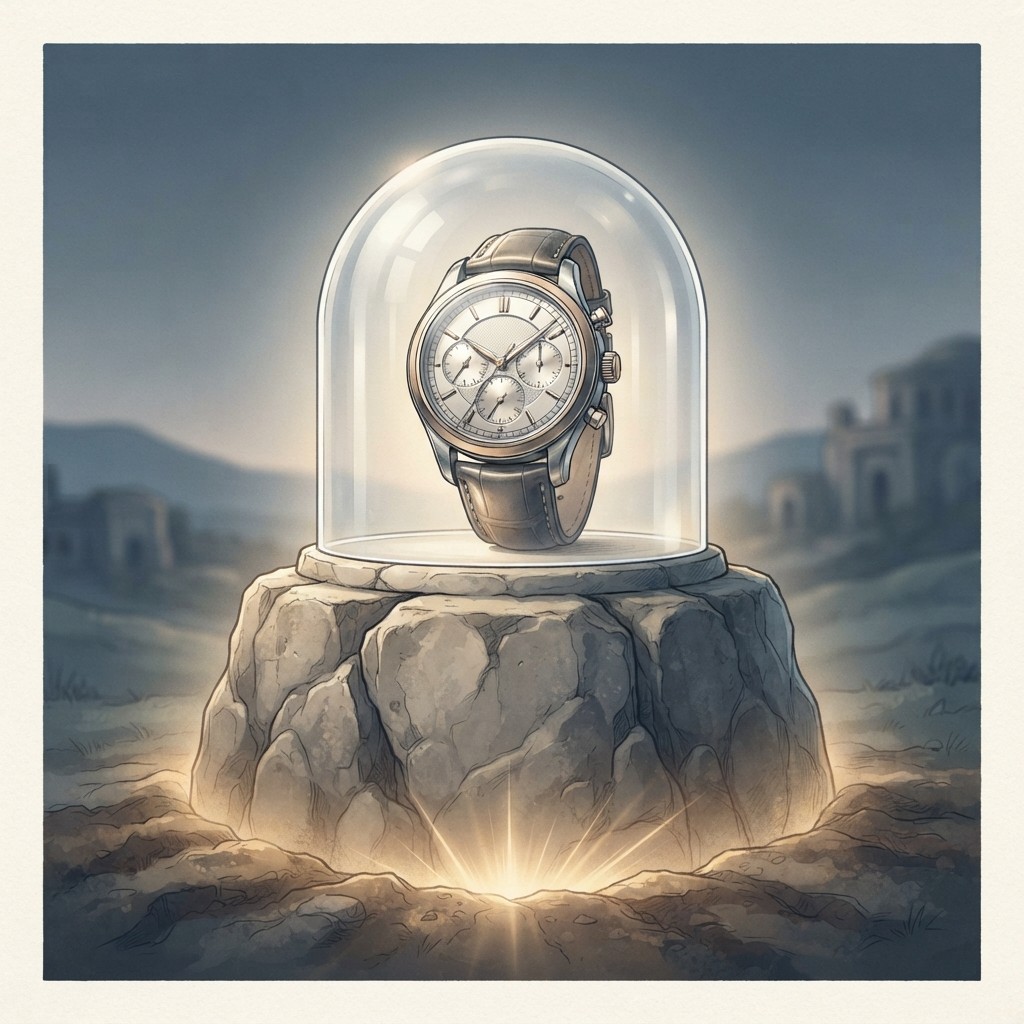
Every luxury house on earth eventually gets the call. A bigger conglomerate with a deeper balance sheet decides it wants your brand, your margins, your name on its annual report - and either your founder cashes out, your family fractures, or your stock price makes the decision for you. LVMH was assembled almost entirely this way10. Rolex has never gotten that call, and never will, because there is no one to make it to. The company has been owned since 1960 by a charitable foundation in Geneva2, and a dead man wrote the rules so that it can never be sold.
The official story is that Rolex is a nonprofit - a watchmaker that gives its money away. Almost every word of that is misleading. Rolex SA is a for-profit corporation that pays taxes, employs over 10,000 people9, and runs one of the most profitable brands in luxury. The charity is its owner, not the watchmaker itself. And the giving isn't the point of the structure. The structure's real product is something no competitor can buy at any price: permanence.
The thing Wilsdorf was really protecting was the brand from its own heirs
Hans Wilsdorf established the Hans Wilsdorf Foundation on 1 August 1945, the year after his wife died, and a contrast worth holding onto is that he did not hand over his Rolex shares while he was alive.1 He kept personal control until the end. The transfer was written into his will and took legal effect only when he died in 1960 - he bequeathed all his shares to the foundation specifically to ensure that Rolex would outlive him.1 Wilsdorf had no direct descendants. So the question every founder dynasty eventually fumbles - who inherits, who fights, who sells - he answered by making the answer 'no one.' The shares went to a purpose, not a person.
That choice is the whole doctrine. A family-owned company is only as disciplined as its least disciplined grandchild. A public company is only as patient as its next quarter. Wilsdorf removed both failure modes at once by removing the owner entirely and replacing it with a charitable purpose that the law treats as untouchable.
| Public (LVMH, Richemont) | Family dynasty | Foundation (Rolex) | |
|---|---|---|---|
| Who can force a sale | An acquirer with enough shares | A divided generation of heirs | No one - it's legally barred |
| Whose patience sets the clock | Quarterly shareholders | The current family head | A purpose written in 1945 |
| Pressure to disclose results | Mandatory | Optional | None - discloses nothing |
| Where the surplus goes | Dividends and buybacks | The family | A charitable trust |
The lock is in Swiss law, not in good intentions
Here is the part that makes it a moat rather than a sentiment. The ownership chain is more intricate than the popular version: the Hans Wilsdorf Stiftung owns Rolex Holding SA, which in turn owns Rolex SA, the operating company.3 But the layers matter less than the lock on top of them. Under Swiss foundation law (Civil Code, Arts. 80–89c), a charitable foundation has no owners or members, its assets are permanently dedicated to their stated purpose, and a return of those assets to any third party is excluded by law1112 — making any sale of the underlying company structurally incompatible with the foundation's legal existence. There are no shares trading anywhere. There is no controlling family to court. There is a purpose, codified, and a legal system that will not let the people running the place betray it. That is why Rolex is, in the plainest sense, un-acquirable - not unlikely to be sold, but structurally incapable of being sold.
Strip the philanthropy away and look at what the structure actually purchases. No takeover defense to maintain - there's nothing to take. No activist investor to placate - there's no investor at all. No earnings call where a number missed by 4% erases two years of brand patience. Rolex discloses no financials and no operational metrics, full stop, unlike Richemont or LVMH.2 It is free to think in decades because the one thing that forces every other luxury house to think in quarters has been amputated by deed.
The reason foundation ownership reads like charity but functions like strategy is that it converts a one-time founder decision into a permanent constraint. Most founder doctrines die with the founder, or get watered down by the second generation that never believed them. Wilsdorf's didn't, because he didn't entrust it to people - he entrusted it to a legal purpose that outranks every person who will ever run the company. The lesson for any operator obsessed with longevity: if a discipline matters more than any individual's judgment, the only way to make it survive is to take the option to abandon it off the table entirely. Permanence isn't a culture. It's a structure.
So where does CHF 300 million a year actually come from?
From a ferociously good business. According to a February 2025 Morgan Stanley and LuxeConsult report, Rolex produced roughly 1.18 million watches in 2024 on estimated revenues of CHF 10.5 billion - about a 32% share of the entire luxury watch market.7 The 'nonprofit' tells you nothing about how the money is made; it tells you only where it goes after. The foundation's General Secretary, Marc Maugué, has said it has around '300 million francs available for charitable purposes every year,' and 'when major projects are pending, it can be significantly more.'4 The foundation funds scholarships, social associations, real estate, and even built a bridge in Geneva.4 But that giving is the exhaust, not the engine. The engine is a commercial machine whose surplus simply happens to flow to a trust instead of to shareholders.
“Around 300 million francs [are] available for charitable purposes every year, and when major projects are pending, it can be significantly more.”4
Watch what Rolex does when given the chance to act on its own logic. In August 2023 it bought the retailer Bucherer, its first major step into selling watches directly to consumers.5 Rolex was explicit about why the deal happened: the Bucherer family chose to sell 'in the absence of direct descendants.'5 Read that again. The acquisition wasn't opportunistic expansion - it was a succession event, the exact same problem Wilsdorf faced when he had no heirs of his own. One childless founder's solution absorbing another childless founder's company. The structure recognizes its own kind.
Isn't a secretive charity that owns a watch empire just a tax dodge?
The fair objection is sharp: a charitable foundation that owns a hugely profitable company, pays a lower tax rate, and refuses to disclose its wealth, its donation amounts, or its beneficiaries looks less like philanthropy and more like a shelter wearing a halo. The transparency is genuinely poor. As far back as 2011 a Rolex spokesman declined to provide evidence of the foundation's charitable giving, and the secrecy has drawn real criticism over the years.8 The honest answer is that both things are true. The foundation does pay a lower tax rate, and it does keep its books shut - that's not in dispute.28 But the tax treatment is the byproduct, not the design. Rolex SA itself is a normal taxpaying corporation.2 If the goal had been pure tax avoidance, the foundation structure is a cumbersome way to achieve it. What the structure buys that a tax dodge cannot is the un-sellability - and that is the part competitors would actually trade their margins for. The opacity is the price of admission, not the prize.
Every other luxury maison is, in the end, a thing that can change hands - a name waiting for the right offer, the right heir, the right quarter to go wrong. Rolex took itself off that table in 1960 and bolted the table to the floor of Swiss law. The genius was never the charity. It was a founder who understood that the most valuable thing he could give his company was the permanent inability to be given away.
Companies built to outlive their founders
Founder Doctrine Canvas
A one-page canvas for the operating system inside a founder's head: the principles they hold, the formative experiences that forged them, and the specific strategic moves each principle produces. Blank to make your own decision rules legible to the people who execute them; filled as the worked example showing why the story's company keeps making the bets it makes — because the founder can't make any others.
Included, filled and blank, in the Founder Doctrine Casebook. See the set → · Preview the blank →
Sources
Where this comes from — the filings, records, and reporting behind it.
- 1The Hans Wilsdorf Foundation was established on 1 August 1945 by Hans Wilsdorf, following the death of his wife in 1944; as confirmed by his will in 1960, he bequeathed all his shares to the foundation to ensure that Montres Rolex SA would outlive him.Wikipedia, Hans Wilsdorf Foundation ↗ · 2026-05-25
- 2Since 1960, Rolex SA has been owned by the Hans Wilsdorf Foundation, a private family trust; the Hans Wilsdorf Foundation is a registered Swiss charitable foundation and pays a lower tax rate; unlike publicly traded competitors like Richemont or LVMH, Rolex maintains strict secrecy, disclosing no financials or operational metrics.Wikipedia, Rolex ↗ · 2026
- 3Rolex's ownership chain is more intricate than commonly described: the Hans Wilsdorf Stiftung owns Rolex Holding SA, which owns Rolex SA, the operating company; under Swiss foundation law the board cannot legally sell the company out from under the charitable purpose Wilsdorf set down in 1945, and Swiss courts treat that as a near-impossible bar.
- 4The foundation's General Secretary Marc Maugué confirmed it has around '300 million francs available for charitable purposes every year' and 'when major projects are pending, it can be significantly more'; the foundation invests in major real estate projects, awards scholarships, supports social associations, and funds the Hans Wilsdorf Bridge (completed 2012). Its statutes also originally accommodated distant family members who were paid out by mutual agreement after a 2006 bylaw revision.Coronet Magazine, The Hans Wilsdorf Foundation ↗ · 2024-08-02
- 5Rolex SA is upending the world of luxury watch retailing by buying Bucherer AG, giving the Swiss brand a major presence in consumer sales for the first time; Rolex said the decision was made after the family controlling the retailer decided to sell 'in the absence of direct descendants'; financial terms were not disclosed.Rolex Newsroom, Rolex acquires Bucherer ↗ · 2023-08-24
- 6Bloomberg reported on 24 August 2023 that Rolex SA is buying Bucherer AG, giving it control of Bucherer's more than 100 stores globally; an analyst at Vontobel estimated Bucherer's annual sales at about CHF 2 billion, giving an enterprise value of as much as CHF 4 billion; financial terms were undisclosed as neither firm publishes financial results.
- 7According to the February 2025 LuxeConsult & Morgan Stanley annual report on the Swiss watch industry, Rolex 2024 units produced were approximately 1,176,000 and revenues were estimated at CHF 10.5 billion, with an implied retail value of CHF 15.5 billion for a 32% market share of the luxury watch market.
- 8In 2011, a Rolex spokesman declined to provide evidence regarding the amount of charitable donations made by the Wilsdorf Foundation, which brought up several scandals due to lack of transparency; the foundation reportedly adheres to a code of conduct under which it does not disclose its wealth, donation amounts, or beneficiaries.
- 9Rolex employs over 10,000 people globally, with workforce intelligence data showing approximately 10,783–11,345 employees in 2024–2025.
- 10LVMH was formed through the merger of Louis Vuitton and Moët Hennessy in 1987, and has since assembled its portfolio through dozens of strategic acquisitions of luxury brands.LVMH, History – LVMH ↗ · 2024
- 11Under Swiss Civil Code Articles 80–89c, a charitable foundation has no owners or members; its assets are permanently dedicated to a specific purpose and a return of those assets to any third party is generally excluded by law.
- 12Since, under Swiss law, charitable foundations do not have members or owners, a return of the assets to the founder or any other third party is generally excluded; if the foundation is dissolved, any remaining funds must be transferred to another charitable organisation.
More like this — beyond Rolex
New Strategically analyses as they publish: the defining moves in business, checked against the record. No noise, and one click to leave.