Pairs with the Distribution Channel Map — a ready-to-use strategy tool. Included in the The Distribution Rebellion Casebook →
Picture the move everyone admired: a customer stands in a Best Buy aisle, scans a television's barcode with a phone, sees it cheaper on Amazon — and instead of walking out, hands the screen to a Blue Shirt, who matches the price on the spot. That was the image Best Buy wanted in 2013, and it worked as theater. The company turned its own worst nightmare, the shopper using its stores as Amazon's free showroom, into a checkout ritual. The press called it the counterattack that beat showrooming. It was not, and the gap between the story and the math is where the actual strategy lived.
The official story is that Best Buy fixed itself by matching Amazon's prices. That story is half true and dangerously incomplete. Price-matching stopped the panic. It did not stop the decline — and it opened a wound in the company's own margin that something else, quietly, had to close.
Showrooming was the symptom everyone could see, not the disease
It is tempting to blame the phone in the aisle for everything. But Best Buy's own filings tell a less dramatic story. In its 10-Q for the period ending in August 2012, the company attributed its comparable-store-sales declines primarily to 'product life-cycle declines in gaming, notebooks and televisions' and to a 'price competitive environment.'4 Notice what is missing: showrooming as the named villain. The categories that had carried Best Buy — the disc games, the laptops, the flat-panel TVs — were maturing, commoditizing, and shrinking as gross-margin engines all at once. Showrooming was a pressure layered on top of that, not the foundation of the collapse. The numbers were grim either way: Domestic revenue in the third quarter of fiscal 2013 fell 4.7% to $7.7 billion, comparable-store sales dropped 4.0%, and Domestic operating income cratered to $50 million from $249 million a year earlier.3 That is the picture of a category problem wearing a showrooming costume.
The price match was a controlled bleed, by design
Hubert Joly did not arrive in 2013 to launch a price-match policy, as the legend tends to imply. He was appointed CEO in August 2012, with an expected start in early September.1 By the holidays he was already running a price-matching pilot — and on March 3, 2013 he made it permanent, rolling the Low Price Guarantee across all 1,000-plus big-box stores and 400-plus Best Buy Mobile locations, matching 19 named online competitors with Amazon explicitly on the list.2 This was not a cold start; it was a pilot being hardened into doctrine.
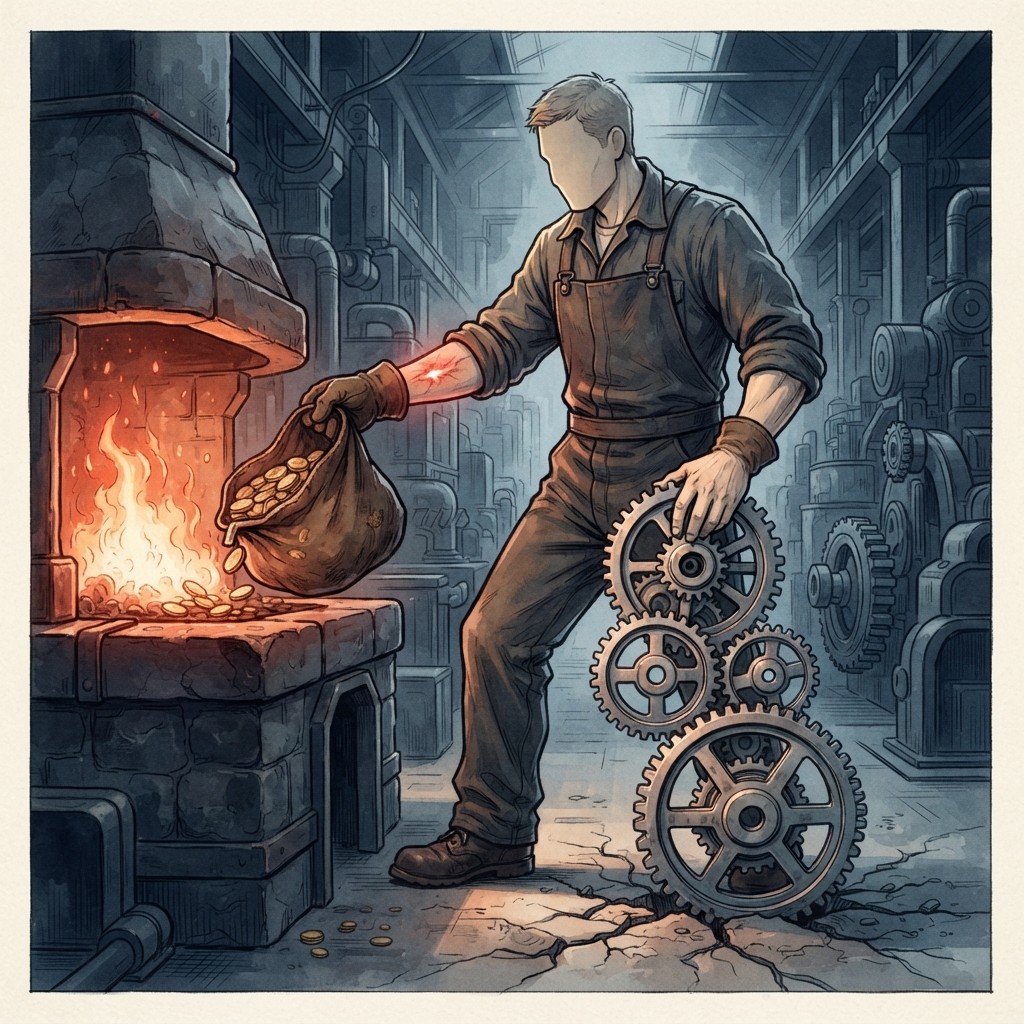
Here is the part the celebration skipped. When you promise to match Amazon's price on identical electronics, you are promising to surrender the one advantage a higher-cost retailer has: a margin cushion. The cost of running 1,000 stores, paying Blue Shirts, and carrying inventory does not vanish because you agreed to Amazon's number. The bill comes due in gross margin — and it did. Best Buy's gross margin fell from 25.1% to 22.4% between 2010 and 2014 — compressed by price-matching commitments layered on top of the category-mix headwinds the company's own filings had already identified.64 That is not a footnote. On tens of billions of revenue, 2.7 points of margin is a self-inflicted wound, taken deliberately, because the alternative — letting customers walk out to buy elsewhere — was worse. The price match did not win the war. It bought time.
| What price-matching achieved | What it cost | |
|---|---|---|
| Customer behavior | Kept the shopper at the register instead of leaving | Onus stayed on the shopper to find and request the lower price |
| The panic | Arrested the showrooming narrative | Did not reverse category decline |
| Margin | — | Gross margin compressed from 25.1% to 22.4% |
| The real question | Can we survive parity? | Only if costs fall to match the lost margin |
The turnaround happened on the cost side and in the vendors' wallets
If price-matching opened the wound, two things closed it. The first was cost. Joly's Renew Blue program ran a parallel track of over $1 billion in annualized cost cuts — reaching $1.02 billion by the end of fiscal 2015 and $1.4 billion across the full five-year transformation — designed precisely to offset the margin the price match was giving away.1112 A company that has agreed to charge Amazon's prices can only stay alive by getting dramatically cheaper to operate — so the price match and the cost program were never two stories. They were one decision: hold the price, then earn the right to hold it by stripping cost out of everything behind the shelf.
The second was cleverer, because it changed who paid for the floor space. Best Buy turned its stores into branded showrooms that vendors funded — store-within-a-store boxes for the very manufacturers who needed a physical home to sell against Amazon's commodity sea. In April 2013, Samsung opened Experience Shops inside more than 1,400 Best Buy locations; Microsoft followed in June 2013 with Windows stores at 500 U.S. sites. Brands paid rent to Best Buy and staffed the spaces themselves or trained Blue Shirts to do it.910 Those partners had every reason to subsidize a premium space in a store that customers still walked into to touch a screen and ask a question. In other words, Best Buy stopped fighting showrooming and started selling it. The thing Amazon was getting for free — a physical place to see and feel the product — Best Buy began renting back to the brands. That is the move Harvard Business School built a case study around: whether a higher-cost retailer could survive permanent price-matching against Amazon at all.8 The answer turned out to be yes, but only because the price match was the least important part of the plan.
When a lower-cost rival sets the price, matching it is necessary but suicidal on its own — you've surrendered your margin cushion and kept your higher costs. The escape isn't a better price; it's a better question: who else benefits from your physical presence, and will they pay for it? Best Buy stopped treating its stores as a cost it had to defend and started treating them as a stage it could rent — to the same vendors who needed somewhere to be touched and demonstrated. The price match keeps the customer in the room. Vendor-funded space and a brutal cost program are what let you afford to keep the room. Confuse the headline move for the mechanism and you copy the part that loses money.
Didn't price-matching obviously work? Look at the timing
The fair objection is that the recovery is right there in the numbers, so the price match must have done it. And the recovery is real: in the fourth quarter of fiscal 2013, Domestic comparable-store sales rose 0.9% and Domestic online revenue grew 11%.5 But read the calendar. That quarter ended around the start of March 2013 — before the permanent Low Price Guarantee had run for even a full quarter, and within months of Joly taking the job.51 The momentum was already turning while the permanent price policy was still being announced. The credit a tidy story hands to price-matching belongs at least as much to the holiday pilot, the cost program, and the operational reset that preceded the headline. And there is a second honest limit: the policy never actually ended showrooming. It still required the customer to find the lower price and ask for the match, item by item, at the register — friction that, by design, capped how often it was ever invoked.7 Best Buy did not abolish the behavior. It made peace with it on terms it could afford.
“We do not issue cards... matching immediately available new products sold by qualified competitors, one price match per identical item, per customer — excluding marketplace sellers, clearance, and open-box items.”7
Best Buy's counterattack on showrooming is remembered as the day it decided to beat Amazon on price. It never tried to. It conceded the price, took a 2.7-point gouge in its own margin to do it, and then spent a parallel program cutting over $1 billion in costs and reinventing the store model to earn back the right to make that concession. The lesson isn't that price-matching saves a struggling retailer. It's that matching a cheaper rival's price is a bill, not a strategy — and the company that survives is the one that has already figured out how it's going to pay it.
When the distribution channel fights back
Distribution Channel Map
A map of every hop between the company and the customer — each intermediary, who owns the relationship at each step, and where the company controls the channel versus where it's at the channel's mercy. Blank to chart your own route to market; filled as the worked example showing where the story's company went direct, fought its gatekeepers, or got disintermediated.
Included, filled and blank, in the The Distribution Rebellion Casebook. See the set → · Preview the blank →
Sources
Where this comes from — the filings, records, and reporting behind it.
- 1Best Buy appointed Hubert Joly as President and CEO on August 20, 2012, with an expected start date of early September 2012, succeeding interim CEO G. Mike Mikan.
- 2Best Buy's Low Price Guarantee launched online and in all 1,000+ big-box stores and 400+ Best Buy Mobile stores on March 3, 2013, matching 19 named online competitors including Amazon, making the holiday 2012 pilot permanent.
- 3Best Buy's Domestic segment Q3 FY2013 revenue was $7.7 billion, a 4.7% decline year-over-year, with a 4.0% comparable-store-sales decline; operating income fell to $50 million from $249 million in the prior-year period.
- 4Best Buy's Q2 FY2013 10-Q attributes comparable-store-sales declines to 'product life-cycle declines in gaming, notebooks and televisions' and a 'price competitive environment' — not showrooming — as primary factors.
- 5Q4 FY2013 Domestic comparable store sales increased 0.9% and Domestic online revenue increased 11%, representing early turnaround momentum before the permanent price-match policy had been running for a full quarter.
- 6Best Buy's gross profit margin declined from 25.1% to 22.4% between 2010 and 2014 as a consequence of matching Amazon prices; Joly simultaneously launched a cost-cutting program to compensate for lost margin.
- 7Best Buy's Low Price Guarantee, per the current official policy page, matches 'immediately available new products' sold by qualified competitors on a one-price-match-per-item-per-customer basis, excluding marketplace sellers, clearance, and open-box items.
- 8Harvard Business School published a case study on showrooming at Best Buy examining whether the company could survive permanent price-matching against Amazon despite higher structural costs.
- 9Best Buy partnered with Samsung in April 2013 to open Samsung Experience Shops in more than 1,400 Best Buy and Best Buy Mobile stores, and entered a similar store-within-a-store arrangement with Microsoft in June 2013, establishing Windows stores at 500 Best Buy U.S. locations.
- 10Brands pay rent to Best Buy for store-within-a-store space and either send their own salespeople or train Best Buy's Blue Shirts.
- 11Renew Blue annualized cost reductions reached $1.02 billion by the end of fiscal year 2015, comprising $710 million in SG&A and $310 million in cost of goods sold.
- 12Best Buy delivered $1.4 billion in cost savings over the five years of the Renew Blue transformation, and announced a plan to drive an incremental $600 million in annualized savings by end of fiscal 2021.
More like this — beyond Best Buy
New Strategically analyses as they publish: the defining moves in business, checked against the record. No noise, and one click to leave.