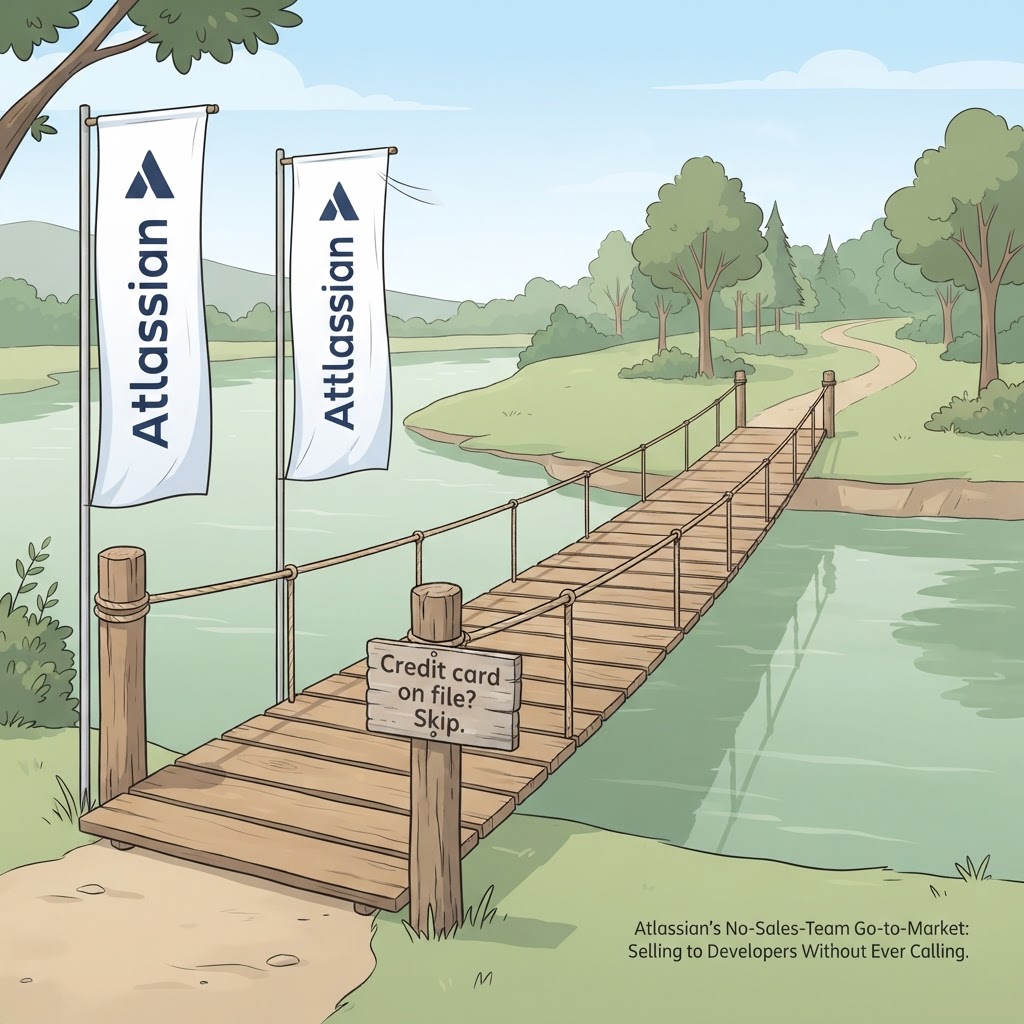
Pairs with the Distribution Channel Map — a ready-to-use strategy tool, filled for Atlassian. Included in the The Distribution Rebellion Casebook →
Two friends from the University of New South Wales started a software company in 2002 with $10,000 of credit-card debt and a stubborn idea: let the product do the selling.2 No reps, no demos, no golf. A developer found Jira, tried it, swiped a card, and told the next developer. The company crossed $100M in revenue, filed to go public describing itself as selling 'online without traditional sales infrastructure,'1 and a legend was born — the company that built a fortune with no sales team. It is one of the most repeated origin stories in software. It is also, by the time most people repeat it, untrue.
The official story is that Atlassian proved you never need salespeople. The actual story is that Atlassian hired its first commissioned salespeople in the summer of 2014 — before its December 2015 IPO — and has been quietly building a conventional enterprise sales machine ever since.34 'No sales team' was true for the first twelve years. It was never the strategy. It was the byproduct of one.
“The Enterprise Sales team was established in the summer of 2014.”4
The sale was always coming. It was just waiting for the deal to grow up.
Here is the part the legend leaves out, and it is the whole point. A salesperson costs money — salary, commission, travel, the months it takes to ramp. To pay for one, a deal has to be big enough that the margin on it covers the human standing in the way of it. For most of Atlassian's history, the deals weren't. A self-serve Jira license ran a few thousand dollars; the marginal cost of a website handling the order was almost nothing. Putting a commissioned rep on a $4,000 transaction is like hiring a sommelier to pour a juice box. The economics forbid it, and Atlassian simply obeyed the economics.
Then the deal grew up. According to CRO Cameron Deatsch, Atlassian launched a Data Center product aimed at large, complex installations, and the average selling price jumped from roughly $4,000 to roughly $48,000.3 At $48,000, the math inverts. Now there is enough margin in a single contract to fund a human who can shorten the sales cycle, navigate a procurement department, and close the customer who would never self-serve a six-figure commitment off a pricing page. So Atlassian hired one. Then five. Then ten — the original Enterprise Advocate team.3 The company didn't have a religious objection to sales. It had a spreadsheet, and the spreadsheet finally said yes.
| The self-serve era (2002–2013) | The Data Center era (2014→) | |
|---|---|---|
| Typical deal size | ~$4,000 | ~$48,000 |
| Who closes it | The product, the docs, the free trial | An Enterprise Advocate (quota-carrying) |
| Cost to serve one more sale | Almost nothing — a web order | A commissioned human |
| Right GTM call | Defer the sales hire | Make the sales hire |
At a $4,000 ASP the left side loses; the product had to sell itself because nothing else could pay rent. At a $48,000 ASP the inequality flips, and a salesperson becomes the cheapest way to win the deal, not the most expensive.3 Atlassian's famous restraint was never ideology — it was this inequality, held until the numbers crossed.
What the missing salesforce was actually buying
Deferring sales wasn't free — it had to be funded by something else, and that something was the product. The F-1 numbers tell the story plainly: revenue of $148.5M in FY2013, $215.1M in FY2014, $319.5M in FY2015, net income positive every year, and an R&D line running at 44% of revenue — dramatically higher than peers relative to what they spent on sales and marketing.17 Most enterprise software companies pour money into a salesforce; Atlassian poured it into the product and let word of mouth do the prospecting. The salary it didn't pay reps, it paid engineers. The pipeline it didn't build with cold calls, it built with a free trial good enough that the user did the selling internally for free.
This is the sticky part: the absent salesforce wasn't a void, it was a transfer. Every dollar not spent acquiring a customer the expensive way was a dollar spent making the customer arrive on their own. Bootstrapped for eight years before taking $60M from Accel in 2010,6 the company had no choice but to be capital-efficient early — and capital efficiency, it turned out, made a virtue out of a constraint. The 'no sales team' wasn't the engine. It was the exhaust.
But didn't it prove sales teams are obsolete?
The seductive reading is that Atlassian discovered a permanent law: great products don't need salespeople, so kill the salesforce and let growth flow. It's a tidy lesson, and the people closest to it warned against drawing it. Then-President Jay Simons put it flatly — the model was enabled by specific product and market conditions, and 'low touch does not mean no touch.'5 Even the famous '$20 billion company with no sales team' headline described a company that, by 2020, already ran an Enterprise Advocate organization with quota-carrying reps across the Americas, EMEA, and APAC, growing for about four years.5 The myth was being printed while the salesforce was being hired.
And the trajectory only steepened. In March 2026, Atlassian announced layoffs of roughly 10% of its workforce explicitly to pivot toward AI and enterprise sales8 — a company once held up as the proof that you can skip the salesforce, now openly reorganizing around one. That isn't a betrayal of the original model. It's the model finishing its arc. Product-led growth gets you in the door cheaply; closing the largest, slowest, most lucrative customers eventually requires the door-opener Atlassian deferred for a decade.
The real Atlassian lesson isn't 'don't hire salespeople.' It's 'hire them on the deal's schedule, not your own.' When your average deal is small and self-serve, a commissioned rep is a tax you can't afford, so make the product carry the sale and put the money you saved into R&D. But watch the deal size, because the day a new tier pushes your ASP up an order of magnitude — Atlassian's was a 12x jump to $48,000 — the same hire that was wasteful becomes the cheapest way to win. The mistake is treating 'no sales team' as an identity instead of a phase. It is a stage of growth, and stages end.
Atlassian didn't win because it banished salespeople. It won because it refused to pay for them before the deals could carry them — and then hired them the moment the deals could. The legend froze a true snapshot of the first twelve years and sold it as an eternal law. The truth is less romantic and far more useful: the product-led motion was never a rejection of sales. It was sales, postponed until it paid for itself. The genius wasn't the absence. It was the timing.
When the way you reach customers is the whole strategy
Distribution Channel Map
A map of every hop between the company and the customer — each intermediary, who owns the relationship at each step, and where the company controls the channel versus where it's at the channel's mercy. Blank to chart your own route to market; filled as the worked example showing where the story's company went direct, fought its gatekeepers, or got disintermediated.
Included, filled and blank, in the The Distribution Rebellion Casebook. See the set → · Preview the blank →
Sources
Where this comes from — the filings, records, and reporting behind it.
- 1Atlassian filed its F-1 with the SEC on November 9, 2015, describing itself as distributing and selling products 'online without traditional sales infrastructure' and enabling a 'self-service, low-friction model.' FY2015 revenue was $319.5M; R&D was 44% of revenue.
- 2Atlassian was founded in 2002 by Mike Cannon-Brookes and Scott Farquhar, who met at the University of New South Wales and bootstrapped the company with $10,000 in credit card debt. Its IPO on December 10, 2015 on NASDAQ (TEAM) valued the company at $4.37 billion.Wikipedia, Atlassian ↗ · 2026
- 3Atlassian's first commissioned salesperson was hired in 2014; the initial Enterprise Advocate team was 5–10 people, triggered by the launch of a Data Center product that raised average selling price from $4,000 to $48,000. This is per CRO Cameron Deatsch.
- 4Atlassian's LinkedIn job posting for Head of Enterprise Sales, Americas states explicitly: 'The Enterprise Sales team was established in the summer of 2014.'
- 5Then-President Jay Simons stated that 'low touch does not mean no touch' and described the Enterprise Advocate function, noting it had been growing for approximately four years as of the podcast recording (~2019–2020), serving large, complex customers.
- 6Atlassian's first external funding was a $60 million round from Accel in 2010; the company was bootstrapped for approximately 8 years prior. Scott Farquhar's Wikipedia biography corroborates this figure and date.Wikipedia, Scott Farquhar ↗ · 2026
- 7TechCrunch's contemporaneous November 2015 report on the F-1 confirms: revenues of $148.5M, $215.1M, and $319.5M for FY2013, FY2014, and FY2015 respectively; net income positive all three years; R&D spend dramatically higher than peers relative to sales and marketing spend.
- 8In March 2026, Atlassian announced a layoff of approximately 10% of its workforce explicitly to pivot toward artificial intelligence and enterprise sales, marking a formal strategic departure from its historic PLG-only stance.Wikipedia, Atlassian ↗ · 2026
More like this — beyond Atlassian
New Strategically analyses as they publish: the defining moves in business, checked against the record. No noise, and one click to leave.