Pairs with the Adjacency / Synergy Map — a ready-to-use strategy tool. Included in the The Adjacency Expansion Casebook →
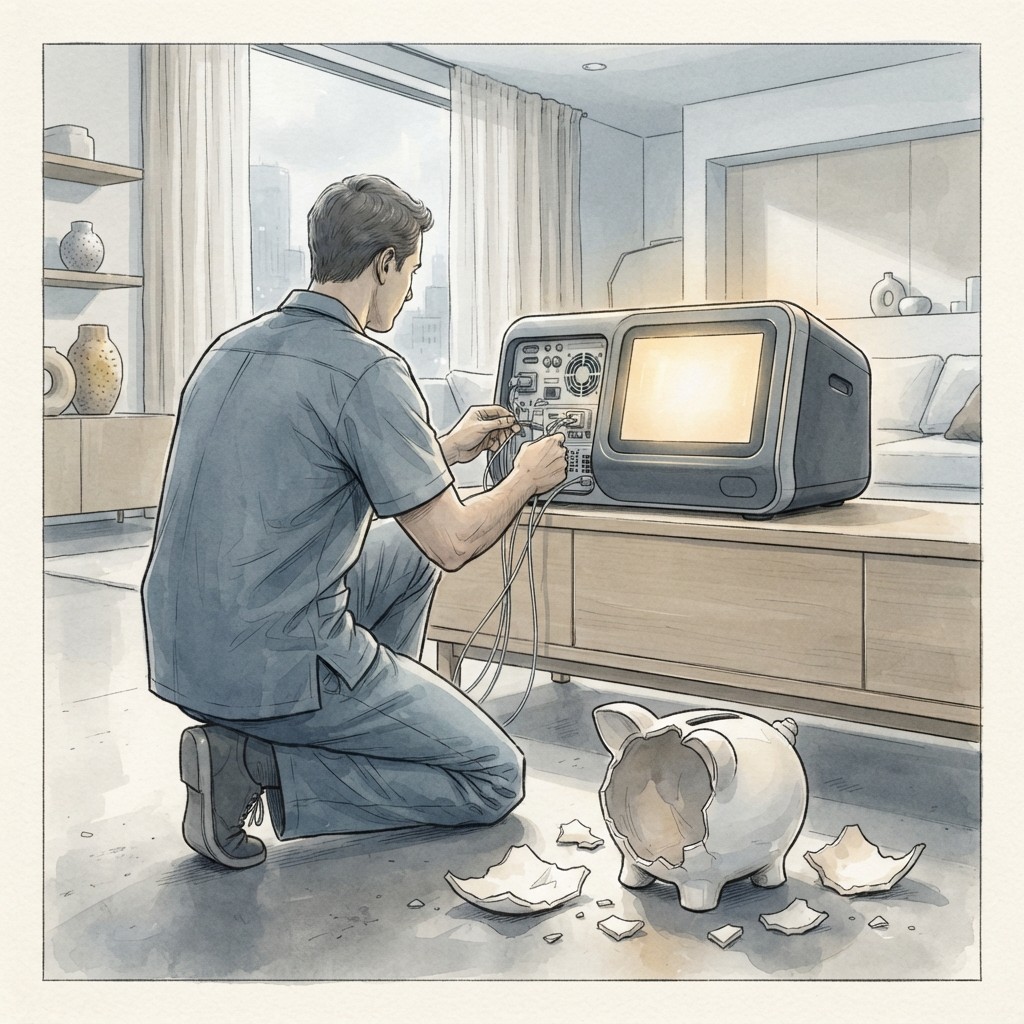
A Geek Squad agent who normally mounts your TV walks into the home of a Geisinger patient with a chronic condition and sets up a remote monitoring kit. The before-and-after is striking: the same setup that used to take an average of 96 hours from referral to working device gets done in 48.6 Cut clean in half. It is exactly the kind of result that makes a strategy deck sing — the install muscle Best Buy spent thirty years building, redeployed to the bedside. The pilot worked. The business did not.
The official story is that Best Buy is pivoting from a struggling box-mover into a services-and-health company, with Geek Squad as the secret weapon. The truer story is shorter and more expensive: Best Buy spent over $1.3 billion buying its way into a market it did not understand, then wrote much of it off and sold a piece back to the man it bought it from.
The bet: that the last mile was the moat
The logic was seductive and, on paper, sound. Healthcare was migrating into the home. Somebody had to physically get the device through the door, plug it in, and make it work for an 80-year-old who has never paired anything by Bluetooth. Best Buy already had that somebody — Geek Squad, the install-and-repair force it had been running since the 1990s, long before it ever thought about healthcare. So it went shopping. In August 2018 it paid $800 million in cash for GreatCall, a connected-health provider with more than 900,000 paying subscribers and over $300 million in annual revenue.1 A year later it added Critical Signal Technologies, a remote-monitoring firm, for $125 million.8 Then in fiscal 2022 it spent $389 million in net cash on Current Health, a care-at-home technology platform — a deal that generated $351 million of goodwill, all of it parked in the Best Buy Health reporting unit.2
“Geek Squad... had more than 900,000 paying subscribers and annual revenue in excess of $300 million.”1
Three acquisitions, over $1.3 billion, one coherent thesis: own the last mile of home health and you own a durable advantage no insurer or hospital can replicate. The thesis had a flaw that doesn't show up in a deck. The last mile was real. It just wasn't where the money lived.
Why installing the device isn't the same as getting paid for it
Here is the part the strategy missed. In consumer retail, the person who chooses the product is the person who pays for it — you walk in, you decide, you swipe. Best Buy is world-class at that game. But home health doesn't run on consumer choice. It runs on clinical reimbursement: a health system or a payer decides whether a remote-monitoring program is covered, at what rate, and for which patients, and that decision is the entire revenue engine. Best Buy could shrink setup time from 96 hours to 48 all day long, and it would not move the variable that mattered, because no payer reimburses faster on the basis of a tidier install.6 The competence Best Buy brought was genuine. It was simply downstream of the gate, and the gate was held by people who had never heard of the Pepsi Challenge of TV-mounting.
| Best Buy's home-tech business | The home-health market | |
|---|---|---|
| Who decides | The consumer | The payer / health system |
| Who pays | The same consumer | An insurer, via reimbursement policy |
| What wins the sale | Service quality, install speed | Coverage codes and clinical evidence |
| Where Geek Squad operated | The whole transaction | The last mile only |
When a company is excellent at one thing and assumes that excellence will carry it into an adjacent market, it usually mistakes a feature for a foundation. Geek Squad was a feature of a healthcare business. The foundation — the reimbursement relationships, the clinical validation, the regulatory patience — Best Buy never owned, and could not buy at scale fast enough to matter.
The write-down that admitted it
The reckoning arrived in the filings, which are blunter than any press release. In the fourth quarter of fiscal 2025, the quarter ending February 1, 2025, Best Buy recorded a pre-tax non-cash goodwill impairment of $475 million on the Best Buy Health reporting unit.3 The company's own annual report explained why in language that reads like a confession: the charge 'primarily arose from downward revisions of revenue growth rates and margin rates compared to projections used in prior years.'7 Translated: the business was never going to make the money the deal model promised. The following quarter brought $109 million in restructuring charges, largely asset impairments tied to the health unit, and a CEO admitting the at-home care business had 'been harder and taken longer to develop than we initially thought.'4
The clearest verdict came in June 2025, when Best Buy sold Current Health back to Christopher McGhee — the co-founder it had bought the company from — for a price it declined to disclose.5 When you return an asset to its originator and won't say what you got for it, the number is not the headline. The reversal is.
But wasn't the home-health thesis basically correct?
The fair objection is that the macro bet was right. Care really is moving into the home, the aging population really does need exactly the install-and-support layer Best Buy provides, and the Geisinger pilot really did work — 96 hours to 48, with a platform that grew past 1,100 enrolled patients.6 Maybe Best Buy was simply early. That's the strongest case, and it concedes the actual lesson. Being right about where the world is going is not the same as being positioned to profit from it. Best Buy bought the easiest layer of the value chain — the physical setup — precisely because it was the layer it already understood, and left the hard, value-defining layers (reimbursement, clinical evidence, payer trust) in other hands. An adjacency is only safe to enter when your existing strength addresses the part of the new market that actually controls the money. Here it addressed the part that didn't. The honest counter is that Best Buy kept the pieces that fit its old game — the Lively senior-support brand and emergency-response devices, which sell to consumers the way TVs do — and shed the enterprise clinical business that never would.5 That isn't a failed pivot so much as a corrected one. The correction just cost half a billion dollars to learn.
Before you expand into a neighboring market on the strength of one capability, find out who controls the money — and check whether your strength touches them. Best Buy's install muscle was real, but in home health the revenue is gated by payers and reimbursement codes, and no amount of last-mile excellence moves that gate. The trap is that the adjacent layer you're best at is usually the one nearest your current business — the doorstep — which is rarely the layer that governs profit. Ask the uncomfortable version of the question: if we are excellent at our piece and everything else goes as planned, who decides whether we get paid? If the answer is someone you have no relationship with and no way to influence, you don't have a moat. You have a service contract waiting to be impaired.
Best Buy could get the hospital into your home faster than anyone. It could not get the hospital to pay for the privilege — because the institution that signs the check was never standing at the front door where Geek Squad does its best work. The genius the company thought it owned was logistical, and logistics is a wonderful thing to be great at. It is just not, on its own, a place to stand in a market where someone else decides who gets reimbursed. Best Buy spent over $1.3 billion proving it, and got most of one acquisition's worth of cash back by handing the keys to the man it bought them from.
When a strong company walks into the wrong market
Adjacency / Synergy Map
A one-page canvas for an adjacency play: the new business next door, the shared assets that justify entering it, the synergies that actually transfer versus the ones that evaporate on contact, and the dis-synergies nobody put on the deck. Blank to test your own expansion; filled as the worked example showing where the story's 'natural adjacency' was real and where it was wishful.
Included, filled and blank, in the The Adjacency Expansion Casebook. See the set → · Preview the blank →
Sources
Where this comes from — the filings, records, and reporting behind it.
- 1Best Buy signed a definitive agreement to acquire GreatCall, Inc. for $800 million in cash on August 15, 2018; GreatCall had more than 900,000 paying subscribers and annual revenue in excess of $300 million at time of acquisition.
- 2In fiscal 2022 (closed November 2, 2021), Best Buy acquired Current Health, a care-at-home technology platform, for net cash consideration of $389 million, generating $351 million of goodwill assigned to the Best Buy Health reporting unit.
- 3In Q4 FY2025 (quarter ended February 1, 2025), Best Buy recorded a pre-tax non-cash goodwill impairment charge of $475 million related to its Best Buy Health reporting unit, reflecting downward revisions in long-term financial projections for Best Buy Health.
- 4Best Buy restructured its health unit in Q1 FY2026, incurring $109 million in restructuring charges primarily representing asset impairments; CEO Corie Barry stated the at-home care business had 'been harder and taken longer to develop than we initially thought.'Healthcare Dive, Best Buy restructures health unit ↗ · 2025-05-30
- 5On June 24, 2025, Current Health co-founder and former CEO Christopher McGhee reacquired Current Health from Best Buy; Best Buy did not disclose the sale price, and the retailer's health unit retained its Lively senior support brand and emergency response devices.
- 6A Geek Squad pilot with Geisinger beginning July 2022 cut remote monitoring device setup time from an average of 96 hours to 48 hours (50% reduction) for chronic-condition patients; Geisinger's ConnectedCare365 platform had more than 1,100 patients enrolled as of late 2023.
- 7Best Buy's FY2025 goodwill impairment on the Best Buy Health reporting unit 'primarily arose from downward revisions of revenue growth rates and margin rates compared to projections used in prior years,' per Best Buy's own annual report filing.
- 8Best Buy also acquired Critical Signal Technologies, a senior-focused remote patient monitoring provider, for $125 million in 2019, making GreatCall (2018), Critical Signal Technologies (2019), and Current Health (2021) a three-acquisition health build-out totaling over $1.3 billion.
More like this — beyond Best Buy
New Strategically analyses as they publish: the defining moves in business, checked against the record. No noise, and one click to leave.