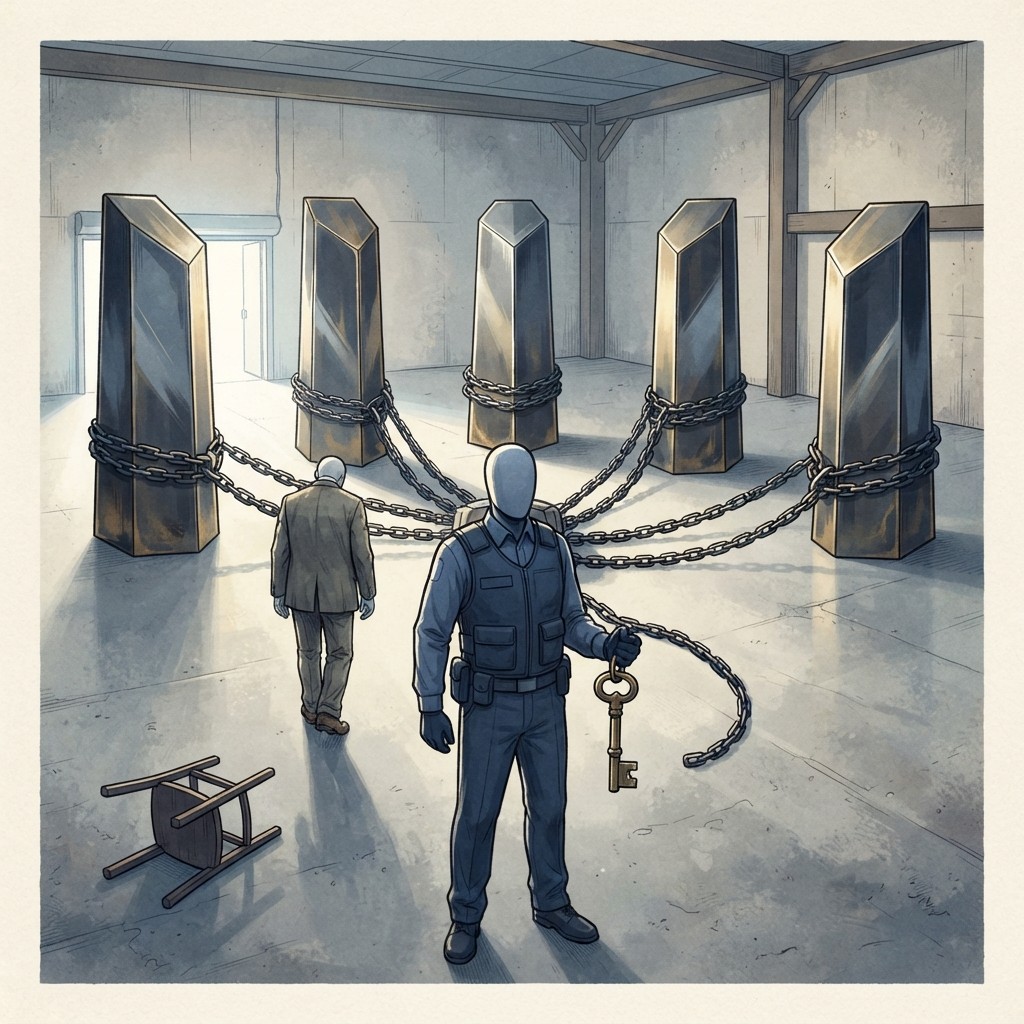
Pairs with the Distribution Channel Map — a ready-to-use strategy tool, filled for Best Buy. Included in the The Distribution Rebellion Casebook →
In 1966, Richard Schulze opened an audio store in St. Paul called Sound of Music and rang up $173,000 in his first year selling hi-fi to people who wanted to be talked into the right turntable.1 Two decades later, the company he'd renamed Best Buy did something that looked like heresy in consumer electronics: it fired the man who did the talking. No more commissioned salespeople hovering over the speakers. All the inventory hauled out of the back and stacked on the floor where you could grab it yourself. The format had a flat, engineering name — Concept II — and it arrived around 1989 to the open dismay of both the sales staff and the manufacturers who supplied the store.3
The story usually gets told as a tale of channel rebellion: Best Buy cut out the middlemen, went direct to manufacturers, and seized control of its own supply. The real move was quieter and more interesting. Best Buy didn't bypass the channel so much as change which seat at the table held the leverage — and the leverage came not from buying direct, but from changing how it sold.
Here is the thesis a smart friend could repeat at dinner: Best Buy's weapon was never disintermediation. It was eliminating the commissioned salesman and putting every box on the floor — a move that let it sell on volume and price, which in turn gave it the only thing that ever actually matters in retail negotiation: the ability to move enough units that manufacturers needed it more than it needed any one of them.
Why firing the salesman was a buying strategy
Trace the causal chain and the legend inverts. A store built on commissioned salespeople is a store that competes on persuasion and margin — you keep prices high enough to fund the people who close the sale. Concept II tore that model out. Brighter lights, self-serve product cards, the whole inventory on display, far fewer staff and none of them paid to push.3 That stripped cost out of the unit economics and let Best Buy compete on price and selection instead of on a salesman's patter. Lower prices pull volume. Volume is the currency you carry into a supplier negotiation. The salesman wasn't a casualty of the strategy — he was the strategy, in reverse: getting rid of him is what made the volume that made Best Buy worth supplying on Best Buy's terms.
Suppliers hated it, which tells you it was working. A manufacturer prefers a retailer that protects price and pampers its product with a trained sales pitch. A self-serve box on a discount floor is the opposite of that. The discomfort of the channel was the proof that power was shifting toward the retailer who could move the most units — not away from the channel altogether.
“Brighter lighting, all stock on the sales floor rather than a stock room, fewer salespersons, self-help product information, and the elimination of commissioned salespeople — a format unpopular with salespersons and suppliers.”3
The 'direct buying' that wasn't a revolution
The popular history likes to date the channel bypass to 1996, when Best Buy began ordering home video straight from Disney's Buena Vista subsidiary to cut costs and fight for the home-video shopper. It sounds like the moment the middleman died. Read the company's own contemporaneous account and the romance deflates: it kept buying most other video through distributors, because distributors gave it quick turnaround and warehousing it didn't want to build.7 Buying direct from Disney was a single-category experiment run for cost reasons, not a wholesale transformation. The channel wasn't slain. It was selectively skipped where the math happened to favor skipping it.
That distinction matters, because today buying direct from manufacturers is simply how the business runs — most merchandise ships from the manufacturer to Best Buy's distribution centers as a matter of course.6 The thing that once looked like a daring 1996 gambit is now plumbing. And plumbing is never the moat.
The 'bypass' that ended in deeper dependence
If Best Buy had truly freed itself from the channel, you'd expect its supplier base to be broad and replaceable — many vendors, no single one with a knife to its throat. The filings say the reverse, and they say it with growing emphasis over time. In fiscal 2011, the five largest suppliers — Apple, Samsung, Sony, Hewlett-Packard and Toshiba — were about 39% of all merchandise purchased, and the top twenty just under 65%.5 By fiscal 2025, the top five — Apple, Samsung, HP, Sony and LG — had climbed to roughly 55%, and the top twenty to about 80%.4 The company that 'bypassed the channel' is more concentrated on a handful of suppliers than it was a decade and a half ago — and it generally does this without long-term written contracts.4
| FY2011 | FY2025 | |
|---|---|---|
| Share from top 5 suppliers | ~39% | ~55% |
| Share from top 20 suppliers | just under 65% | ~80% |
| Long-term written contracts | Generally none | Generally none |
| Who has the leverage | Contested | Increasingly the giants |
This is the part the heroic version misses. The leverage Best Buy won in 1989 was real, but it was always conditional on those suppliers needing a high-volume retail floor. As consumer electronics consolidated into a few dominant brands — and as those brands learned to sell directly to consumers themselves — the balance of need crept back toward the manufacturer. A store can be the best place in the country to buy an iPhone and still have very little say over the terms on which it buys iPhones.
The honest objection: didn't the bypass actually work?
The fair counter is that this read is too cynical. Best Buy did, after all, outlast the specialty retailers that clung to commissioned selling; it grew from a single St. Paul store into a public company — IPO'd in 1985 raising about $8 million, NYSE-listed two years later — and it survived long enough that its own founder tried to take it private again in 2012, offering $24 to $26 a share, a 36–47% premium to the price at the time.28 By any survival test, the model won. That's true, and it's the steelman: Concept II built a durable, cost-advantaged machine that crushed weaker formats.
But notice what the survival proves and what it doesn't. It proves Best Buy built a better retail operation. It does not prove it escaped the channel — and the filings show it plainly didn't. The win was operational efficiency and selling leverage, not independence. Best Buy is as channel-dependent as ever; it just changed the layer where the dependence lives, from a thicket of distributors to a short list of giants who can now reach the customer with or without it.
The instinct in any distribution fight is to attack the middleman — cut him out, go direct, own the supply. But disintermediation is downstream of demand. Best Buy didn't earn bargaining power by buying direct; it earned it by changing its store model (kill the commission, stack the floor, win on price) until it moved enough volume that suppliers had to deal. The caution rides on the same logic: that power is rented, not owned. The day your suppliers can reach the customer without you — or consolidate into a handful of must-stock brands — the leverage you 'won' flows quietly back upstream. Concentration is the bill that arrives for a bypass that was never quite complete.
Best Buy's real act of nerve happened on the sales floor, not in the supply chain. It bet that customers would rather grab the box themselves at a lower price than be sold to at a higher one — and it was right for a generation. But a bet on selling is not the same as a bet on independence. The company that is remembered for cutting out the middleman now buys more than half of everything it sells from five companies it cannot afford to lose. It didn't bypass the channel. It traded a crowd of small middlemen for a handful of large ones — and discovered, slowly, that the second kind is harder to argue with.
Distribution Channel Map
A map of every hop between the company and the customer — each intermediary, who owns the relationship at each step, and where the company controls the channel versus where it's at the channel's mercy. Blank to chart your own route to market; filled as the worked example showing where the story's company went direct, fought its gatekeepers, or got disintermediated.
Included, filled and blank, in the The Distribution Rebellion Casebook. See the set → · Preview the blank →
Sources
Where this comes from — the filings, records, and reporting behind it.
- 1Best Buy was founded in 1966 by Richard M. Schulze and James Wheeler as Sound of Music, an audio specialty store in St. Paul, Minnesota; first-year sales reached $173,000; Schulze bought out his partner ~1969–1970.
- 2Best Buy went public in 1985 (NASDAQ), raising $8 million through an IPO, and two years later in 1987 gained a listing on the NYSE. This was the company's seventh stock split since going public in 1985, per a 2002 Best Buy 8-K filing.
- 3In 1988–1989, Best Buy introduced Concept II stores: brighter lighting, all stock on the sales floor rather than a stock room, fewer salespersons, self-help product information, and the elimination of commissioned salespeople. The format was unpopular with salespersons and suppliers.
- 4In fiscal 2025, Best Buy's 20 largest suppliers accounted for approximately 80% of merchandise purchased, with five suppliers—Apple, Samsung, HP, Sony and LG—representing approximately 55% of total merchandise purchased. Best Buy generally does not have long-term written contracts with its vendors.
- 5In fiscal 2011, Best Buy's five largest suppliers—Apple, Samsung, Sony, Hewlett-Packard and Toshiba—represented 39% of total merchandise purchased, and the 20 largest accounted for just under 65%. This establishes a decade-long baseline showing supplier concentration has grown, not shrunk, since the company's 'channel bypass' era.
- 6Most merchandise is shipped directly from manufacturers to Best Buy's distribution centers, per the FY2024 10-K—confirming that the direct-from-manufacturer model is now the operational norm, not a recent innovation.
- 7In 1996, Best Buy began ordering home video direct from Buena Vista (Disney's home video subsidiary) to cut costs and compete in home video sales, but continued to purchase most other videos through distributors for quick turnaround and warehousing.
- 8Richard Schulze, as Founder and largest shareholder controlling 20.1% of shares, submitted a formal written proposal on August 6, 2012 to acquire Best Buy for $24.00–$26.00 per share, a premium of 36–47% to the $17.64 closing price on August 3, 2012, per SEC SC 13D/A.
More like this — beyond Best Buy
New Strategically analyses as they publish: the defining moves in business, checked against the record. No noise, and one click to leave.