Pairs with the Profit-Engine Map — a ready-to-use strategy tool. Included in the Money Machine Casebook →
“Where does the money actually come from, and who sets the rate it comes in at?”
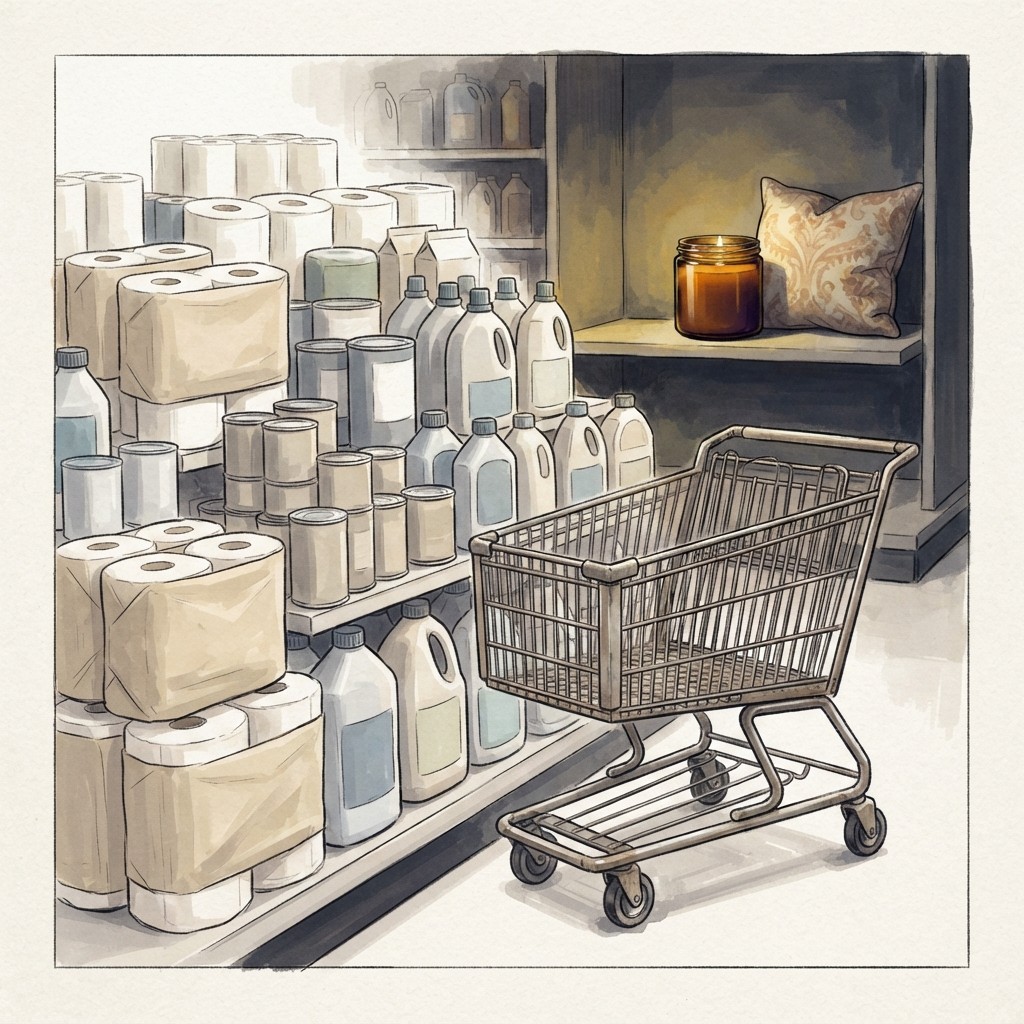
Walk into one of the roughly 20,000 Dollar General stores scattered across small-town America and the first thing you reach for is a gallon of milk, a roll of paper towels, a sleeve of candy.3 These are the things you came for, and they are the things the company makes almost nothing on. The milk is not the business. The milk is the bait. Somewhere past it, on an endcap, sits a $5 throw pillow or a seasonal candle you didn't plan to buy - and that, quietly, is where Dollar General actually gets paid.
The official story is that Dollar General is a discounter that wins on price - the place where everything was once a dollar, where margins are razor-thin and volume does the rest. Nearly every part of that is misleading. Prices are no longer capped at a dollar; the model is everyday low price, with most items typically $10 or less. And the margins are not uniformly thin at all. They are deliberately uneven - and the unevenness is the entire engine.
The category that drives traffic isn't the category that pays
Dollar General splits its world into two halves, and they do two completely different jobs. Consumables - the food, the cleaning supplies, the paper goods, the tobacco - are about 82% of net sales.4 By the company's own admission in its 10-K, that category carries the lowest gross profit margin it sells.2 The other half - seasonal goods, home products, apparel - is the smaller slice, and it carries the highest margins on the shelf.2 The company says it plainly: consumables are 'the key drivers of net sales and customer traffic,' while the non-consumables are 'the key drivers of more profitable sales growth.'3 One half brings you in. The other half pays the rent.
| Consumables | Seasonal / home / apparel | |
|---|---|---|
| Share of net sales | ~82% | the remainder |
| Gross margin | Lowest in the company | Highest in the company |
| What it does | Pulls traffic, builds the habit | Generates the profitable growth |
| What you came for | Yes | No - you discover it |
This is why the cheap-prices story misses the point. Dollar General is not running thin everywhere and praying for volume. Its overall gross margin was 29.6% in fiscal 2024 - not trivial for a retailer that sells milk.5 The blended rate is a weighted average of a high-margin half and a low-margin half, and management's whole craft is tilting the mix toward the profitable side without scaring off the traffic the cheap side generates. Get a shopper in for the paper towels; sell them the candle on the way out.
The other half of the engine is the cost line
Margin mix only works if the store itself is cheap to run, and here Dollar General is almost surgical. The typical store is about 7,500 square feet of selling space - a low-cost, no-frills building with limited capital requirements and low operating costs, by the company's own description.7 Roughly 80% of them sit in towns of 20,000 people or fewer, where rents are low and big-box competitors don't bother to go.7 And the labor model is skeletal: a store manager, one or more assistant managers, and three or more sales associates running the whole box.7 A small lease in a small town, run by a handful of people - that is how a 29.6% gross margin survives the trip down to net income and lands as profit.
So the model, stated plainly: lure traffic with low-margin essentials, harvest profit from high-margin extras, and keep the cost of serving each shopper near the floor with tiny leases and lean crews. It is not a price story. It is a margin-architecture story, and for decades it printed money - net income rose 34.4% in fiscal 2025 to roughly $1.5 billion.9
Why a poorer customer is bad news for a poor-people's store
Here is the trap built into the design. The whole engine depends on shoppers reaching past the milk for the candle. But when those shoppers are squeezed, they do the rational thing: they buy the milk and skip the candle. Dollar General's 10-K says the consumables share of sales 'is currently at historical highs,' driven by customers under economic pressure trading toward lower-margin essentials.2 More traffic, more sales, less profit per sale - the mix tilts toward exactly the half that doesn't pay.
The numbers show it bleeding through. In fiscal 2024 net sales grew 5.0% - but the gross margin slipped 70 basis points to 29.6%, the company citing increased markdowns, a greater proportion of sales from consumables, and rising inventory damage.5 And operating profit didn't just soften; it fell 29.9%, dragged further by roughly $232 million in charges from a store portfolio optimization review.5 Top line up, bottom line down. That is not what a recession-proof retailer looks like. The traffic is counter-cyclical. The profit is not.
“Sales in our consumables category… have been the key drivers of net sales and customer traffic, while sales in our non-consumables categories… have been the key drivers of more profitable sales growth.”3
Isn't 'lean' just good operations?
The fair objection is that everything above is just disciplined retailing - cheap stores, tight labor, smart category mix - and that calling it fragile is hindsight on a single soft year. There's truth in that; the company still opened 725 new stores in fiscal 2024 and planned hundreds more, which is not the behavior of a broken model.5 But the lean side has a floor it keeps hitting. In July 2024 Dollar General settled with the U.S. Department of Labor for $12 million over recurring violations - blocked emergency exits, blocked electrical panels, unsafe storage - after more than 243 inspections and over $21 million in cumulative fines since 2017.8 The settlement now threatens assessments of up to $500,000 per incident for future lapses.8 Crews that thin can't reliably keep the aisles clear, and 'efficient' staffing that systematically fails basic safety compliance isn't only a cost advantage - it's a liability the model has been quietly accruing. The same thinness that funds the profit is the thinness regulators keep finding.
In a lot of retail, the product people walk in for and the product that earns the profit are two different things - and the easiest way to misread a business is to assume the popular item is the profitable one. Dollar General's volume is consumables; its margin is everything else. The danger is that this only works while the two halves stay in balance. When the customer base gets poorer, it buys more of the traffic-driver and less of the profit-maker, and a 'recession-proof' retailer discovers its top line and its bottom line point in opposite directions. The lesson: know which half of your mix is the bait and which half is the catch - and watch what happens to the catch when your customer's wallet tightens.
Dollar General was never really a dollar store, and it was never really a price story. It is a precisely tuned machine for converting cheap traffic into expensive margin, one candle at a time, in a 7,500-square-foot box in a town the big chains skipped. The genius was the architecture. The risk is that the same customer who makes the traffic so dependable is the one who can no longer afford the part that pays. When your business model needs poor people to buy things they don't strictly need, a poorer customer is not a tailwind. It is the bill coming due.
Companies that profit where you'd never look
Profit-Engine Map
A one-page map that pulls a business apart into the hook that gets the customer in the door and the engine that quietly earns the margin. Use it to see where the real profit lives, how the two halves are wired together, and what breaks if the link is cut. Blank to dissect your own P&L; filled as the worked example of a business whose advertised product is not where it makes its money.
Included, filled and blank, in the Money Machine Casebook. See the set → · Preview the blank →
Sources
Where this comes from — the filings, records, and reporting behind it.
- 1Dollar General fiscal year 2024 net sales were $40,612.3 million (a 5.0% increase from 2023), gross profit was $12,017.5 million (gross margin 29.6%), and operating profit fell 29.9% to $1,714.1 million including ~$232 million in impairment charges from a store portfolio optimization review.
- 2Dollar General's own 10-K states: seasonal and home products categories 'typically account for the highest gross profit margins' while consumables 'typically accounts for the lowest gross profit margin.' As of fiscal 2024 the company disclosed consumables sales as a percentage of total sales 'is currently at historical highs,' driven by customers under economic pressure trading toward lower-margin essentials.
- 3As of the most recent quarterly filing (Q2 FY2026, period ending August 1, 2025), Dollar General's 10-Q reaffirms: 'sales in our consumables category…have been the key drivers of net sales and customer traffic, while sales in our non-consumables categories…have been the key drivers of more profitable sales growth.' The company operated 20,095 same-stores generating $10.32 billion in same-store sales for that period.
- 4Dollar General's FY2025 10-K (fiscal year ended January 31, 2025) reports consumables at approximately 82% of total net sales, with inventory turnover of 4.5x. Net income for FY2025 was $1,512.3 million (+34.4% vs FY2024), net margin 3.54%, and net sales $42.7 billion.
- 5Dollar General Corporation Q4 and full fiscal year 2024 investor press release confirms: gross profit rate of 29.6% for full year 2024 vs 30.3% in 2023 (a 70 bps decline); the rate decrease was 'driven primarily by increased markdowns, a greater proportion of sales coming from the consumables category and increased inventory damages; partially offset by decreased transportation costs.' In fiscal 2024, the company opened 725 new stores (including 5 in Mexico) and plans 575 new stores in FY2025.
- 6The first Dollar General store opened on June 1, 1955, in Springfield, Kentucky, when Turner's Department Store was converted—no item priced over $1. The predecessor entity J.L. Turner and Son was founded in October 1939 in Scottsville, Kentucky as a wholesale dry goods business with $5,000 invested by each partner. By 1957, 29 stores had annual sales of $5 million. The company went public as Dollar General Corporation in 1968 with annual sales over $40 million.
- 7Dollar General's typical store averages approximately 7,500 square feet of selling space; approximately 80% of stores are located in towns of 20,000 or fewer people; and stores feature 'a low-cost, no frills building with limited capital requirements, low operating costs.' The company is operated with a store manager, one or more assistant store managers, and three or more sales associates per store.
- 8In July 2024, Dollar General settled with the U.S. Department of Labor / OSHA for $12 million, resolving contested and open inspections alleging violations including blocked emergency exits, blocked electrical panels, blocked fire extinguishers, and unsafe storage. Since 2017, the company had faced over $21 million in OSHA fines across more than 243 inspections nationwide. The settlement requires Dollar General to correct future violations generally within 48 hours or face assessments of $100,000 per day of violation up to $500,000.
- 9Dollar General net income rose 34.4% to $1.5 billion in fiscal 2025 (year ended January 30, 2026), with diluted EPS of $6.85.
Weighing outside help with a decision like this? Hiring a pricing strategy consultant
More like this — beyond Dollar General
New Strategically analyses as they publish: the defining moves in business, checked against the record. No noise, and one click to leave.