Pairs with the Market-Entry Gambit Canvas — a ready-to-use strategy tool. Included in the Market-Entry Gambit Casebook →
“How fast can this actually be done?”
Drive a two-lane highway through rural America and you will start to notice a rhythm: a yellow-and-black box at the edge of one town, then another at the edge of the next, then a third where there is barely a town at all — a gas station, a church, and a Dollar General. There are 20,893 of them, spread across 48 states, and roughly four out of five sit in towns of 20,000 people or fewer.35 The folk story is that Dollar General goes where no one else will, filling food deserts as a quiet act of service. That story has the cause and effect exactly backwards.
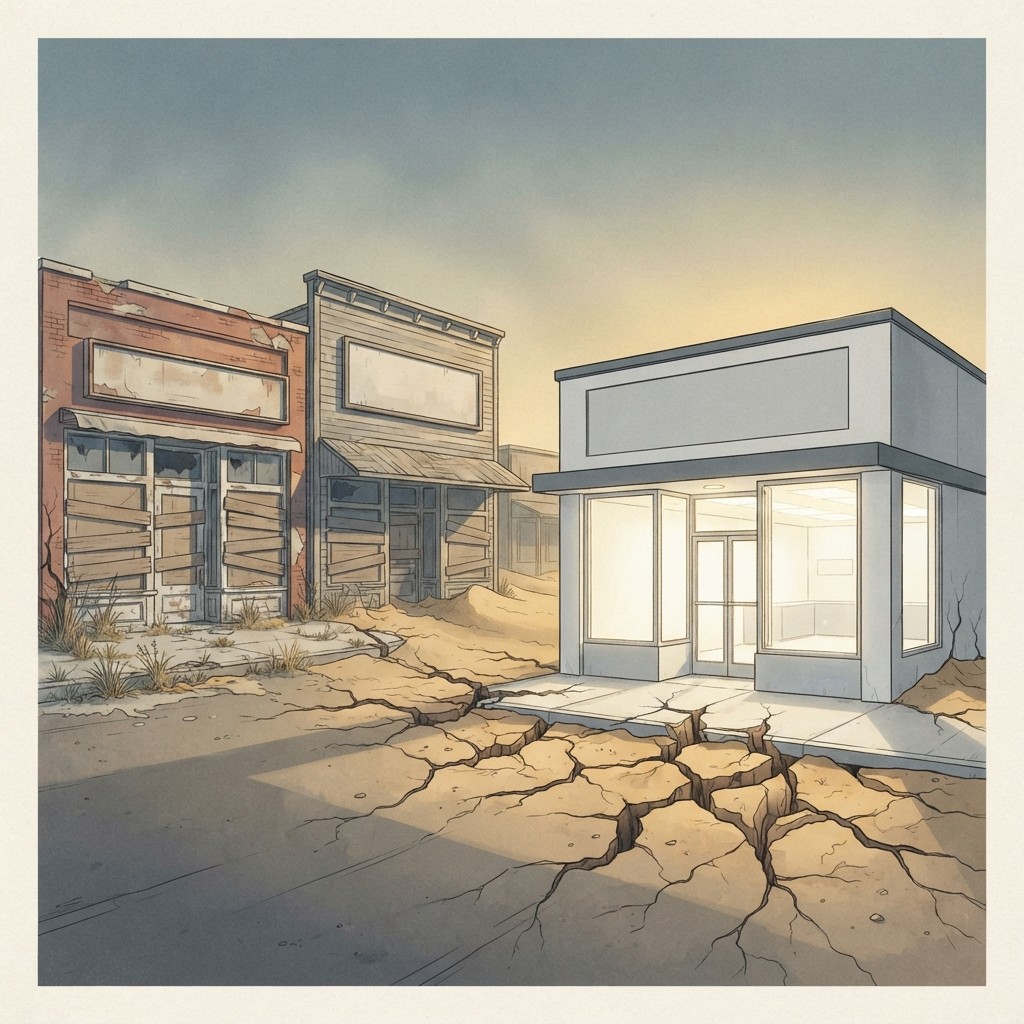
The official version is that Dollar General serves communities the big retailers abandoned. The real version is that it gets to those communities first — and then makes sure no one else can profitably follow. The boxes aren't filling a vacuum left by competitors. They are the reason the vacuum never gets filled.
Here is the thesis, in one line: Dollar General isn't a discount retailer that happens to operate in small towns. It's a land-grab machine that uses cheap, fast, leased stores to seed rural density faster than any rival can react — and the discount retailing is what funds the grab.
The math of a box that pays for itself in two years
Start with the unit, because the whole strategy lives there. A new Dollar General costs roughly $500,000 to open — and that figure includes the initial inventory on the shelves.6 It's that low because the company owns almost nothing. Most stores are leased; a third-party developer builds the shell to spec, and Dollar General just walks in and finishes the interior.6 No real estate on the balance sheet, no construction crews, no land at suburban prices. In a town where dirt is cheap, the cost of placing a flag is about as low as physical retail gets. Management guides to a cash payback of roughly two years and average new-store returns of 16–17%.5 A store that returns its own cost in 24 months isn't a store. It's a reusable stamp.
Because each box is capital-light and leased, the binding constraint isn't capital — it's available towns. Dollar General opened toward 450 new U.S. stores in its fiscal-2026 plan and still estimates ~11,000 expansion opportunities left.5 At a ~2-year payback and 16–17% returns,6 every store funds the next ones. The flywheel isn't sales growth; it's the rate at which it can plant flags before anyone else does.
Why a second store next to the first one is the whole point
Now the move that gives the game away. A rational single-store operator never opens a new location that steals sales from one it already owns — that's burning your own returns. Dollar General does it on purpose. It has openly pursued intentional cannibalization: putting a new store near an existing one, accepting that the two will split the same customers, because the split isn't the goal.8 The goal is the saturation. Two Dollar Generals four miles apart don't just serve a town; they consume the entire addressable demand of that micro-market. And here is the mechanism that matters — in a rural town that can support exactly one small-box retailer, the company that has already taken that slot twice over leaves little room for anyone else. The land-grab isn't really about Dollar General's own returns. The likely effect is to foreclose the entry of any rival before they ever break ground.8
This is what makes the food-desert framing a category error. Dollar General doesn't compete with Walmart in most of its core — analysts describe it as operating in markets too small to support the scale economics required by big-box retailers like Walmart or Costco.9 An ~8,500–9,500-square-foot box (the company's newer primary format) with a ~$15 average basket is engineered for a town too small for a supercenter.107 The competitor it's actually foreclosing isn't Walmart. It's the second Dollar General that someone else might have built — the regional dollar chain, the independent grocer, the next entrant who runs the numbers, sees the market is already double-covered, and walks away. The geography does the suppressing. Dollar General just gets there first and stays.
| The 'food desert filler' story | The land-grab machine | |
|---|---|---|
| Why it enters a town | No one else will serve it | Get there before anyone else can |
| Why it builds nearby stores | More access for residents | Intentional cannibalization to foreclose entry |
| The real competitor | Walmart, Amazon | The second entrant who never gets to build |
| What it's optimizing | Community service | Density that can't be dislodged |
The customer who can't shop their way out
The moat holds because of who shops there. Dollar General's typical customer earns about $35,000–$40,000 a year, and roughly 80% of what they buy is consumables — the paper towels, the canned goods, the cleaning supplies you need before payday.7 That mix is the second wall of the fortress. A $15 basket of bulky, low-margin necessities is, in the view of analysts who cover the company, precisely the order that e-commerce struggles to profitably ship to a rural address.7 So the customer who would, in a city, simply order from Amazon instead is, in a town of 3,000, structurally tethered to the store on the highway. Density locks out the physical rival; the basket locks out the digital one. The land-grab works because the land itself is the defense.
Isn't a strategy this tidy just luck — and didn't it already break?
The honest objection is that this reads too clean, and Dollar General's recent results invite the doubt. Fiscal 2024 net sales rose 5.0% to $40.6 billion — but operating profit fell 29.9% to $1.7 billion, dragged by a $232 million Q4 charge.2 And the most telling part of that charge: it stemmed primarily from store closures and the impairment of pOpshelf, the company's attempt to push its model into urban and suburban markets.11 Read that failure carefully, because it's the steelman and the proof at once. pOpshelf is what happens when Dollar General tries to win where its land-grab logic doesn't apply — in places dense enough to support many competitors, where being first buys you nothing and cannibalization just bleeds. The suburban experiment didn't disprove the rural moat. It demonstrated that the moat is the geography. Take the same company out of the towns that can only hold one entrant, and the magic evaporates. The strategy isn't luck. It's location, and only location — which is exactly why it can't be exported.
“...markets that cannot support the scale economics required by big-box retailers.”1
The most defensible expansion isn't into the biggest markets — it's into the markets too small for a second player, claimed before anyone else does the math. In a town that supports exactly one small-box store, the first capital-light entrant doesn't just win the customer; it deletes the business case for every rival. Find the geographies where scale is a curse rather than a blessing, get there cheap and fast, and over-build on purpose until the addressable demand is fully spoken for. But heed the boundary condition Dollar General paid $232 million to learn: this only works where the market can hold one winner. Carry the same playbook into a dense market that can hold ten, and you're not foreclosing competitors — you're just cannibalizing yourself.
Dollar General did not find America's small towns abandoned and rush in to help. It got to them first — store by leased store, at half a million dollars and a two-year payback apiece — and made them places no one else could afford to serve. The yellow boxes aren't filling the empty spaces on the map. They are how the spaces stay empty for everyone else. The genius was never the discount. It was choosing to compete only where winning once means winning forever — and building the second store before the first one was even needed.
More companies that win by where they stand
Market-Entry Gambit Canvas
A one-page canvas for staging an entry into a market you don't own yet: the beachhead you take first, the wedge that gets you in cheaply, the sequence that turns a foothold into a position, and the incumbent's likely counter-move. Blank to plan your own entry; filled as the worked example showing how the story's challenger picked its landing spot and walked the rest in.
Included, filled and blank, in the Market-Entry Gambit Casebook. See the set → · Preview the blank →
Sources
Where this comes from — the filings, records, and reporting behind it.
- 1Dollar General had 20,022 stores in 48 U.S. states and Mexico as of March 1, 2024, and self-describes as the largest discount retailer in the United States by number of stores.
- 2Dollar General's fiscal year 2024 (ended January 31, 2025) net sales increased 5.0% to $40.6 billion; operating profit decreased 29.9% to $1.7 billion; the Q4 store portfolio review produced $232 million in charges, primarily pOpshelf impairment and store closures.
- 3As of fiscal year end January 30, 2026, Dollar General operated 20,893 stores across 48 states and Mexico, with 48 distribution centers and 13 fresh/combination distribution centers.
- 4The first Dollar General retail store opened on June 1, 1955, in Springfield, Kentucky, converting a Turner's Department Store; the predecessor entity J.L. Turner and Son Wholesale was founded in October 1939 in Scottsville, Kentucky with a $5,000 investment each from J.L. Turner and Cal Turner Sr.
- 5Dollar General's fiscal 2026 real estate plan calls for ~450 new U.S. stores and 10 in Mexico; ~80% of its store base serves towns with populations of 20,000 or fewer; management estimates ~11,000 additional store-expansion opportunities nationwide; new stores target cash payback of ~2 years and average financial returns of 16–17%.
- 6Most Dollar General stores are leased rather than owned; third-party developers typically construct the building shell; new stores average roughly $500,000 to open including initial inventory and capex; management guides to ~2-year cash payback and 16–17% average new-store returns; stores are placed in rural/low-density markets where land and lease costs are materially lower than suburban geographies.
- 7Dollar General's typical customer earns around $35,000–$40,000 per year; its product mix is approximately 80% consumables; average basket size is roughly $15; these factors collectively insulate it from e-commerce competition.
- 8Dollar General has explicitly pursued intentional cannibalization — opening stores near existing locations to foreclose competitor entry and secure density advantages — rather than solely optimizing individual store returns on capital.
- 9Dollar General operates in markets that typically cannot support the scale economics required by big-box retailers such as Walmart or Costco.
- 10Dollar General's selling-space format has more recently increased to roughly 8,500 to 9,500 square feet, with over 80% of 2025 new-store plans focused on its 8,500-square-foot format, predominantly in rural areas.
- 11Dollar General's Q4 fiscal 2024 operating profit included $232 million in charges from a store portfolio review, primarily due to store closures and pOpshelf impairment charges; the company planned to close 96 Dollar General stores and 45 pOpshelf stores.
Weighing outside help with a decision like this? Hiring a commercial due diligence provider
More like this — beyond Dollar General
New Strategically analyses as they publish: the defining moves in business, checked against the record. No noise, and one click to leave.