Pairs with the Profit-Engine Map — a ready-to-use strategy tool. Included in the Money Machine Casebook →
“Where does the money actually come from, and who sets the rate it comes in at?”
Drive far enough off the interstate, past the last Walmart, into a town of a few thousand people, and you will find a small beige box with a yellow sign. No deli, no garden center, no escalator — about 7,500 square feet of selling floor, a handful of staff, and shelves of detergent, snacks, and socks, almost all of it priced at $10 or less.13 There are 20,022 of these, more locations than any other discount retailer in America, and roughly four out of five of them sit in towns of 20,000 people or fewer.31 Dollar General did not win by building the best store. It won by building a serviceable store in the places everyone else decided weren't worth the trouble.
The official story is that Dollar General is a recession-proof machine — when times get hard, shoppers trade down, and the dollar store fills up. It is a comforting story, and the numbers just buried it. Operating profit fell 26.5% in fiscal 2023, then another 29.9% in fiscal 2024.42 Both years arrived with exactly the trade-down tailwind the recession-proof thesis promised. The model didn't get hit by the weather. It got hit by the one bill its whole design exists to avoid paying.
The genius is the geography, not the merchandise
Start with what the store actually is. Dollar General's own filings describe a low-cost, no-frills building with limited capital requirements, low operating costs, and a focused merchandise offering — staffed by a manager, an assistant or two, and four or more sales associates.7 A traditional leased store carried roughly $180,000 of equipment and fixtures, with low initial capital expenditure and limited maintenance.8 That cheapness is the entire point. A box this small and this inexpensive can be profitable on a customer base far too thin to interest a Walmart Supercenter. The merchandise is unremarkable on purpose. What is remarkable is where it sits.
Here is the mechanism, worked all the way down. Big-box retail needs density — it needs enough shoppers within a drive to justify a 150,000-square-foot store and a deep grocery operation. Small towns can't supply that density. So Dollar General inverts the math: shrink the box, strip the overhead, and the breakeven population drops low enough that a town of a few thousand becomes a viable market. Once it plants a store there, the town's own thinness becomes the moat. A second discounter can't profitably split a market that barely sustains one. The low-overhead model doesn't just cut costs — it lets Dollar General claim ground no one else can afford to contest, and the geography does the defending for it.
| Big-box discounter | Dollar General small box | |
|---|---|---|
| Selling space | ~150,000+ sq ft | ~7,500 sq ft existing fleet1 |
| Fixtures per store | Tens of millions | ~$180,000 equipment & fixtures8 |
| Breakeven population | Large metro / suburb | Towns of 20,000 or fewer1 |
| Where it competes | Where density already exists | Where density never will |
The model is old, and it has survived ownership that would have broken a weaker one. KKR announced a $7.3 billion buyout in March 2007 and completed it that July — and by early 2009, with the financial crisis having flattened the rest of KKR's 2007 mega-deals, Dollar General was the only one of the five in the black.6 A leveraged buyout is a stress test: it loads a company with debt and dares its cash flows to keep up. Dollar General's did, because low-overhead small boxes throw off steady cash regardless of the cycle. That durability is real. It is also exactly what makes the recent collapse so revealing.
The bill the model is built to dodge
Look at what actually broke. Sales kept growing — net sales rose 5.0% to $40.6 billion in fiscal 2024, with same-store sales up 1.4%.2 The top line was fine. The profit was not: operating profit fell to $1.7 billion, a 29.9% drop, with diluted EPS down 32.3% to $5.11.2 The year before told the same story — operating profit down 26.5% to $2.45 billion from $3.33 billion, with SG&A as a share of sales climbing 153 basis points.4 The damage wasn't on the revenue line. It was in the cost of running the stores.
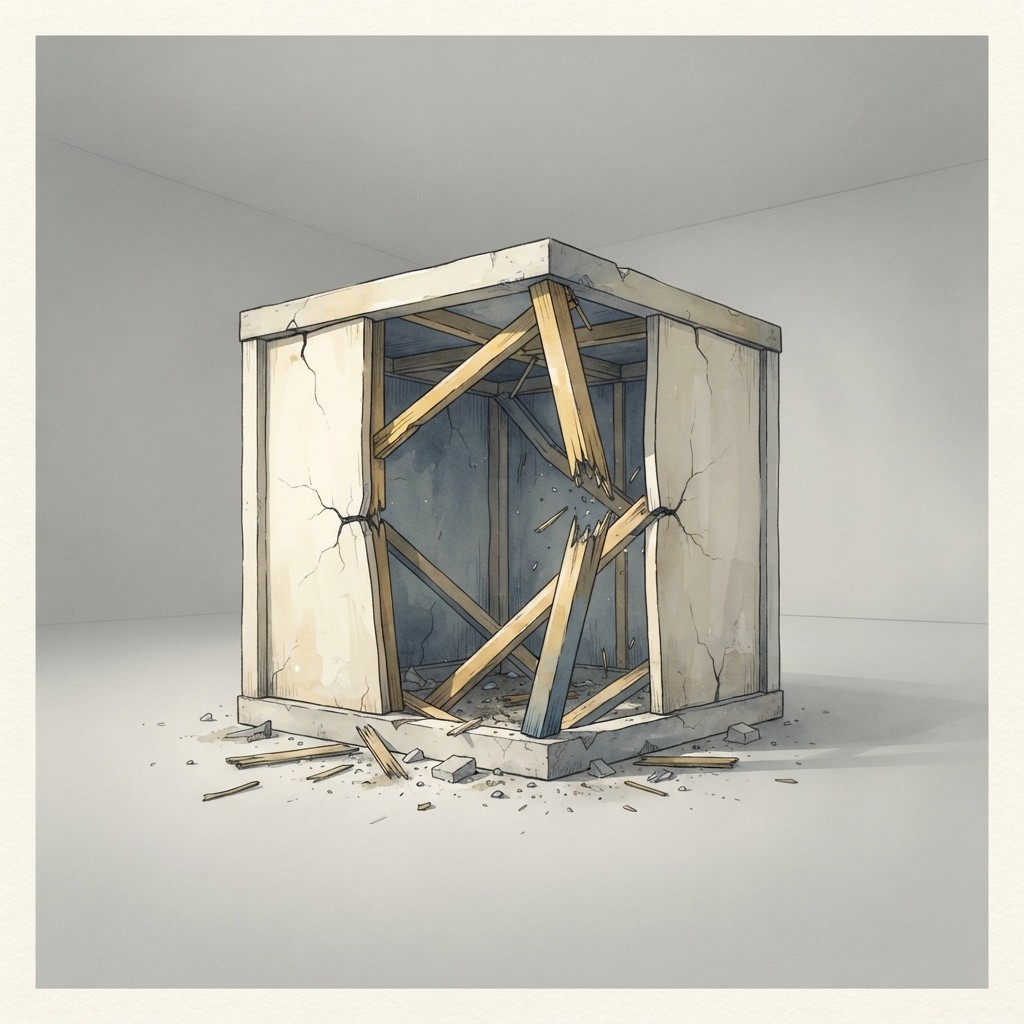
And that is the trap inside the design. The whole model rests on keeping overhead brutally low — few staff, lean floors, minimal loss prevention. That works beautifully until two costs the model is structured to underspend on come due at once: retail labor and shrink. A box with a manager and a handful of associates has no slack. When wages rise and theft climbs, a leaner-staffed store has fewer hands to watch the floor and fewer ways to absorb the hit. Sales per square foot were just $264 in fiscal 20234 — there is almost no margin cushion to soak up rising costs at that level. The low-overhead ethos that built the moat is precisely the discipline that lets these pressures fester, because spending on labor and loss prevention is the one thing the culture treats as non-negotiable.
Isn't this just a bad couple of years?
The fair objection is that two down years don't unmake an 85-year-old model — and the rebuttal lives inside the numbers. Trade-down should help a discount retailer; if these were normal cyclical headwinds, a model built for hard times should have been winning. Instead profit fell twice while sales rose.24 That pattern doesn't say 'tough economy.' It says the cost of running a deliberately under-resourced store rose faster than the model could absorb. The honest counter cuts the other way too: the same discipline that left the stores exposed is what made them durable enough to outlast a financial crisis under a debt load.6 Low overhead is not a flaw — it is the asset. The point is narrower and harder. The model's real risk was never the macro. It was the slow accumulation of the bills it is designed to defer, until the floor itself starts to cost more than the box was built to spend.
Cost discipline so deep it becomes a moat is a powerful thing — it lets you serve markets no one else can afford to touch. But the same discipline quietly defers spending on the unglamorous basics: labor depth, loss prevention, store condition. Those deferrals don't show up in a good year; they compound silently until a wage spike or a shrink wave makes them all come due at once. The lesson isn't 'spend more.' It's that a strategy whose entire edge is underspending must know exactly which costs it is deferring and what they will eventually demand — because the most dangerous line item is the one your culture has decided it is not allowed to grow.
Dollar General got the hardest part right: it found the towns no one else wanted and made them defensible by being cheap enough to stay. That geography still holds. What faltered was never the location strategy and never the customer — it was the arithmetic of running thousands of deliberately bare-bones stores when the cheapest line items stopped being cheap. The model isn't recession-proof, and it was never supposed to be. It is austerity-proof — right up until the day austerity sends the bill.
Other companies that win where others won't look
Profit-Engine Map
A one-page map that pulls a business apart into the hook that gets the customer in the door and the engine that quietly earns the margin. Use it to see where the real profit lives, how the two halves are wired together, and what breaks if the link is cut. Blank to dissect your own P&L; filled as the worked example of a business whose advertised product is not where it makes its money.
Included, filled and blank, in the Money Machine Casebook. See the set → · Preview the blank →
Sources
Where this comes from — the filings, records, and reporting behind it.
- 1Dollar General's primary new-store format averages approximately 8,500 square feet of selling space; the existing fleet averages approximately 7,500 square feet; approximately 80% of stores are in towns of 20,000 or fewer people.
- 2Fiscal year 2024 (ended January 31, 2025) net sales increased 5.0% to $40.6 billion; same-store sales rose 1.4%; full-year operating profit decreased 29.9% to $1.7 billion; diluted EPS decreased 32.3% to $5.11.
- 3As of March 1, 2024, Dollar General is the largest discount retailer in the United States by number of stores, with 20,022 stores in 48 U.S. states and Mexico; products are offered at everyday low prices, typically $10 or less.
- 4Average sales per square foot in fiscal 2023 were $264; operating profit decreased 26.5% to $2.45 billion in 2023 compared to $3.33 billion in 2022; SG&A as a percentage of sales increased 153 basis points.
- 5The first Dollar General store opened in Springfield, Kentucky on June 1, 1955; the founding concept was that no item would cost more than $1.00; J.L. Turner and Cal Turner Sr. opened J.L. Turner and Son Wholesale in October 1939 in Scottsville, Kentucky with an initial investment of $5,000 each.
- 6KKR completed the $7.3 billion acquisition of Dollar General in July 2007 (announced March 2007); the deal was the only one of KKR's five large 2007 mega-deals that was in the black by early 2009.
- 7Dollar General stores feature a low-cost, no-frills building with limited capital requirements, low operating costs, and a focused merchandise offering; the typical store staff includes a store manager, one or more assistant store managers, and four or more sales associates.
- 8Dollar General's 2012 10-K (for fiscal 2011) reported average selling space of approximately 7,200 square feet; the average cost of equipment and fixtures in traditional leased stores was approximately $180,000; the model featured low initial capital expenditures, limited maintenance capital, and low occupancy and operating costs.
Weighing outside help with a decision like this? Hiring a pricing strategy consultant
More like this — beyond Dollar General
New Strategically analyses as they publish: the defining moves in business, checked against the record. No noise, and one click to leave.