Pairs with the Crisis Response Playbook — a ready-to-use strategy tool. Included in the Crisis Response Casebook →
“What is one more quarter of not acting worth?”
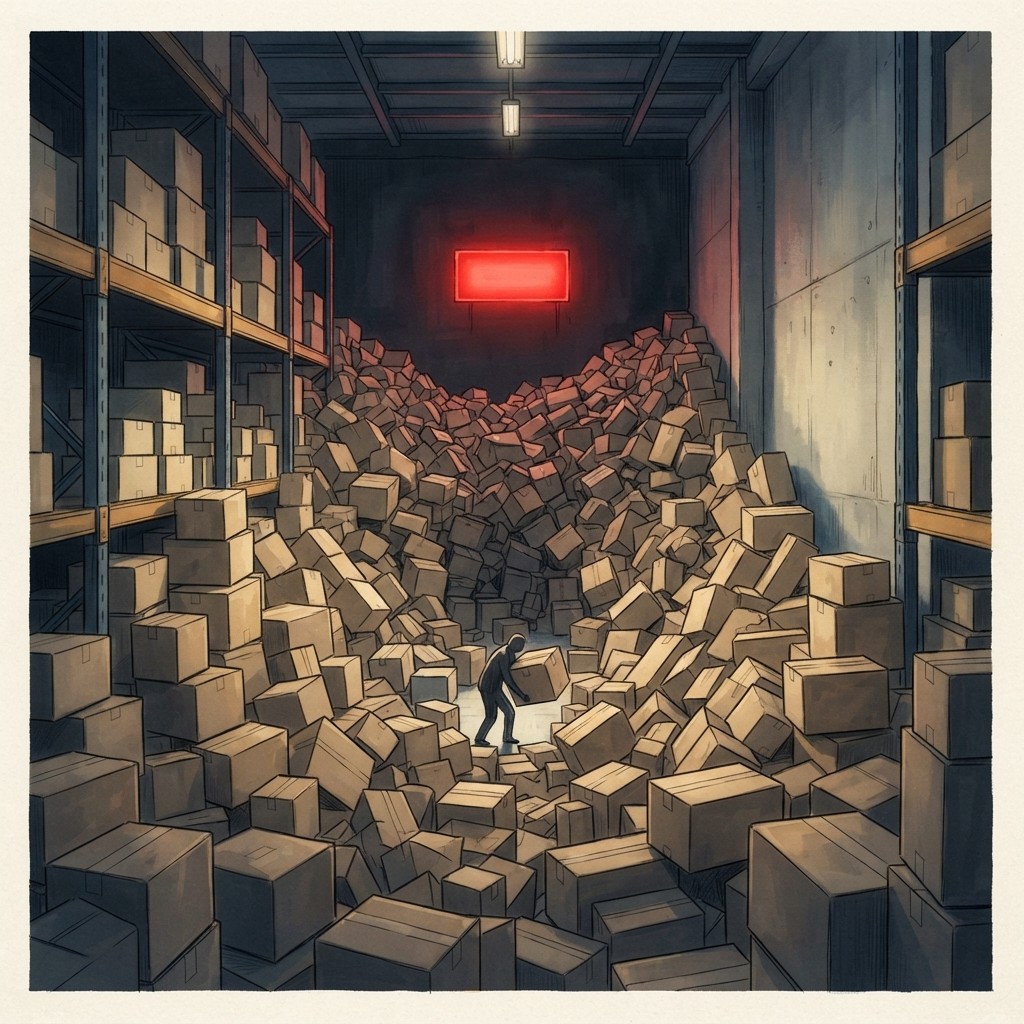
Picture the back half of a Dollar General store: a stack of cardboard boxes — fresh freight that arrived faster than anyone could shelve it — piled in front of a fire exit, an electrical panel, sometimes a fire extinguisher. An OSHA inspector walks in, photographs the blocked door, writes a citation. Then it happens again, in another store, in another state, with the same boxes against the same kind of door. OSHA documented this same scene in more than 240 inspections and assessed over $26 million in proposed penalties between January 2017 and July 2024.2 The natural reading is sloppiness. It isn't. The blocked door is the visible end of an invisible decision made far upstream — about how many people would ever be standing in that store to move those boxes.
The official story is that Dollar General had a safety problem — a string of store-level lapses that better training and faster audits would fix. The real story is that the safety problem was a labor problem wearing a fire-code costume. You cannot keep an exit clear in a store that is too thinly staffed to ever empty the freight that blocks it. The hazard wasn't a deviation from the model. It was the model's exhaust.
The blocked exit is a staffing decision, made visible
Here is the mechanism, worked down to the floor. Dollar General's whole price promise rests on running stores lean — low rent, sparse fixtures, and very few labor hours per location. Freight, meanwhile, arrives on a schedule the store doesn't control. When the hours on the schedule are smaller than the work the freight demands, the boxes have to go somewhere, and the path of least resistance is the floor — including the aisle in front of the exit. No worker decides to block a fire door. The math decides for them: there is more box than there is body. Do that across thousands of stores and you don't get one careless manager — you get a pattern so consistent that regulators stopped treating it as a series of accidents and started treating it as a system. That is exactly the language a securities complaint later used, alleging stores were 'chronically understaffed with employee hours insufficient to complete required tasks.'7
| Treated as a store-level lapse | Treated as a model-level tax | |
|---|---|---|
| Cause | Careless managers, bad training | Labor hours below the freight workload |
| Fix | Audits, reminders, signage | More staffing hours — which costs margin |
| Pattern across stores | Coincidence | 240+ inspections of the same hazard |
| Why it recurs | Hard to explain | The incentive never changed |
Regulators reached the structural reading the hard way: by watching it repeat. In Alabama, Florida, and Georgia alone, OSHA opened more than 30 investigations between February 2022 and April 2023 and proposed nearly $10 million in penalties — for the same repeat violations of blocked exit routes, blocked electrical panels, and fire hazards.5 Repeat is the operative word. A one-off is an accident. A repeat is a choice, and OSHA has a category for companies that keep making it.
When the watchdog rewrites its own rules for you
In fall 2022, OSHA did something rare: it expanded its Severe Violator Enforcement Program — long aimed at manufacturers and construction sites — to cover retail, and made Dollar General the first company swept in.3 The practical effect is brutal. Under the program, OSHA can walk into any Dollar General store at random, without waiting for a complaint.3 A company that built its empire on having stores everywhere suddenly had inspectors who could go anywhere. A shareholder proxy filing put the agency's reasoning in plain federal prose: the listing came 'as a result of the unprecedented numbers of repeat safety and health violations found in facilities across the country,' with six facilities under active program inspection as of early 2023.6
And yet the penalties, for years, were almost theoretical. As of mid-2023, Dollar General had racked up roughly $21 million in assessed penalties but actually paid only about $4 million — the rest was contested, tied up in the long machinery of appeals.4 That gap is the tell. A fine you can contest and defer for years is just a line item with a question mark next to it. It does not change the math that puts boxes in front of doors. For the model to bend, the cost of the crisis had to become harder to ignore than the cost of fixing it.
The settlement that finally priced the freight
On July 11, 2024, the resolution arrived — and its real significance isn't the headline number. Dollar General agreed to pay $12 million.1 But the cash was the least of it. The settlement requires the company to correct hazards within 48 hours or face fines of $100,000 a day up to $500,000, to retain a third-party auditor, to submit quarterly reports to OSHA, and — the part that aims at the actual mechanism — to reduce in-store inventory.1 Read that last item again. The regulator didn't just demand cleaner aisles; it demanded less freight, because it had finally diagnosed that the freight, not the worker, was the problem. The remedy went upstream of the symptom.
“[Dollar General is included in OSHA's Severe Violator Enforcement Program] as a result of the unprecedented numbers of repeat safety and health violations found in facilities across the country.”6
There's a quiet irony in how that audit requirement got there. In May 2023, shareholders voted — over the company's own opposition — to require an independent third-party worker-safety audit; Dollar General had argued it already did its own safety checks.8 The company lost that vote, then lost the broader fight, and the audit it resisted was eventually folded into the 2024 federal settlement anyway.8 When your own owners and your regulator independently arrive at the same demand, 'we already check ourselves' stops being a defense and starts being evidence.
Wasn't this just bad operations, not a flawed model?
The fair objection is that none of this proves the model was the cause. Plenty of retailers run lean, take OSHA citations, and never end up first on a Severe Violator list. Maybe Dollar General simply had weak field execution — fixable with better managers, not a different strategy. And it's true the most extreme stories, of stores run by a single worker, describe a deviation from the company's stated model of a manager, assistant managers, and at least three associates, not the policy itself. Conflating the worst anecdote with corporate intent would be sloppy. But the honest counter has a hard time with the repetition. Bad execution at one store is a personnel problem; the identical hazard across 240-plus inspections, in store after store, state after state, for seven straight years, is a systems problem — and systems are designed. The market eventually said as much: when Dollar General reported a 24.2% operating-profit decline and cut its guidance, the stock fell roughly 12% in a single day, and a securities class action tied the very same staffing and inventory failures the regulators had been documenting to losses shareholders could feel.7 When investors, regulators, and the company's own owners all reach for the same explanation, the explanation is no longer a coincidence of bad shifts.
A single store with a blocked exit is an operational lapse. The same hazard across hundreds of locations for seven years is a setting on a dial somewhere upstream — usually the labor budget. Before you spend on training, audits, and reminders to fix a recurring failure, ask the structural question: what economic incentive produces this exact mistake when everyone is doing their job correctly? If the cheapest path through the day creates the hazard, no amount of vigilance fixes it; you are paying people to fight the system you designed. The repeat violation is data about your model, not your managers. Fix the incentive — reduce the freight, fund the hours — or keep paying the fine forever and call it the cost of doing business until a regulator names you the worst in the category.
Dollar General spent years treating a federal penalty as a manageable line item — contested, deferred, smaller than the labor it would have cost to clear the aisles. The model kept the boxes coming and kept the bodies few, and the gap between the two piled up against the exit doors. It took a Severe Violator listing, a shareholder revolt, a $12 million settlement that reached up and capped the inventory itself, and a market that finally repriced the risk to force the obvious conclusion. The hazard was never carelessness. It was arithmetic — and the cheapest way to keep prices low turned out to be the most expensive door to leave blocked.
When the cost shows up where nobody was looking
Crisis Response Playbook
A playbook for a crisis already in motion: who decides, which plays fire on which trigger, and what gets said to whom. It replaces panic and the all-hands meeting with a pre-agreed sequence each person can run alone. Blank to pre-load before a crisis hits; filled as the worked example reconstructing the plays the story's team ran — and the ones they should have.
Included, filled and blank, in the Crisis Response Casebook. See the set → · Preview the blank →
Sources
Where this comes from — the filings, records, and reporting behind it.
- 1The July 11, 2024 DOL settlement requires Dollar General to pay $12 million, correct hazards within 48 hours or face $100,000/day fines up to $500,000, retain a third-party auditor, reduce in-store inventory, and submit quarterly OSHA reports; the settlement resolves all existing contested and open federal OSHA inspections.
- 2From January 1, 2017 through July 7, 2024, OSHA assessed Dollar General over $26 million in proposed safety-related penalties across more than 240 nationwide inspections, for violations including blocked emergency exits, blocked electrical panels, blocked fire extinguishers, and unsafe storage.
- 3Dollar General was the first company added to OSHA's expanded Severe Violator Enforcement Program in fall 2022, after the agency broadened the program — which had traditionally targeted manufacturers and construction firms — to cover retail. Under the SVEP, OSHA may inspect any Dollar General store at random, without a direct complaint.
- 4As of mid-2023, Dollar General had accumulated approximately $21 million in OSHA safety penalties since 2017 but had paid only $4 million; the remainder was contested.
- 5Between February 1, 2022 and April 20, 2023, in Alabama, Florida, and Georgia alone, OSHA assessed Dollar General nearly $10 million in proposed penalties after more than 30 investigations — for repeat violations including blocked exit routes, blocked electrical panels, and fire hazards.
- 6Dollar General's SVEP listing is documented in an SEC proxy filing (PX14A6G) submitted by shareholder Domini in May 2023, which states Dollar General is included in OSHA's SVEP 'as a result of the unprecedented numbers of repeat safety and health violations found in facilities across the country,' and notes that as of March 2023, six facilities were under active SVEP inspection. The proxy also documents that Dollar General opposed the shareholder resolution calling for an independent worker safety audit.
- 7The securities class action Washtenaw County Employees' Retirement System v. Dollar General Corporation (No. 23-cv-01250, M.D. Tenn.) alleges that throughout the class period (May 28, 2020 – August 31, 2023), defendants made materially false statements about staffing levels and inventory management; that stores were chronically understaffed with employee hours insufficient to complete required tasks; and that Dollar General was systematically overcharging customers. On August 31, 2023, after Dollar General reported Q2 results showing a 24.2% operating profit decline and slashed full-year guidance, the stock fell $19.16 per share (approximately 12%) on unusually high volume.
- 8In May 2023, shareholders voted to approve — over Dollar General's opposition — a resolution requiring an independent third-party worker safety and well-being audit; the company had argued it already performs its own safety checks. The audit requirement was later folded into the July 2024 OSHA settlement.
Weighing outside help with a decision like this? Hiring a supply chain strategy consultant
More like this — beyond Dollar General
New Strategically analyses as they publish: the defining moves in business, checked against the record. No noise, and one click to leave.