Pairs with the Profit-Engine Map — a ready-to-use strategy tool. Included in the The Money Machine Casebook →
On March 2, 2022, Ford split itself in two. One unit, Ford Blue, would keep building the gasoline trucks and SUVs that print money. The other, Ford Model e, would build the electric future — and Ford put a number on that future right there on stage: two million EVs a year by 2026, roughly a third of everything the company sold, at a 10% margin.4 It was a clean story with a clean ambition. Almost none of it survived contact with the road.
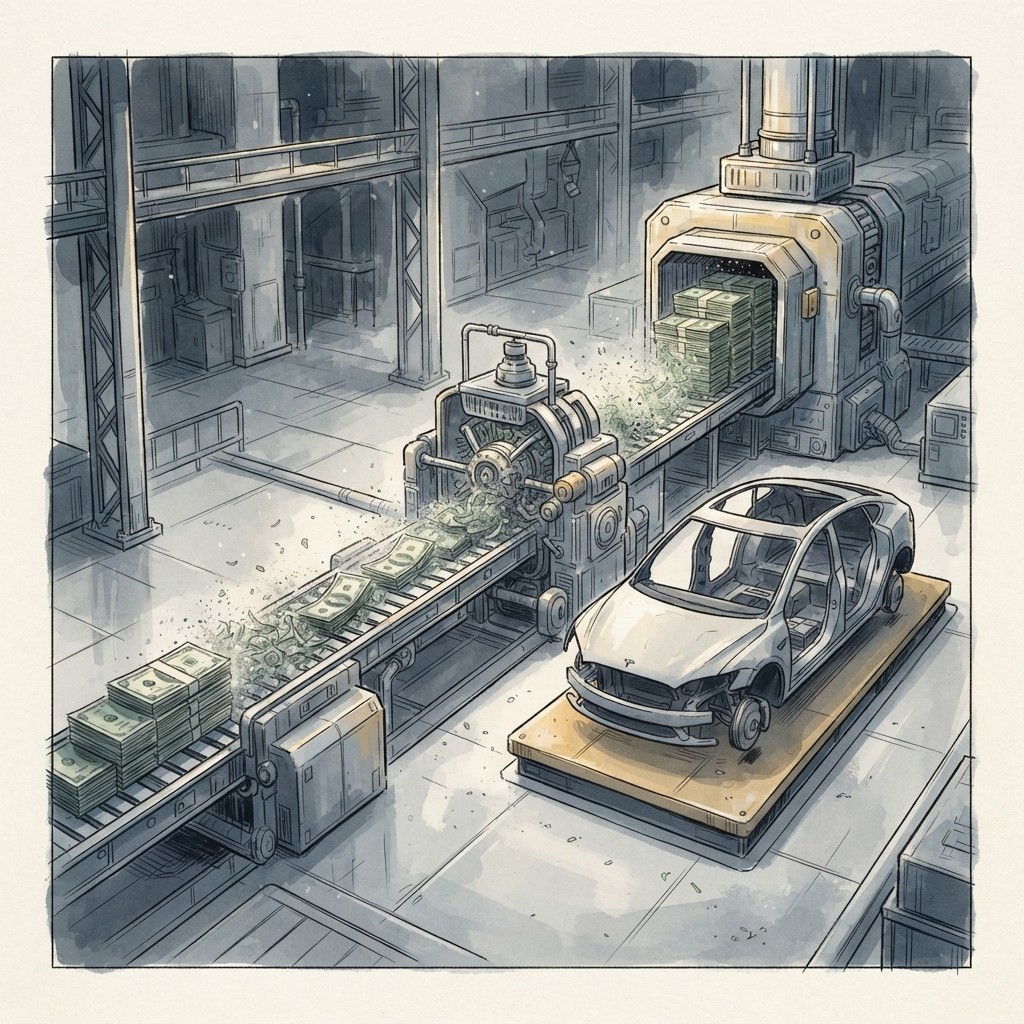
The official story is that Model e is a startup — a scrappy bet inside a giant, burning cash now to win scale later, the way every disruptor does. That framing is wrong in the one way that matters. A startup spends money it never had to chase a market it hasn't entered. Ford spent money it already earned to build capacity it has since written off. By the end of 2025 it had run the same machine that mints profit on F-150s — and run it in reverse.
The loss got bigger every year it was supposed to shrink
Look at the sequence, because the sequence is the argument. Model e lost $2.1 billion in 2022, the year it was created.3 In 2023 the loss widened to $4.7 billion — more than the entire company's net income of $4.3 billion for that year.5 In 2024 it widened again to $5.1 billion, even after the segment squeezed out $1.4 billion in cost improvements.1 In 2025 the operating loss came in at $4.8 billion.9 Four years, more than $16 billion in cumulative EBIT losses8 — and every one of those years was supposed to be the one where the curve finally bent toward profit. The curve bent the other way.
That $40,525 figure deserves a moment, because a much uglier number — around $64,000 a vehicle — circulated far more widely. The bigger number is an artifact of bad arithmetic: it divides Model e's global loss by Ford's U.S.-only sales of 72,608 cars, ignoring the global units that actually generated the loss.6 Use the right denominator — 116,000 EVs sold worldwide — and you get Ford's own stated $40,525.5 The point isn't that the loss was small. It's that it was severe enough not to need exaggerating, and the exaggeration obscures the real story, which isn't per-unit economics at all. It's a strategy quietly walked back at every milestone.
Every target moved before it could be missed
Here is the pattern that separates Model e from an honest startup bet: each headline goal didn't fail in public, it disappeared from guidance. The 600,000-units-a-year run rate was first promised for the end of 2023. At the July 2023 earnings call, CEO Jim Farley pushed it to 'sometime during 2024.'7 Ford never came close — it sold roughly 97,865 BEVs in the U.S. in 2024, while global Model e wholesale volumes remained far below the 600,000 target.10 The grander target, two million EVs annually by 2026, was quietly shelved at the July 2023 earnings call — Ford said only that it no longer knew when it would reach that volume — without the fanfare of the original announcement.7 And the profitability promise — an 8% Model e EBIT margin by the end of 2026, articulated by CFO John Lawler at the March 2023 investor teach-in3 — was finally buried in early 2026, when Ford's CFO said EV profitability 'likely won't happen until 2029.'8
| The commitment | Set | What happened |
|---|---|---|
| 2 million EVs/year | March 2022 | Vanished from guidance, never retracted |
| 600,000-unit run rate | for end-2023 | Pushed to 2024, never reached; ~105,000 sold in 2024 |
| 8% Model e EBIT margin | by end-2026 | Deferred to 2029 profitability |
| 10% company EBIT margin | by 2026 | Undercut by a $19.5B restructuring charge |
“[EV profitability] likely won't happen until 2029.”8
The write-down is the part that breaks the startup analogy
Operating losses, you can defend as the cost of learning. The 2025 numbers are something else. On top of the $4.8 billion operating loss9, Ford took a $19.5 billion pre-tax restructuring charge — including $10.7 billion of Model e impairments and EV program cancellations — and posted a full-year GAAP net loss of $8.2 billion.8 An impairment isn't money spent chasing growth. It's Ford admitting, in the formal language of accounting, that capital it already deployed to build EV capacity is worth less than it paid, because the volume that capacity was sized for is no longer coming. That is not a startup buying its future. It is a legacy industrial operation conceding it built a plant for a demand curve that never arrived.
The entire bull case rested on the first term shrinking: spread billions of fixed battery and plant investment across two million cars and the per-unit burden collapses. But Ford sold ~105,000 EVs in 2024, not two million7 — so the denominator stayed tiny while the fixed costs stayed huge. When the volume never shows up, the fixed investment doesn't amortize; it impairs. That is exactly the $10.7 billion Ford wrote off in 2025.8
The fair case for patience — and why it falls short
The honest objection is that this is Monday-morning quarterbacking. In 2022, EV adoption looked like it was about to go vertical, Tesla was minting margins, and a legacy automaker that sat out the transition risked becoming the next Kodak. Building capacity ahead of demand is what you do when you believe a category is about to explode — and Ford was, briefly, the No. 2 EV brand in America.6 Buying optionality on a generational shift is a defensible bet even when it loses. That much is true. But optionality has a price you're willing to pay and a price you aren't, and the tell is the impairment. Ford didn't pause spending and wait for demand to catch up to its plant; it wrote the plant down. You impair an asset when you no longer expect to use it — which means this wasn't a bet held with conviction through a slow patch. It was a bet abandoned, with the abandonment booked as an $8.2 billion GAAP net loss.8 The difference between investment and destruction is whether you still believe the asset will earn its keep.
When a company tells you its losses are 'investment in the future,' the number that confirms or refutes the story isn't the operating loss — it's the impairment line. An operating loss says: we're spending to build capacity we believe in. An impairment says: we built capacity we no longer believe in, and we're writing off the cash already sunk into it. The first is a bet in progress; the second is a verdict already delivered. Ford's $4.8 billion 2025 operating loss was the cost of learning. The $10.7 billion write-down beneath it was the company grading its own homework — and giving the 2022 plan an F.
Ford ran the most reliable money machine in the auto industry — high-margin trucks, sold at scale, for decades — and pointed it at electrification expecting the same physics to apply. The physics never showed. Volume that was supposed to dilute the fixed costs never arrived, so the fixed costs didn't amortize; they impaired. Every milestone was moved before it could be missed, until the only milestone left was the write-down. The lesson isn't that Ford shouldn't have built EVs. It's that you can't pre-build the cost structure of a market that hasn't agreed to exist yet — and when it doesn't, the same machine that compounds profit on the way up compounds destruction on the way down. Ford spent four years and more than $16 billion discovering which direction it was pointed.
When the numbers tell a different story than the press release
Profit-Engine Map
A one-page map that pulls a business apart into the hook that gets the customer in the door and the engine that quietly earns the margin. Use it to see where the real profit lives, how the two halves are wired together, and what breaks if the link is cut. Blank to dissect your own P&L; filled as the worked example of a business whose advertised product is not where it makes its money.
Included, filled and blank, in the The Money Machine Casebook. See the set → · Preview the blank →
Sources
Where this comes from — the filings, records, and reporting behind it.
- 1Ford Model e reported a full-year 2024 EBIT loss of $5.1 billion; the segment delivered $1.4 billion in cost improvements net of a $100 million increase in spending to launch new battery plants and next-generation EVs.
- 2Ford Motor Company's 2024 Form 10-K (Annual Report for year ended December 31, 2024) describes three segments: Ford Blue (ICE/hybrid), Ford Model e (EVs and embedded software), and Ford Pro (commercial vehicles).
- 3Ford Model e lost $2.1 billion in 2022 and Ford guided for up to $3 billion in 2023 losses; the company publicly targeted a positive 8% EBIT margin for Model e by end of 2026 at its March 23, 2023 investor teach-in.
- 4Ford formally created Ford Model e and Ford Blue as distinct operating units on March 2, 2022, and simultaneously announced targets of 2 million EVs annually by 2026 (~33% of global volume) and a 10% total company EBIT margin by 2026.
- 5In full-year 2023, Ford Model e reported an EBIT loss of $4.7 billion on sales of 116,000 EVs globally, equating to an average loss of $40,525 per vehicle as stated by Ford; the loss exceeded Ford's total net income of $4.3 billion for the same period.
- 6Ford sold 72,608 EVs in the U.S. in full-year 2023 (including 25,937 in Q4), making it the No. 2 EV brand in America; this is the U.S.-only figure frequently (mis)used as the denominator for per-vehicle loss calculations.
- 7Ford's 600,000 EV/year production run-rate target was originally set for end-of-2023; at Q2 2023 earnings (July 27, 2023) CEO Farley pushed it to 'sometime during 2024.' Ford never reached 600,000 — it sold only ~105,000 Model e EVs globally in all of 2024.
- 8In December 2025, Ford took a $19.5 billion pre-tax restructuring charge (including $10.7 billion of Model e impairments and EV program cancellations), reported a 2025 GAAP net loss of $8.2 billion, and Ford CFO Sherry House stated EV profitability 'likely won't happen until 2029' — formally abandoning the 2026 target. Cumulative Model e EBIT losses 2022–2025 exceed $16 billion.
- 9Ford Model e posted a full-year 2025 EBIT loss of $4.8 billion, a modest improvement from 2024.
- 10Ford sold 97,865 BEVs in the U.S. in full-year 2024, an increase of almost 35% year-over-year across its three all-electric models.
More like this — beyond Ford
New Strategically analyses as they publish: the defining moves in business, checked against the record. No noise, and one click to leave.