Pairs with the Adjacency / Synergy Map — a ready-to-use strategy tool, filled for Ford. Included in the The Adjacency Expansion Casebook →
For decades Ford reported its earnings the way an old country does its census — by region. North America, Europe, China, all the rest. It was a map of where the money came from, and it was very good at hiding where the money went. Then, on March 2, 2022, Ford redrew the map. It announced three customer-facing businesses, each with its own profit-and-loss statement: Ford Blue for the gas and hybrid vehicles, Ford Model e for the electrics and software, and Ford Pro for commercial.1 Within a year the new books would say something the old ones never could.
The story almost everyone told was that Ford had split itself into two companies — a legacy automaker and a startup — and that the split would eventually let each trade on its own. Nearly every part of that is wrong. There were three segments, not two. None was spun off. And asked directly whether this was a breakup, the CEO said the plain thing.
“It is not a spinoff.”2
A reorg that didn't move a single factory
Here is the thesis, stated once and plainly: Ford's Blue/Model e split was a transparency play, not a structural transformation. Nothing physical changed. The plants stayed where they were. Both businesses kept their Dearborn address and shared initiatives, and Ford had looked at an actual spinoff and rejected it.2 What changed was the accounting. By forcing discrete P&Ls into the open, Ford took a question that had been comfortably blurred inside a regional average and answered it in public: how much does the electric future cost, and who is paying for it right now? The reorganisation didn't transform the company. It just turned the lights on in a room everyone had been walking past in the dark.
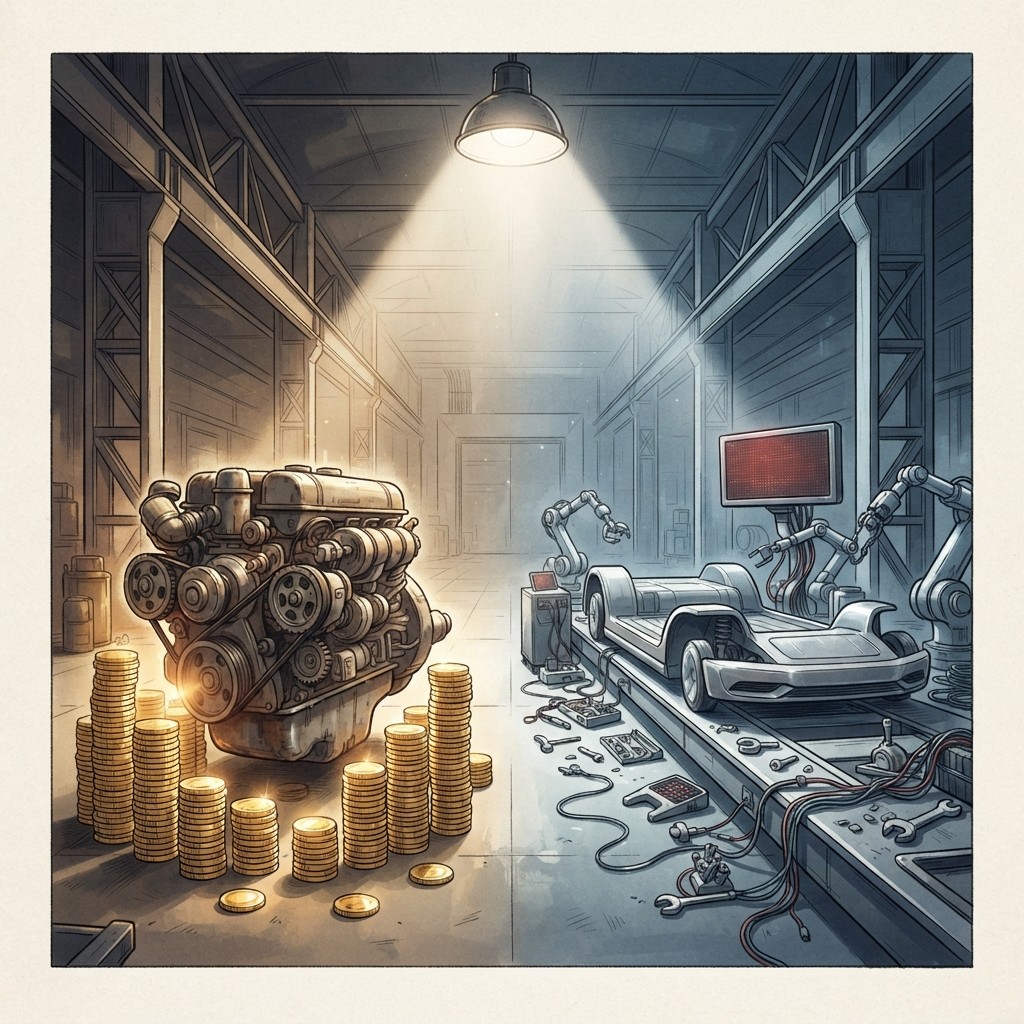
When the lights came on, the answer was not subtle. Ford began reporting by segment in 2023, and the restated 2022 numbers laid the cross-subsidy bare. Ford Blue — the gas-engine business everyone had been told was the past — threw off $6.8 billion. Ford Pro, the commercial fleet unit, added $3.2 billion. And Ford Model e, the future, lost $2.1 billion.4 The map by region had let those flows blend into one company-wide figure. The map by business showed a cash engine and a money pit standing in the same room, connected by a pipe.
| Ford Blue (gas/hybrid) | Ford Pro (commercial) | Ford Model e (EV) | |
|---|---|---|---|
| 2022 result | +$6.8B operating income | +$3.2B operating income | −$2.1B EBIT |
| Role in the system | Cash engine | Cash engine | The investment being funded |
| What the old regional report showed | Blended into one number | Blended into one number | Blended into one number |
The losses were supposed to shrink. They compounded.
At launch, the framing was the familiar startup story: heavy upfront losses that stabilise as volume scales. Ford carried that confidence right into its targets — a company-wide 10% adjusted EBIT margin and more than two million EVs a year by 2026.3 The discrete P&L was supposed to be the scoreboard that proved the curve was bending. Instead it documented the opposite. Model e's restated 2021 loss was $900 million. 2022 was $2.1 billion. Ford then forecast a $3 billion loss for 2023 — a number that already assumed things would get worse before they got better.5 The actual 2023 loss came in at $4.7 billion, on roughly 116,000 EVs sold — a loss of about $40,525 on every electric vehicle that left the lot.6
Then 2024 did not bend the curve either. Model e's loss reached $5.1 billion, EV sales fell about 9% to roughly 105,000 units, and the segment's revenue dropped 35% to $3.9 billion — losses widening while the top line shrank, the worst of both directions at once. Ford guided to another $5 to $5.5 billion loss for 2025.7 This is not the signature of a startup approaching scale. It is the signature of a division burning more for less. The two-million-EV ambition that anchored the original story quietly receded from view, and the segment structure Ford built to showcase progress instead chronicled, with unusual precision, the absence of it.
Isn't transparency exactly what a serious company should do?
The fair objection is that this reads the split too cynically. Putting discrete P&Ls in the open is a genuinely good thing — it is the opposite of hiding the bill inside a regional average, and most companies would rather you never saw it. Investors can now price the EV bet on its own terms instead of guessing. And there is a real management benefit: a unit with its own scoreboard is harder to subsidise unconsciously. All true. But transparency about a problem is not the same as solving it, and Ford's own launch language sold the reorganisation as a 'refounding,' a transformation — not merely as better disclosure. Judged as a transformation, it has so far delivered a clearer view of a worsening number. The structure works exactly as advertised. The business inside it does not. That the three-segment frame still stood, unchanged, at the end of 20248 tells you the reporting was durable; it tells you nothing about whether the EV unit is closer to making money. It is, on the evidence, further away.
Splitting a company into discrete P&Ls is one of the most powerful moves in management — but understand what it actually does. It is a measurement instrument, not a treatment. It converts a blurred average into a sharp number, and a sharp number can be wonderful news or a public indictment; the structure cannot tell the difference. Before you celebrate a 'transformation,' ask which one you've built. If the new clarity is showing you a loss that compounds — $2.1B, then $4.7B, then $5.1B — the org chart has done its job perfectly and the business still hasn't. Transparency is the diagnosis. Don't mistake it for the cure, and don't let the announcement language sell it as one.
Ford did not refound itself in March 2022. It installed better instruments — and then watched them faithfully record a problem the old gauges had been merciful enough to obscure. The gas and commercial businesses keep the lights on; the electric one keeps the bill rising. That is a real and useful thing to know, and Ford deserves credit for putting it where everyone could see it. But a thermometer is not a fever breaking. The discrete P&L was supposed to be the proof that the future was arriving on schedule. So far, it has been the most precise documentation yet of how much that future still costs — and how little nearer it has come.
Adjacency / Synergy Map
A one-page canvas for an adjacency play: the new business next door, the shared assets that justify entering it, the synergies that actually transfer versus the ones that evaporate on contact, and the dis-synergies nobody put on the deck. Blank to test your own expansion; filled as the worked example showing where the story's 'natural adjacency' was real and where it was wishful.
Included, filled and blank, in the The Adjacency Expansion Casebook. See the set → · Preview the blank →
Sources
Where this comes from — the filings, records, and reporting behind it.
- 1Ford announced the creation of three distinct customer-focused segments — Ford Blue (ICE/hybrid), Ford Model e (EV/connected), and Ford Pro (commercial) — on March 2, 2022, with all three expected to have discrete P&Ls by 2023, under the existing Ford corporate umbrella with no spinoff.
- 2Ford CEO Jim Farley confirmed the reorganisation was not a spinoff: 'It is not a spinoff,' with both Ford Blue and Ford Model e remaining headquartered in Dearborn and sharing certain initiatives. Farley also confirmed Ford had evaluated but rejected a spinoff option.
- 3Ford confirmed full-year 2022 adjusted EBIT guidance of $11.5–$12.5 billion and targeted a company-wide 10% adjusted EBIT margin and more than 2 million EVs annually by 2026 at the time of the reorganisation announcement.
- 4Starting in 2023, Ford began reporting financial results by the three new business segments rather than by region; restated 2022 results showed Ford Model e lost $2.1 billion (EBIT), Ford Blue generated $6.8 billion, and Ford Pro generated $3.2 billion in adjusted operating income.
- 5Ford Model e's restated 2021 EBIT loss was $900 million; the 2022 EBIT loss was $2.1 billion. Ford projected a $3 billion loss for Model e in 2023, while expecting $7 billion EBIT for Ford Blue and ~$6 billion for Ford Pro.
- 6Ford Model e's actual full-year 2023 EBIT loss came in at $4.7 billion on sales of 116,000 EVs — an average loss of approximately $40,525 per vehicle — significantly worse than Ford's own $3 billion forecast issued at the start of 2023. Ford's 2023 full-year Model e loss was later revised upward to $4.7 billion.
- 7Ford Model e reported a full-year EBIT loss of $5.1 billion in 2024, with worldwide EV sales falling 9% versus 2023 to approximately 105,000 units and Model e revenue down 35% year-over-year to $3.9 billion. Ford guided for a further $5–$5.5 billion Model e EBIT loss in 2025.
- 8Ford's 2024 Annual Report (10-K/ARS) confirms the three-segment structure remains operative as of December 31, 2024, with Ford Blue defined as covering ICE and hybrid vehicles, service parts, accessories, and digital services for retail customers.
More like this — beyond Ford
New Strategically analyses as they publish: the defining moves in business, checked against the record. No noise, and one click to leave.