Pairs with the Bet-Sizing Worksheet — a ready-to-use strategy tool. Included in the Gamble Casebook →
“How much does this bet commit before anybody outside the company acts on it?”
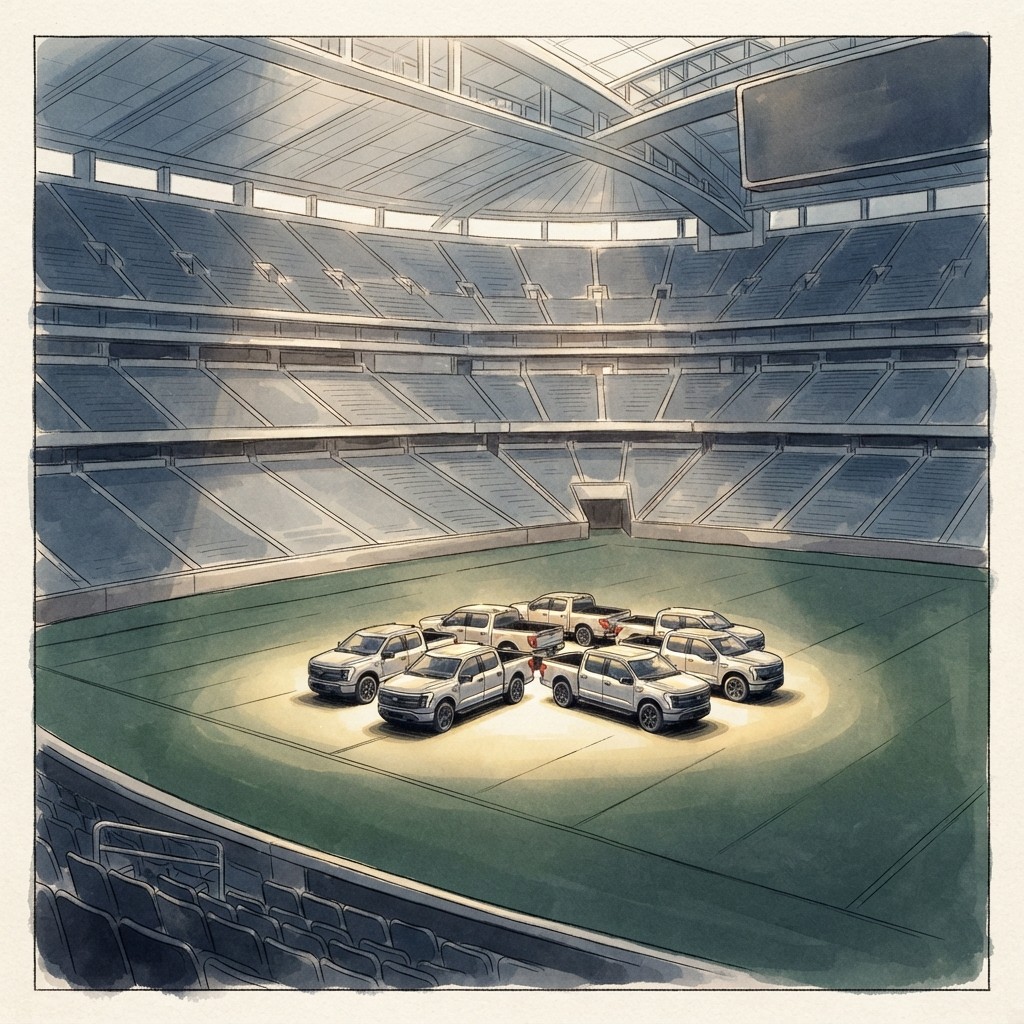
In January 2022, Ford bragged that its Rouge Electric Vehicle Center would crank out 150,000 electric F-150s a year by mid-2023.8 It was a number meant to sound like inevitability — the best-selling vehicle in America, electrified, at industrial scale. The trucks never came close. Peak annual sales of the F-150 Lightning never surpassed roughly 40,000 units.8 Ford had poured the concrete for a stadium and sold tickets to a high-school gym. In December 2025, it shut the BEV down and wrote off $19.5 billion.6
The tidy story is that America test-drove the electric pickup and said no. Buyers rejected the Lightning. They didn't. In the fourth quarter of 2023 the Lightning held 72% of the entire electric-pickup segment — outselling Rivian, the Hummer EV, and the Silverado EV combined.9 The trucks that left lots, left fast. The problem was never that nobody wanted a Lightning. The problem was that Ford built for a flood and got a stream — and priced the stream out of reach besides.
The gamble wasn't on demand. It was on the size of demand.
Here is the thesis a smart friend can repeat at dinner: the F-150 Lightning was not a failed bet on whether electric trucks would sell. It was a botched bet on how many, compounded by a price that bore no resemblance to the one Ford advertised. The nearly 200,000 reservations that fueled the hype required only a $100 refundable deposit — a number that measured curiosity, not commitment.10 Not all of them translated into sales; Ford ultimately halved its production plan when actual demand fell well short of the signal those deposits had sent. Annual deliveries crept from 15,617 in 2022 to 24,165 in 2023, a real 55% jump, against a planned run-rate of 150,000.5 When the math finally sank in, Ford halved its 2024 production plan from roughly 3,200 to 1,600 trucks a week.5 You don't cut output in half on a product nobody wants. You cut it in half on a product you wildly over-built for.
A $39,974 promise that arrived costing $59,974
When Ford revealed the Lightning in May 2021, the headline was a price: $39,974 for the Pro Standard-Range trim.1 That number did the marketing. It said: a real electric truck, for the price of a loaded gas F-150. Then raw-materials costs and a tight market did what they do. Ford raised prices several times through 2022, and by March 2023 the same Pro SR carried a sticker of $59,974 — twenty thousand dollars above the figure that sold the dream.2 A July 2023 cut walked it back to $49,995, but even that left the truck roughly $10,000 over the original promise.2 The buyer who reserved a $40,000 truck was being asked to buy a $50,000 one. Many of them simply didn't show.
| The 2021 promise | What buyers actually faced | |
|---|---|---|
| Pro SR starting price | $39,974 | $59,974 (Mar 2023), then $49,995 (Jul 2023) |
| Annual volume plan | 150,000 units/yr | Peak ~40,000, plan halved for 2024 |
| What the reservation signaled | Multi-year demand | $100 of refundable curiosity |
| The bet | Scale fast, win the segment | Win the segment, then can't fill the plant |
Now layer in the losses, and read them carefully — because this is where the popular numbers go wrong. Ford's Model e division lost $4.7 billion in 2023 on roughly 116,000 EVs, which works out to roughly $40,500 per vehicle.3 In 2024 it lost another $5.1 billion.4 But Model e is not the Lightning; it bundles the Mach-E, the E-Transit, and — crucially — the R&D, capital expenditure, and battery-plant build-outs for vehicles that didn't exist yet. The widely-quoted 'Ford loses $40,000 on every EV it sells' is a divisional average carrying the freight of future investment, not a per-Lightning production loss. The real damage wasn't a bleeding unit margin. It was the fixed cost of a 150,000-unit factory amortized across a fraction of that volume.
Build a line for 150,000 trucks and sell ~40,000, and every truck has to carry nearly four times its share of the fixed cost. Ford's $4.7B Model e loss in 2023 spread across ~116,000 vehicles works out to roughly $40,500 each3 — but that denominator is the problem, not the numerator. The cure for a fixed-cost-per-unit problem is volume. Ford never got the volume, so it never got the cure.
The tell: the nameplate outlived the powertrain
If you want to know what Ford actually concluded, watch what it kept and what it killed. In December 2025 it ended production of the all-electric Lightning and took $19.5 billion in special charges tied to its EV retreat — including $8.5 billion in asset write-downs for the Model e division.611 A clean burial. Except it wasn't a burial — it was a transplant. Ford simultaneously announced a next-generation F-150 Lightning as an EREV, an extended-range electric vehicle with a gasoline range-extender on board.7 Read that again. The battery-only powertrain is dead. The word 'Lightning' lives. Ford decided the brand equity it built — a fast, electric, recognizably-F-150 truck — was worth more than the specific bet on a pure battery powertrain that customers wouldn't pay $50,000-plus to range-anxiety their way through. The gamble that failed was the powertrain. The asset that survived was the name.
Doesn't the segment lead just mean the market was too small?
The honest counter is the strongest one: if the Lightning won 72% of its segment and still couldn't fill a plant, maybe the real lesson is that the electric-pickup market itself is small — and Ford's only sin was believing it would be big. There's truth in that. A 72% share of a thin market is still a thin market. But that reframes the mistake rather than erasing it. Ford didn't misjudge whether the product was good; it misjudged the slope of adoption and then sized its capital — a 150,000-unit factory — to the optimistic curve. The capacity decision was made in 2022, when reservations looked like demand and a $40,000 price looked deliverable.8 Both assumptions broke. A company can be right that the future is electric and still be catastrophically wrong about the schedule — and schedule, when you've poured concrete against it, is the expensive part.
A $100 refundable deposit is a measure of interest, not intent — and the gap between the two is where capital goes to die. Ford built a 150,000-unit factory on a signal that cost buyers nothing to send and nothing to abandon, then discovered that intent at $50,000 is a fraction of curiosity at $40,000. The discipline is brutal but simple: separate the demand that costs the customer something from the demand that doesn't, and pour concrete only against the former. And when the powertrain bet sours, ask the deeper question Ford eventually did — is the asset the technology, or the name? Keep what the market actually values. Write off the rest.
Ford didn't lose because it built a bad truck. It built a very good one — good enough to dominate its segment while it was failing. It lost because it built the wrong-sized bet: a 150,000-unit factory for a 40,000-unit reality, sold at a price its own marketing had already disowned. The $19.5 billion write-down is the receipt for a single confusion — mistaking a refundable deposit for a purchase order. And the most telling thing Ford did at the end was the most strategic: it killed the battery, kept the badge, and bolted a gas engine to a name that had outlasted the very technology that made it. The Lightning's lesson isn't that electric trucks don't sell. It's that you can be right about the destination and still go bankrupt on the timing.
Bet-Sizing Worksheet
Most bets fail on size, not on direction — right call, ruinous stake. This worksheet forces the three numbers that matter: how much of the bankroll is on the table, how strong the conviction really is, and whether the worst case is survivable. Blank, it stops you betting the company on a hunch; filled, it reverse-engineers the story's wager so you can judge whether it was bold or reckless.
Included, filled and blank, in the Gamble Casebook. See the set → · Preview the blank →
Sources
Where this comes from — the filings, records, and reporting behind it.
- 1Ford F-150 Lightning starting MSRP at May 2021 reveal was $39,974 for the Pro Standard-Range trim.
- 2Ford raised Lightning prices several times in 2022 due to rising raw-materials costs; by March 2023 the Pro SR stood at $59,974. Ford then cut prices in July 2023, restoring the Pro SR to $49,995 — still ~$10,000 above the original launch price.CNBC, Ford F-150 Lightning EV price cuts ↗ · 2023-07-17
- 3Ford Model e reported a full-year EBIT loss of $4.7 billion in 2023 on sales of approximately 116,000 EVs, equating to roughly $40,525 per vehicle — a figure that includes R&D and capex for future-generation EVs.
- 4Ford Model e reported a full-year EBIT loss of $5.1 billion in 2024, per Ford's own Q4 2024 earnings report Business Segment Highlights (Page 7).
- 5F-150 Lightning annual US sales: 15,617 (2022); 24,165 (2023, up ~55% YoY). Ford had targeted a 150,000/yr run-rate by mid-2023. Ford halved its 2024 production plans from ~3,200 to ~1,600 weekly units due to lower-than-expected demand.
- 6Ford discontinued the all-electric F-150 Lightning in December 2025, ending 2025 model-year production; CEO Jim Farley announced a $19.5 billion EV write-down simultaneously. The Lightning nameplate will return as an EREV.
- 7Ford announced a second-generation F-150 Lightning as an EREV with a gasoline range-extender in a December 15, 2025 statement; separately announced $19.5 billion write-down related to EV investments.
- 8Ford's Rouge Electric Vehicle Center was originally targeted to reach 150,000 Lightning units/year by mid-2023 (later pushed to fall 2023 after a production halt for facility upgrades); actual peak annual sales never surpassed ~40,000 units.
- 9In Q4 2023, the F-150 Lightning held 72% of the electric full-size pickup segment, with the Rivian R1T at 21%, Hummer EV Pickup at 5%, and Silverado EV at 3%.
- 10Ford received nearly 200,000 reservations for the F-150 Lightning, each requiring a $100 refundable deposit, before closing the reservation list in December 2021.
- 11Ford announced $19.5 billion in special charges tied to its EV pullback, including $8.5 billion in write-downs of EV assets, stopping production of the all-electric F-150 Lightning, and pivoting to EREV and hybrid models.
Weighing outside help with a decision like this? Hiring a commercial due diligence provider
More like this — beyond Ford
New Strategically analyses as they publish: the defining moves in business, checked against the record. No noise, and one click to leave.