Pairs with the Succession Readiness Scorecard — a ready-to-use strategy tool, filled for GE. Included in the The Succession Question Casebook →
In September 2008, the most respected industrial company in America - maker of jet engines, turbines, and the light bulb itself - went looking for someone to vouch for it. Warren Buffett wrote a $3 billion check for GE preferred stock at a moment its own world was, in Fortune's phrase, 'deteriorating fast.'7 But the check was a press release. The plumbing came from somewhere else: $16 billion borrowed from the Federal Reserve, and $74 billion issued under a federal guarantee program that GE became the single largest customer of.4 The company that built things had become a bank that needed bailing out - and the regulators agreed, formally designating GE Capital an eligible financial institution that November.3
The official story of how GE got here is a casting error. Jack Welch, the most celebrated CEO of his era, ran a famous talent search and picked the wrong man. Jeff Immelt took over and the stock fell. Pick a better heir, and GE survives. Almost every word of that is true, and the conclusion is still wrong.
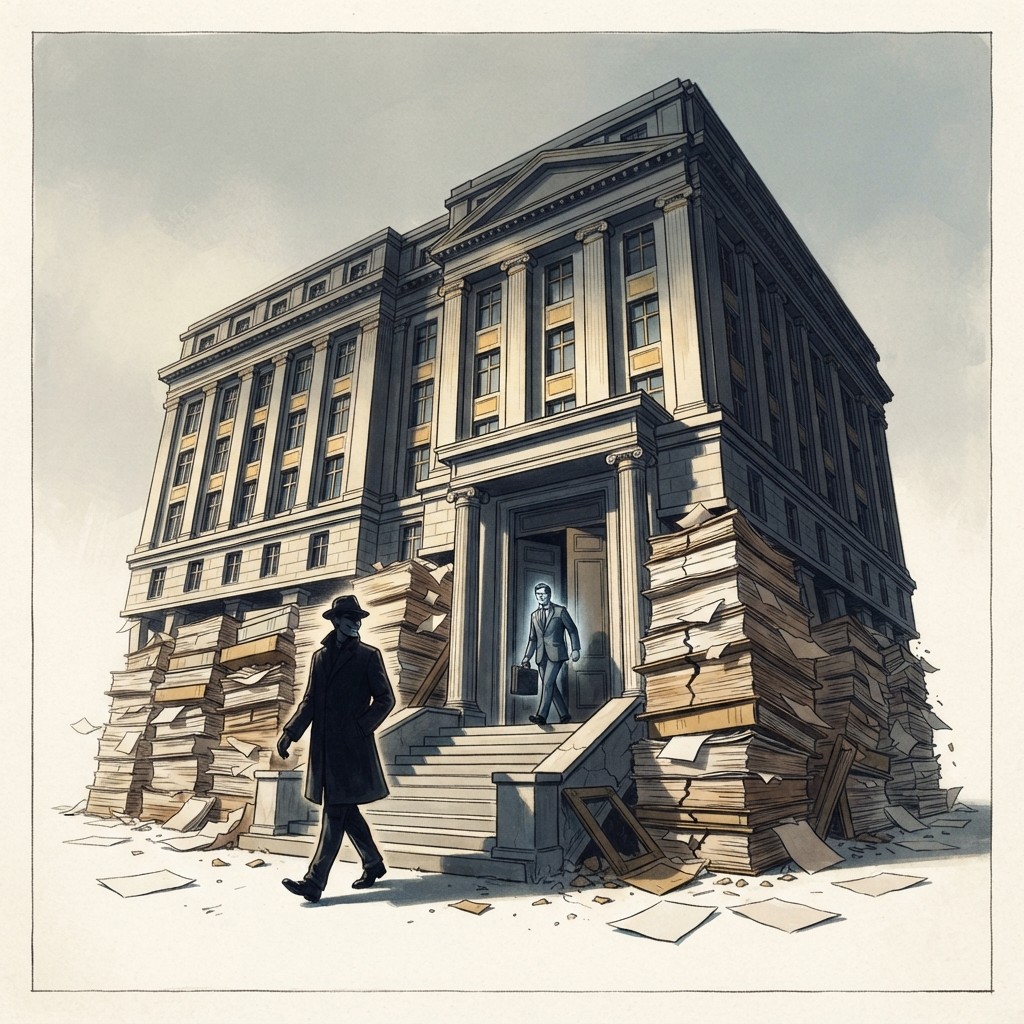
Here is the thesis a smart friend can repeat at dinner: GE's slide was not chosen by Welch's successor. It was built by Welch himself, into the balance sheet, years before any successor's name was called. Immelt inherited a bomb. His sin was not that he was the wrong man to defuse it - it was that he kept winding the timer, and then spent his retreat badly.
The machine that made the magic was a finance company
Under Welch, GE's market value grew from less than $15 billion in 1981 to a peak of $594 billion in 2000 - one of the great runs in corporate history.1 The legend credits the industrial discipline: be number one or number two in every market, fire the bottom ten percent, run lean. But a large part of the earnings engine was quieter and far less industrial. Welch made nearly 1,000 acquisitions during his tenure, and the same relentless deal-making that built the empire pushed up the company's debt-to-equity ratio along the way.8 The crown jewel of all that buying was GE Capital - a lending and leasing operation that grew into subprime, commercial real estate, and credit cards until it threw off something close to half of GE's profits.
This is the part that gets lost in the morality play. A finance arm that big does not behave like a division. It behaves like a bank - one funded heavily by short-term commercial paper that must be rolled over constantly. As long as credit markets stay open, the model is a money machine. The moment they freeze, it is a margin call on the entire company. Welch left office in 2001 with that machine humming and the markets open. The structure was a bet that the music would never stop. It was not Immelt's bet. He just happened to be holding the instrument when it did.
The horse race won the prize and emptied the stable
Now the succession itself - the part everyone fixates on. Welch ran the choice as a multi-year, very public 'horse race' among internal candidates. This was not dithering; it was a known Welch method, deliberate by design.5 And it had a foreseeable cost. When the race came down to three and Immelt won, the two losing finalists, Bob Nardelli and Jim McNerney, did not stick around to serve under their rival. They left immediately for top jobs elsewhere, draining GE's executive bench at the exact moment a new CEO needed depth around him.5
So the 'people failure' is real, but notice what kind it is. It is not that GE picked a dud. It is that the contest structure traded leadership depth for a clean coronation - and it handed the winner a thinner team to face a thicker problem. The horse race produced a champion and lost two thoroughbreds in the same week.
| Welch built it | Immelt inherited it | |
|---|---|---|
| GE Capital scale | Grown to bank-sized, funded short | Over half a trillion in debt |
| Acquisition debt load | Nearly 1,000 deals, rising leverage | A balance sheet already stretched |
| Executive bench | Won by horse race | Two finalists gone overnight |
| Stock | Peaked at $594B in 2000 | Already falling from the bubble |
Where Immelt turned a bad hand into a catastrophe
None of this absolves him. The crisis exposed the structure, but Immelt's choices deepened the wound. GE's financial-services profits fell 38% in a single quarter of 2008 as the credit markets seized.7 The honest read is that a structurally sound CEO would have spent the early 2000s shrinking GE Capital while the markets were calm and the price was right. Instead, the finance arm stayed dominant deep into his tenure, which is why the divestiture, when it finally came, was a fire sale rather than a plan: GE Capital's assets fell from more than $600 billion before the crisis to $129 billion afterward.6 You do not get good prices unwinding a bank in a panic.
That is the precise location of his failure - not that he inherited GE Capital, but that he kept feeding it, then dismantled it at the worst possible moment, then poured the proceeds of the retreat into overpriced industrials. A structural inheritance became a personal catastrophe through a series of timing errors, each defensible in isolation, ruinous in sequence.
The seductive lie of succession is that the new CEO starts with a blank page. They don't. They start with the previous CEO's bets, already placed, with the timers already running. Welch's GE looked like an industrial triumph and was, underneath, a leveraged finance company that needed open credit markets to survive. Any successor who didn't unwind that bet early - while it was cheap and uncontroversial to do so - was going to be standing under it when it fell. When you evaluate a new leader, the first question isn't 'are they good?' It's 'what did they inherit, and what is it costing them to hold it?' The most expensive decisions a CEO makes are often the ones their predecessor made for them.
But the stock collapsed on his watch - isn't that on him?
The fair objection is brutal and simple: Immelt was CEO from 2001 to 2017, and over that span GE's stock fell more than 30%, erasing roughly $150 billion.2 His own 13-year return was 9.4% against Welch's 5,400% over twenty years.8 By the only scoreboard most people care about, he lost, badly, and Welch won. How is that not a verdict on the man?
Two things complicate the scoreboard. First, the starting line was a bubble. GE peaked at $594 billion in 2000 - at the very top of the dot-com mania - and the slide began in Welch's final year, before Immelt's first day in September 2001.18 The return on capital employed had also already turned down before he took over.8 Beating a bubble peak was never going to happen. Second, Welch's gaudy multiple was itself partly a product of the finance earnings whose risk Immelt later had to eat. Welch booked the upside of GE Capital and handed over the downside. The comparison flatters the man who got the boom and blames the man who got the bust - for the same machine.
The steelman survives anyway: a great CEO is judged precisely by how he plays a bad hand, and Immelt played his poorly. True. But 'he played the inheritance badly' is a very different verdict from 'he was the wrong heir.' The first is a competence story. The second is a casting story. And the casting story lets the architect off the hook.
GE's fall is taught as a cautionary tale about choosing the right successor, as if a better name on the door would have held back the tide. But the tide was built into the building. Welch spent twenty years converting an industrial company into a leveraged bet on open credit markets, took his bow at the peak, and handed the next man a balance sheet that only worked in good weather. Immelt's job was to read the weather and didn't, fast enough. The deepest lesson isn't about picking heirs at all. It's that a legend's last gift can be a structure that only one set of conditions keeps standing - and the successor's real inheritance is the day those conditions end.
Succession Readiness Scorecard
A scorecard that turns 'we'll figure out succession later' into a number you can argue with. It rates the four things that decide whether a handover lands — bench strength, board alignment, knowledge transfer, and whether the incumbent can actually let go. Blank to grade your own readiness honestly; filled as the worked example diagnosing why the story's company was (or wasn't) ready when the moment came.
Included, filled and blank, in the The Succession Question Casebook. See the set → · Preview the blank →
Sources
Where this comes from — the filings, records, and reporting behind it.
- 1GE's peak market value was $594 billion in 2000, built from less than $15 billion when Welch started in 1981; the subsequent stock slide wiped out more than half a trillion dollars in shareholder value.
- 2During Jeff Immelt's tenure as CEO from 2001 to 2017, GE's stock price fell by over 30%, a decline of roughly $150 billion in shareholder value.
- 3GE Capital Corporation issued FDIC-guaranteed senior unsecured debt notes under the Temporary Liquidity Guarantee Program; the FDIC approved GE Capital's application as an eligible entity on November 12, 2008.
- 4GE sold more than $21 billion in commercial paper under the FDIC TLGP in the last weeks of 2008 and by spring 2009 had issued $74 billion in commercial paper and longer-term notes under the program, becoming the FDIC program's largest customer.
- 5The Welch succession process took more than six years in the public eye and came down to a three-way 'horse race'; the two losing finalists (Nardelli, McNerney) left GE for top jobs elsewhere, creating an executive void for Immelt.
- 6GE Capital's outstanding debt peaked at more than half a trillion dollars in mid-2008; after the crisis, GE Capital's assets fell from more than $600 billion before the financial crisis to $129 billion after Immelt's divestiture program.
- 7Warren Buffett agreed to invest $3 billion of Berkshire Hathaway money in GE preferred stock plus warrants on September 30, 2008, at a moment when GE's world was 'deteriorating fast'; GE's financial-services profits fell 38% in Q3 2008.
- 8GE's ROCE decline began before Immelt took over in September 2001; Welch's relentless acquisition activity (nearly 1,000 acquisitions during his tenure) increased the company's debt-to-equity ratio; Immelt's 13-year stock return was 9.4% vs. Welch's 5,400% over 20 years.
More like this — beyond GE
New Strategically analyses as they publish: the defining moves in business, checked against the record. No noise, and one click to leave.