Pairs with the Disruption Vulnerability Assessment — a ready-to-use strategy tool, filled for GE. Included in the The Fall Casebook →
In the year 2000, General Electric pulled in roughly $130 billion in revenue and was, by most measures, the most admired company on earth. It made jet engines and light bulbs, MRI machines and gas turbines, and — quietly, enormously — it ran a finance company so large it lived inside the industrial giant like a second heart. Twenty-four years later, on the morning of April 2, 2024, that company finished cutting itself into pieces. GE Vernova began trading on the NYSE, GE HealthCare was already gone, and the thing left standing answered to a new, narrower name: GE Aerospace.1 The conglomerate had not collapsed. It had been disassembled, on schedule, by its own hand.
The popular story credits one man with the demolition: Larry Culp, the first outsider ever to run GE, who walked in and broke up the empire.8 It is a clean story, and it is wrong about where the pressure came from. The real forcing function arrived years before Culp did, not from a boardroom but from a regulator — and it didn't target GE's jet engines or its turbines. It targeted the money.
The day a regulator called GE a bank
In July 2013, the Financial Stability Oversight Council designated GE Capital a nonbank systemically important financial institution — a SIFI.5 In plain terms: the government decided GE's finance arm was big enough and entangled enough that its failure could threaten the whole system, and so it would now be supervised by the Federal Reserve and held to stricter capital standards.5 For a company that built airplane engines, this was the equivalent of waking up and being told you were also a bank, and would be regulated like one. The label didn't merely add paperwork. It put a permanent regulatory tax on the very thing that had made GE's earnings look so smooth for decades — a sprawling financial business bolted onto an industrial one.
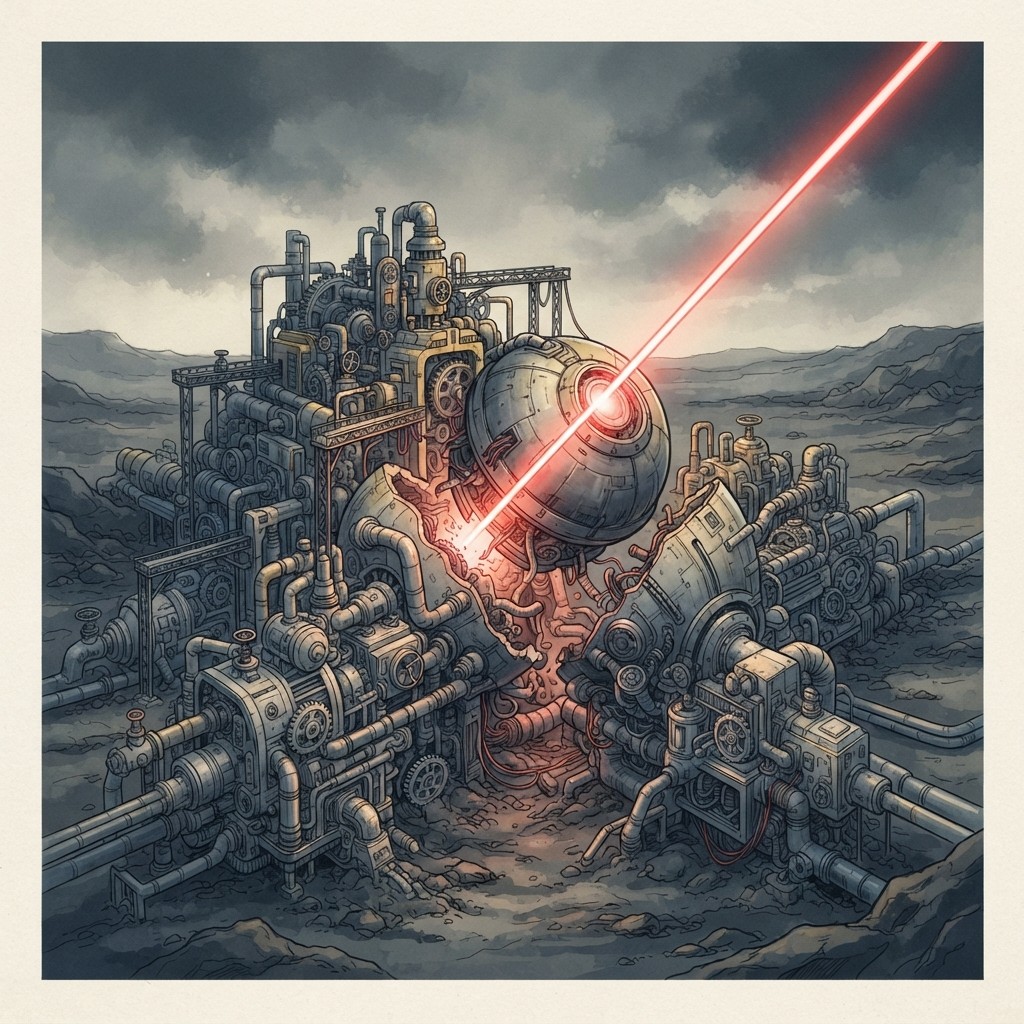
Here is the thesis, plainly. GE did not break up because conglomerates are inherently doomed, or because diversification stopped working. It broke up because the financial engine at its core was reclassified as a systemic risk — and once you have to dismantle the engine, the chassis it was bolted into no longer has a reason to stay welded together. The SIFI tag was the first cut. Everything after it was sequencing.
“GE Capital was designated a nonbank systemically important financial institution, subjecting it to Federal Reserve Board supervision and stricter prudential standards.”5
How you dismantle a company on purpose, in the right order
By April 2015, GE had announced it would dramatically shrink GE Capital specifically to shed the SIFI designation — a move that came with roughly $16 billion in expected after-tax charges in a single quarter, about $12 billion of it non-cash.6 That is not the math of a company tidying its portfolio. That is the price of amputation, paid willingly, because keeping the limb cost more. GE filed its formal request to be de-designated on March 31, 2016, and on June 28, 2016 the FSOC voted to lift the SIFI label after the divestitures were done.9106 All of this happened under Jeff Immelt, and all of it happened before Larry Culp had any say at GE.
Culp joined the board in April 2018 and became CEO that October — the first outsider to ever lead the company.8 What he inherited was not a healthy conglomerate to be optimized, but a structure already missing its load-bearing financial wall. His contribution was sequencing the rest of the demolition cleanly. The formal three-way split — GE Aerospace, GE HealthCare, GE Vernova — was announced on November 9, 2021.2 The why behind the why is this: with the finance arm gone, the only logic for holding aerospace, healthcare, and energy under one roof was the cross-subsidy and earnings smoothing that GE Capital used to provide. Strip that out, and three excellent businesses are just three businesses paying a conglomerate discount to wear the same logo.
| The popular story | The structural read | |
|---|---|---|
| The cause | Culp broke up a bloated conglomerate | A 2013 regulatory designation forced the finance arm out |
| The decisive moment | November 2021 announcement | July 2013 SIFI label |
| The protagonist | Larry Culp, the outsider CEO | FSOC, then Immelt, then Culp — in sequence |
| What had to go first | The conglomerate structure | GE Capital, the systemic-risk engine |
The mechanics of the final separations show how deliberate the choreography was. GE HealthCare completed its spin-off on January 3, 2023, with regular-way trading under 'GEHC' beginning the next day; GE distributed roughly 80.1% of the shares to holders of record and held back exactly 19.9% — a retained stake it could sell down over time rather than dump all at once.3 GE Vernova followed on April 2, 2024, after board approval on February 29, at a clean exchange ratio of one Vernova share for every four GE shares.14 These are not the actions of a company falling apart. They are the actions of one taking itself apart, plank by plank, with the patience of a demolition crew that already knows where every load-bearing beam is.
Wasn't the conglomerate just a bad idea that finally died?
The fair objection is that this gives a regulator too much credit. GE was, by the late 2010s, a wounded company — overpaying for acquisitions, carrying power-business losses, watching its stock crater. Surely it would have had to simplify regardless, SIFI or no SIFI. There's truth in that, and it would be dishonest to pretend the only problem was GE Capital. But notice what the timeline actually shows: the structural unwinding started at the finance arm, in 2013, and proceeded outward from there. The SIFI designation didn't merely add to GE's troubles — it removed the one thing that had made the conglomerate cohere. For decades, the financial business smoothed earnings and let the industrial units share a balance sheet that looked stronger together than apart. Once that mechanism was regulated out of existence, the diversification stopped paying for itself, and the case for holding the businesses together collapsed under its own logic. The poor capital allocation made GE weaker. The SIFI label made the conglomerate structurally pointless. Those are different failures, and only one of them required a breakup.
When a sprawling company comes apart, the obvious culprit is bigness itself — too many divisions, too little focus. But sprawl alone rarely forces a breakup; companies tolerate it for decades. What forces the split is the loss of the one mechanism that made the sprawl pay: a shared balance sheet, an earnings-smoothing engine, a cross-subsidy nobody talked about. For GE, that keystone was GE Capital, and a single regulatory designation in 2013 pulled it out of the arch. The lesson for anyone reading a corporate breakup: don't ask why the conglomerate finally became too big. Ask what changed that made staying together stop being worth it — and look for the regulator, the rule, or the financial mechanism that quietly held the whole thing up.
The neat version of GE's story is a morality tale: hubris, over-diversification, a fallen titan. The truer one is colder and more interesting. A company that booked roughly $130 billion in 2000 was held together less by industrial logic than by a financial engine humming in its chest — and the day a regulator labeled that engine a systemic risk, the clock on the conglomerate started running. Immelt began the amputation. Culp sequenced the rest. The split that ended in April 2024 wasn't the conglomerate finally failing. It was the conglomerate quietly admitting that, without its bank, it had never really been one company at all.
When the structure itself is the story
Disruption Vulnerability Assessment
An assessment that rates a company across the dimensions that predict disruption: how cheaply a challenger can serve the unsexy bottom of the market, how trapped you are by margins and a satisfied core. Blank to score your own position before the cliff; filled as the worked example showing where the story's incumbent was already exposed while the numbers still looked great.
Included, filled and blank, in the The Fall Casebook. See the set → · Preview the blank →
Sources
Where this comes from — the filings, records, and reporting behind it.
- 1On April 2, 2024, General Electric Company completed the separation of GE Vernova Inc. via a pro rata distribution of all GE Vernova shares; GE then became GE Aerospace. Shareholders of record on March 19, 2024 received one share of GE Vernova per four GE shares.
- 2On November 9, 2021, GE announced its plan to form three independent public companies: GE Aerospace, GE HealthCare, and GE Vernova. GE HealthCare completed its spin-off on January 3, 2023.
- 3GE HealthCare Technologies Inc. completed its spin-off from GE on January 3, 2023; regular-way trading on Nasdaq under 'GEHC' began January 4, 2023. GE distributed approximately 80.1% of GE HealthCare's outstanding common stock to GE holders of record as of December 16, 2022, retaining 19.9%.
- 4GE's Board of Directors approved the GE Vernova spin-off on February 29, 2024, setting April 2, 2024 as the spin-off date; GE Vernova began trading on the NYSE under 'GEV' that day.
- 5The FSOC designated GE Capital as a nonbank systemically important financial institution (SIFI) in July 2013, subjecting it to Federal Reserve Board supervision and stricter prudential standards. FSOC voted to lift the SIFI designation on June 29, 2016, after GE Capital executed significant divestitures.
- 6In April 2015, GE announced it would dramatically reduce GE Capital to seek de-designation as a SIFI; approximately $16 billion of after-tax charges were expected in Q1 2015, of which about $12 billion were non-cash. GE filed its formal rescission request with FSOC on March 31, 2016.
- 7GE reported approximately $130 billion in revenues for the year 2000.
- 8Larry Culp joined the GE Board in April 2018, was appointed CEO in October 2018, and is the first outsider to lead GE in the company's history. He announced the three-way split plan in November 2021.
- 9FSOC voted on June 28, 2016 to rescind the designation of GE Capital Global Holdings, LLC as a nonbank systemically important financial institution
- 10The Council announced that it voted to rescind the designation of GE Capital Global Holdings, LLC on June 28, 2016
More like this — beyond GE
New Strategically analyses as they publish: the defining moves in business, checked against the record. No noise, and one click to leave.